Alibhai Alyshah, Hendrikse Clint, Bruijns Stevan R
Division of Emergency Medicine, University of Cape Town, F-51 Old Main Building, Anzio Road, Groote Schuur Hospital, Cape Town, South Africa.
Afr J Emerg Med. 2019;9(Suppl):S38-S42. doi: 10.1016/j.afjem.2019.01.004. Epub 2019 Jan 17.
Injury and violence are neglected global health concerns, despite being largely predictable and therefor preventable. We conducted a small study to indirectly describe and compare the perception of availability of resources to manage major trauma in high-income, and low- and middle-income countries using evidence-based guidance (as per the 2016 National Institute of Clinical Excellence guidelines), as self-reported by delegates attending the 2016 International Conference on Emergency Medicine held in South Africa.
A survey was distributed to delegates at the International Conference on Emergency Medicine 2016. The survey instrument captured responses from participants working in both pre- and in-hospital settings. Responses were grouped according to income group (either high-income, or low- and middle-income) based on the respondent's nationality (using the World Bank definition for income group). A Fisher's Exact test was conducted to compare responses between different income groups.
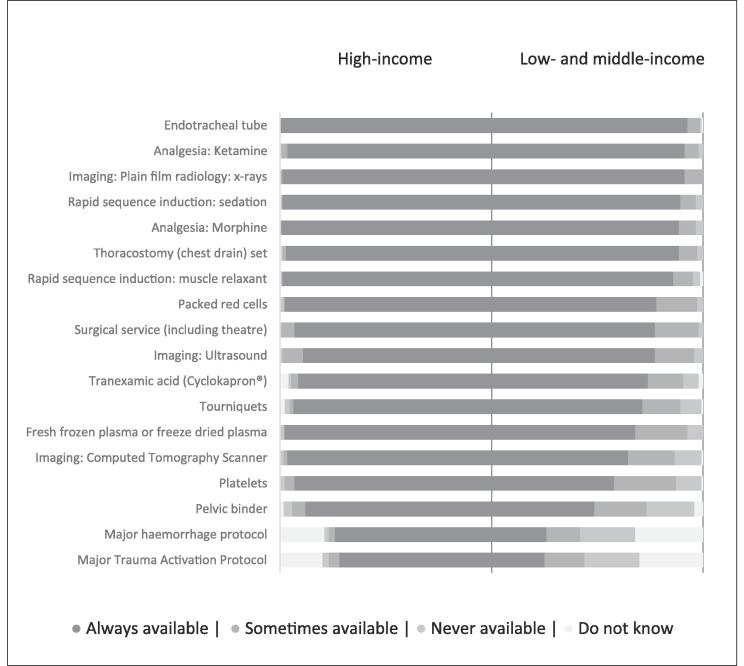
The survey was distributed to 980 delegates, and 392 (40%) responded. A total of 206 (53%) respondents were from high-income countries and 186 (47%) were from low- to middle-income countries. Respondents described significantly less access to resources and services for low- and middle-income countries to adequately care for major trauma patients both pre- and in-hospital when compared to high-income countries. Shortages ranged from consumables to analgesia, imaging to specialist services, and pre-hospital to in-hospital care.
Major trauma care requires a chain of successful, evidence-based events for outcomes to benefit. This small study suggests that many of the links of this chain are either missing or broken within low- and middle-income countries. These settings simply do not benefit from the currently available evidence-base in major trauma care. It is important that this evidence-base also be evaluated within low- and middle-income countries. The capacity of low- and middle-income country emergency care systems also needs better describing.
伤害和暴力是被忽视的全球健康问题,尽管它们在很大程度上是可预测的,因此也是可预防的。我们开展了一项小型研究,以间接描述和比较高收入国家以及低收入和中等收入国家在使用循证指南(根据2016年英国国家临床优化研究所指南)管理重大创伤方面资源可及性的认知情况,这些认知情况由参加2016年在南非举行的国际急诊医学会议的代表自行报告。
向2016年国际急诊医学会议的代表发放了一份调查问卷。该调查工具收集了在院前和院内环境中工作的参与者的回复。根据受访者的国籍(采用世界银行的收入组定义)将回复按收入组(高收入组或低收入和中等收入组)进行分组。进行了费舍尔精确检验以比较不同收入组之间的回复情况。
共向980名代表发放了调查问卷,392人(40%)回复。其中,共有206名(53%)受访者来自高收入国家,186名(47%)来自低收入和中等收入国家。与高收入国家相比,受访者表示低收入和中等收入国家在院前和院内为充分护理重大创伤患者而获取资源和服务的机会明显更少。短缺范围从耗材到镇痛药物、从影像检查到专科服务,以及从院前护理到院内护理。
重大创伤护理需要一系列成功的循证环节才能使结果受益。这项小型研究表明,在低收入和中等收入国家,这一环节的许多环节要么缺失要么中断。这些环境根本无法从目前可用的重大创伤护理循证依据中受益。重要的是,也需要在低收入和中等收入国家对这一循证依据进行评估。还需要更好地描述低收入和中等收入国家急诊护理系统的能力。