Kakamu Takeyasu, Hidaka Tomoo, Kumagai Tomohiro, Masuishi Yusuke, Kasuga Hideaki, Endo Shota, Sato Sei, Takeda Akiko, Koizumi Makoto, Fukushima Tetsuhito
Department of Hygiene and Preventive Medicine, Fukushima Medical University.
Fukushima National Health Insurance Organization, Fukushima, Japan.
Medicine (Baltimore). 2019 Apr;98(15):e15071. doi: 10.1097/MD.0000000000015071.
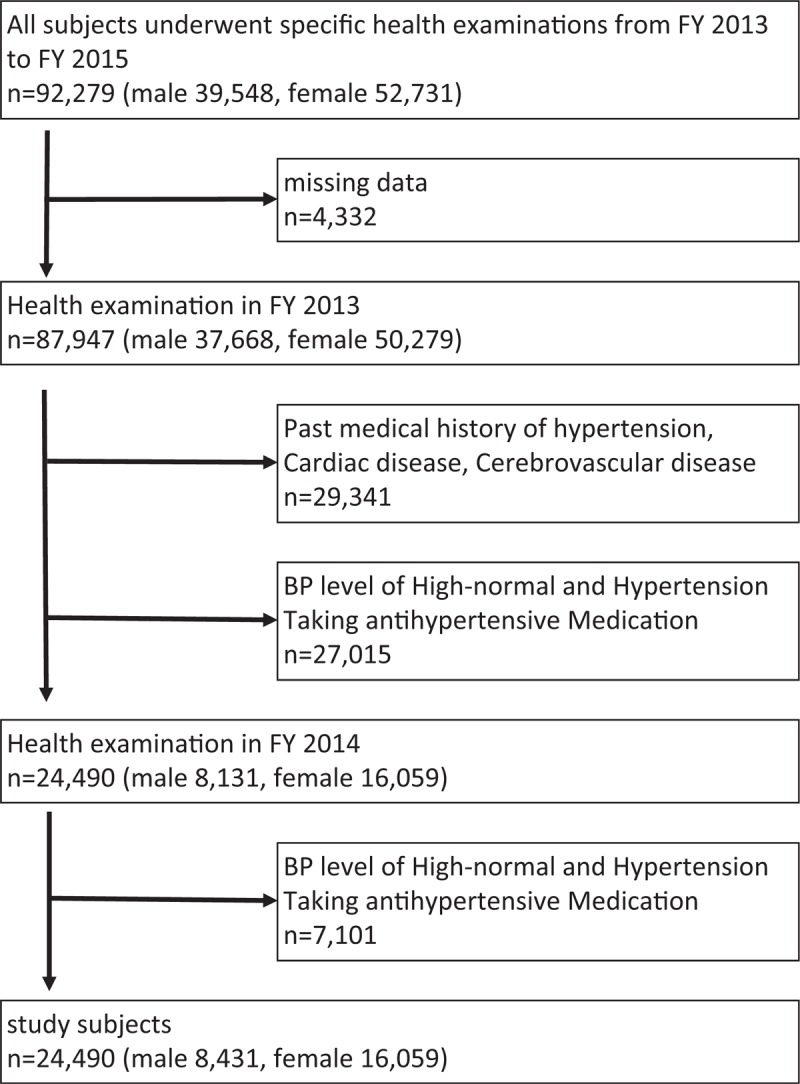
The aim of this study was to determine what lifestyle changes can predict acute onset hypertension in the normotensive community-dwelling elderly.This study targeted elderly people enrolled in National Health Insurance in Fukushima Prefecture, Japan. The subjects were 24,490 people who took all of the specific health examination conducted by National Health Insurance in fiscal years 2013, 2014, and 2015 continuously and had a recorded systolic blood pressure (BP) <130 mm Hg and diastolic BP <85 mm Hg in the first 2 fiscal years. We examined their lifestyle changes for the first 2 fiscal years using the questionnaires given at the health examination. Multivariate Poisson regression analysis was conducted to examine the relationship between new-onset hypertension observed at the last examination and unhealthy lifestyle changes.The mean age of the subjects was 61.5 ± 8.2 years old at baseline. We observed new-onset hypertension in 1.062 subjects at the last examination. Of the study subjects, 12,027 (49.1%) answered to having at least one of the items of unhealthy lifestyle change in the questionnaire. In the multivariate logistic regression, eating supper before bedtime showed a significant increase in the risk ratio for acute onset hypertension (risk ratio 1.27, 95% confidence interval, 1.01-1.58).This study indicated that eating before bedtime is a risk factor of new-onset hypertension in the normotensive community-dwelling elderly. Adequate health guidance to avoid unhealthy lifestyle changes is required even in normotensive people as this hypertension is preventable.
本研究的目的是确定哪些生活方式的改变可以预测社区居住的正常血压老年人急性高血压的发病情况。本研究的对象是参加日本福岛县国民健康保险的老年人。研究对象为24490人,他们连续参加了2013财年、2014财年和2015财年国民健康保险组织的所有特定健康检查,并且在前两个财年中记录的收缩压(BP)<130 mmHg,舒张压<85 mmHg。我们使用健康检查时发放的问卷,对他们前两个财年的生活方式变化进行了调查。进行多变量泊松回归分析,以研究在最后一次检查中观察到的新发高血压与不健康生活方式变化之间的关系。研究对象的平均年龄在基线时为61.5±8.2岁。在最后一次检查中,我们观察到1062名研究对象出现了新发高血压。在研究对象中,12027人(49.1%)回答在问卷中至少有一项不健康生活方式变化。在多变量逻辑回归中,睡前吃晚餐显示急性高血压发病风险比显著增加(风险比1.27,95%置信区间,1.01-1.58)。本研究表明,睡前进食是社区居住的正常血压老年人新发高血压的一个危险因素。即使是血压正常的人,也需要进行适当的健康指导,以避免不健康的生活方式改变,因为这种高血压是可以预防的。