Center for Free Radical and Antioxidant Heath, USA; Department of Environmental and Occupational Health, University of Pittsburgh, USA; Department of Chemistry, University of Pittsburgh, USA; Department of Pharmacology and Chemical Biology, University of Pittsburgh, USA; Department of Radiation Oncology, University of Pittsburgh, USA; Laboratory of Navigational Redox Lipidomics, IM Sechenov Moscow State Medical University, Moscow, Russian Federation.
Center for Free Radical and Antioxidant Heath, USA; Department of Environmental and Occupational Health, University of Pittsburgh, USA.
Free Radic Biol Med. 2020 Feb 1;147:231-241. doi: 10.1016/j.freeradbiomed.2019.12.028. Epub 2019 Dec 25.
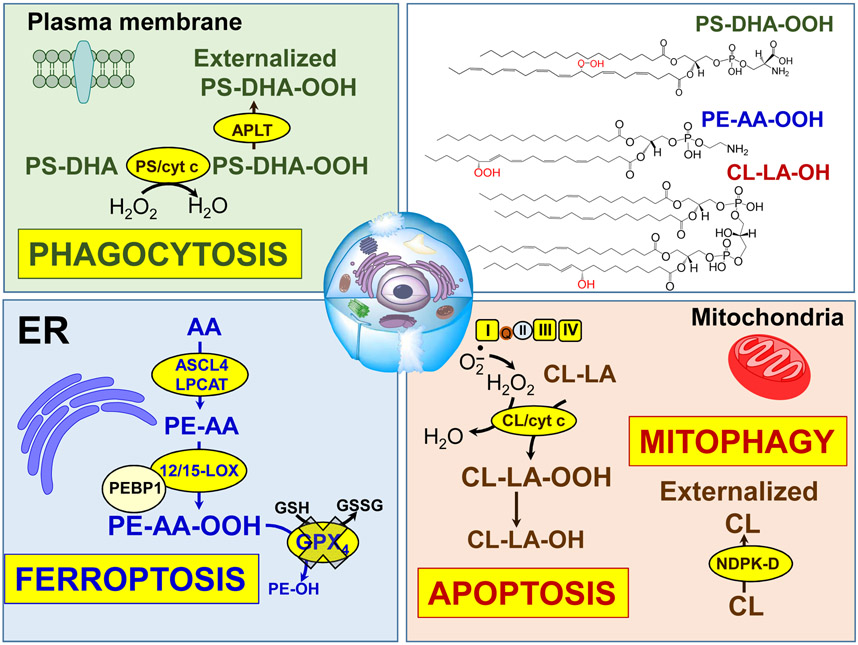
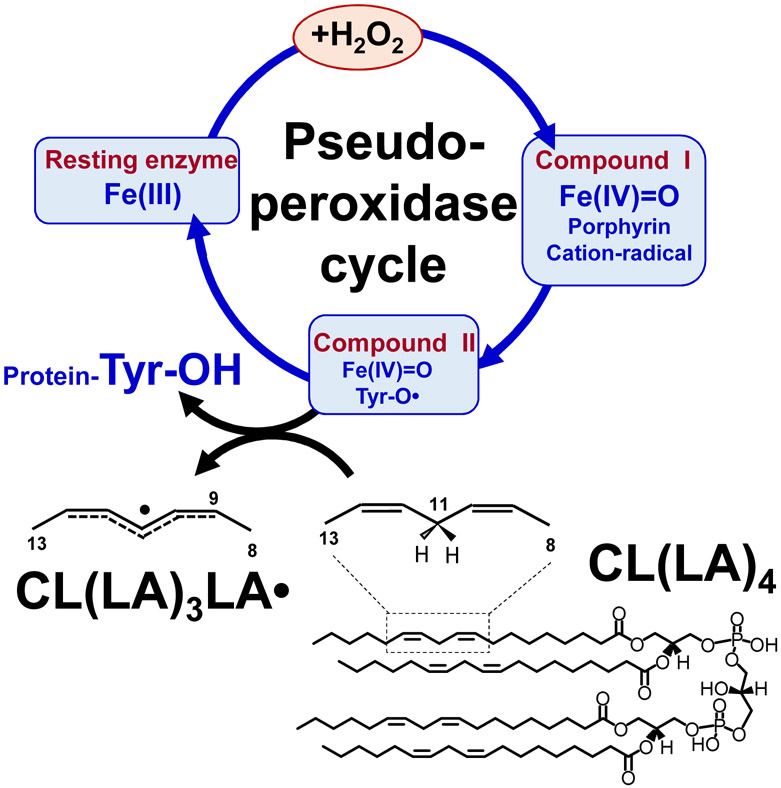
High fidelity and effective adaptive changes of the cell and tissue metabolism to changing environments require strict coordination of numerous biological processes. Multicellular organisms developed sophisticated signaling systems of monitoring and responding to these different contexts. Among these systems, oxygenated lipids play a significant role realized via a variety of re-programming mechanisms. Some of them are enacted as a part of pro-survival pathways that eliminate harmful or unnecessary molecules or organelles by a variety of degradation/hydrolytic reactions or specialized autophageal processes. When these "partial" intracellular measures are insufficient, the programs of cells death are triggered with the aim to remove irreparably damaged members of the multicellular community. These regulated cell death mechanisms are believed to heavily rely on signaling by a highly diversified group of molecules, oxygenated phospholipids (PLox). Out of thousands of detectable individual PLox species, redox phospholipidomics deciphered several specific molecules that seem to be diagnostic of specialized death programs. Oxygenated cardiolipins (CLs) and phosphatidylethanolamines (PEs) have been identified as predictive biomarkers of apoptosis and ferroptosis, respectively. This has led to decoding of the enzymatic mechanisms of their formation involving mitochondrial oxidation of CLs by cytochrome c and endoplasmic reticulum-associated oxidation of PE by lipoxygenases. Understanding of the specific biochemical radical-mediated mechanisms of these oxidative reactions opens new avenues for the design and search of highly specific regulators of cell death programs. This review emphasizes the usefulness of such selective lipid peroxidation mechanisms in contrast to the concept of random poorly controlled free radical reactions as instruments of non-specific damage of cells and their membranes. Detailed analysis of two specific examples of phospholipid oxidative signaling in apoptosis and ferroptosis along with their molecular mechanisms and roles in reprogramming has been presented.
细胞和组织代谢对不断变化的环境的高保真度和有效适应变化需要严格协调众多生物过程。多细胞生物发展了复杂的监测和响应这些不同环境的信号系统。在这些系统中,含氧脂质通过各种重编程机制发挥重要作用。其中一些作为生存途径的一部分被执行,通过各种降解/水解反应或专门的自噬过程消除有害或不必要的分子或细胞器。当这些“局部”细胞内措施不足时,会触发细胞死亡程序,目的是去除多细胞群体中不可修复的受损成员。这些受调控的细胞死亡机制被认为严重依赖于高度多样化的分子群体,即含氧磷脂(PLox)的信号。在成千上万种可检测的单个 PLox 物种中,氧化还原磷脂组学解析了几种似乎是专门死亡程序的诊断性特定分子。含氧心磷脂(CLs)和磷脂酰乙醇胺(PEs)分别被鉴定为细胞凋亡和铁死亡的预测生物标志物。这导致解码它们的形成涉及细胞色素 c 介导的线粒体氧化 CL 和脂氧合酶介导的内质网相关氧化 PE 的酶促机制。对这些氧化反应的特定生化自由基介导机制的理解为设计和寻找高度特异性的细胞死亡程序调节剂开辟了新途径。本综述强调了这些选择性脂质过氧化机制在对比随机、控制不佳的自由基反应作为细胞及其膜非特异性损伤的工具方面的有用性。沿着它们的分子机制和在重编程中的作用,详细分析了凋亡和铁死亡中两个特定的磷脂氧化信号的例子。