Institute of Human Genetics, CNRS and University of Montpellier, Montpellier, France.
Sci Adv. 2019 Apr 10;5(4):eaaw1668. doi: 10.1126/sciadv.aaw1668. eCollection 2019 Apr.
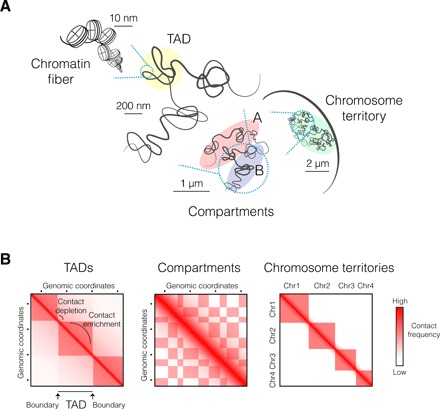
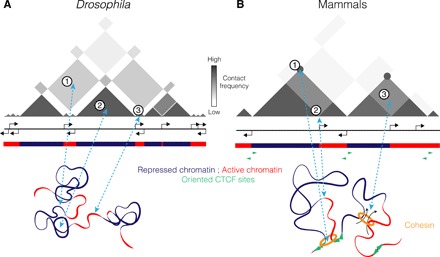
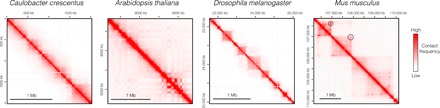
Understanding the mechanisms that underlie chromosome folding within cell nuclei is essential to determine the relationship between genome structure and function. The recent application of "chromosome conformation capture" techniques has revealed that the genome of many species is organized into domains of preferential internal chromatin interactions called "topologically associating domains" (TADs). This chromosome chromosome folding has emerged as a key feature of higher-order genome organization and function through evolution. Although TADs have now been described in a wide range of organisms, they appear to have specific characteristics in terms of size, structure, and proteins involved in their formation. Here, we depict the main features of these domains across species and discuss the relation between chromatin structure, genome activity, and epigenome, highlighting mechanistic principles of TAD formation. We also consider the potential influence of TADs in genome evolution.
了解细胞内染色体折叠的机制对于确定基因组结构和功能之间的关系至关重要。最近应用的“染色体构象捕获”技术揭示了许多物种的基因组组织成优先内部染色质相互作用的域,称为“拓扑关联域”(TAD)。这种染色体折叠已经成为高级基因组组织和功能进化的关键特征。尽管 TAD 已经在广泛的生物中被描述,但它们在大小、结构和参与其形成的蛋白质方面似乎具有特定的特征。在这里,我们描绘了这些跨物种域的主要特征,并讨论了染色质结构、基因组活性和表观基因组之间的关系,强调了 TAD 形成的机制原则。我们还考虑了 TAD 在基因组进化中的潜在影响。