Department of Biosciences and Nutrition, The Innovative Use of Mobile Phones to Promote Physical Activity and Nutrition Across the Lifespan Research Group, Karolinska Institutet, Huddinge, Sweden.
Division of Pediatrics, Department of Clinical Science, Intervention and Technology, Karolinska Institutet, Huddinge, Sweden.
JMIR Mhealth Uhealth. 2019 Apr 17;7(4):e12512. doi: 10.2196/12512.
Physical activity (PA) is already beneficial at the preschool age. In many countries, young children spend most of their days in the preschool setting, making it a common arena for PA interventions. Mobile health tools are becoming increasingly popular to promote PA in different populations; however, little is known about the interest for and how the preschool setting could incorporate such a tool.
This study aimed to examine how teachers and parents perceive PA in preschool-aged children in general and their perceptions of how a mobile phone app could be used to promote PA in the preschool setting.
Semistructured interviews were conducted with 15 teachers (93%, [14/15] women, mean age 43.5 years, 47%, [7/15] with a university degree and 10 parents [91%, 9/10] women, mean age 38.9 years, all with a university degree) recruited from 2 urban preschools in central Sweden. The interviews were recorded, fully transcribed, coded, and analyzed using thematic analysis by means of an inductive approach.
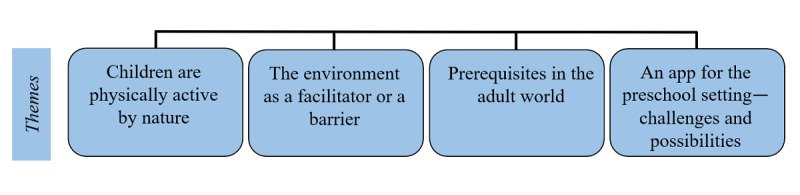
The analysis revealed 4 themes: (1) children are physically active by nature, (2) the environment as a facilitator or a barrier, (3) prerequisites of the adult world, and (4) an app in the preschool setting-challenges and possibilities. Parents and teachers perceived preschoolers as being spontaneously physically active; however, high-intensity PA was perceived as low. The PA was specifically performed during the day in the preschool. Identified facilitators of PA were access to safe and engaging outdoor environments such as forests, spacious indoor areas, and adult involvement. Adult involvement was considered especially important for children preferring sedentary activities. Identified barriers for PA were restricted indoor and outdoor space, rules for indoor activities, and lack of adult involvement because of time constraints. The teachers perceived that they had limited skills and experiences using apps in general, although they also acknowledged the increasing role of technological tools in the curriculum. Thus, the teachers expressed an interest for an app designed as a support tool for them, especially for situations when PA was limited because of perceived barriers. They suggested the app to include accessible information regarding the health benefits of PA in children linked to a library of activities for different settings and seasons. Parents suggested interactive app features including problem-solving tasks and music and dance, but not video clips as they made children passive.
Vigorous PA was perceived as low in preschool-aged children. Future tailoring of interventions in the preschool setting should work around barriers and support facilitators to PA, especially PA of high intensity. In such work, an app could serve as a source of inspiration for PA in different ages, settings, and seasons and thus reduce environmental and structural inequalities in the preschool setting.
体力活动(PA)在学龄前就已有益。在许多国家,幼儿大部分时间都在学龄前环境中度过,这使得该环境成为 PA 干预的常见场所。移动健康工具越来越受欢迎,可用于促进不同人群的 PA;然而,对于该工具在学龄前环境中的应用兴趣和方式,我们知之甚少。
本研究旨在探讨教师和家长对学龄前儿童 PA 的一般看法,以及他们对如何使用手机应用程序在学龄前环境中促进 PA 的看法。
从瑞典中部 2 所城市幼儿园招募了 15 名教师(93%[14/15]为女性,平均年龄 43.5 岁,47%[7/15]拥有大学学位)和 10 名家长(91%[9/10]为女性,平均年龄 38.9 岁,均拥有大学学位)进行半结构化访谈。使用主题分析方法,通过归纳法对访谈进行记录、完整转录、编码和分析。
分析结果揭示了 4 个主题:(1)儿童天生好动,(2)环境是促进因素还是障碍,(3)成人世界的前提,以及(4)在学龄前环境中使用应用程序——挑战和可能性。家长和教师认为学龄前儿童具有自发的体力活动能力;然而,高强度 PA 被认为较低。PA 是在白天专门在学龄前进行的。促进 PA 的因素包括可进入安全且有趣的户外环境,如森林、宽敞的室内区域以及成人的参与。成人的参与对喜欢久坐活动的儿童尤为重要。限制室内和室外空间、室内活动规则以及因时间限制导致成人参与度低,这些都被认为是 PA 的障碍。教师们认为他们在使用应用程序方面的技能和经验有限,尽管他们也承认技术工具在课程中的作用日益增强。因此,教师们对专为他们设计的支持工具应用程序表示了兴趣,尤其是在 PA 受到感知障碍限制的情况下。他们建议该应用程序包含有关 PA 对儿童健康益处的可访问信息,并链接到不同环境和季节的活动库。家长们建议应用程序具有互动功能,包括解决问题的任务、音乐和舞蹈,但不包括视频剪辑,因为这些会使儿童变得被动。
高强度 PA 在学龄前儿童中被认为较低。未来在学龄前环境中进行干预时,应围绕 PA 的障碍和促进因素开展工作,尤其是高强度 PA。在此类工作中,应用程序可以作为不同年龄段、环境和季节 PA 的灵感来源,从而减少学龄前环境中的环境和结构性不平等。
