Heidelberg Institute of Global Health (HIGH), Faculty of Medicine and University Hospital, Heidelberg University, Heidelberg, Germany.
Department of Global Health and Population, Harvard T.H. Chan School of Public Health, Boston, MA, United States of America.
PLoS One. 2019 Apr 18;14(4):e0215663. doi: 10.1371/journal.pone.0215663. eCollection 2019.
While a few studies have tried to estimate the economic burden of noncommunicable diseases (NCDs) associated with air pollution, most previous studies have methodological limitations. For example, neither the cost of illness approach nor the value of a statistical life approach accounts for economic adjustment mechanisms (i.e., they do not include substitution of labor lost due to an illness with capital or other workers), and neither approach considers disease impact on physical and human capital. Furthermore, since new evidence shows that air pollution is also linked to diabetes, previous studies did not estimate the economic costs of diabetes associated with air pollution. The total economic costs of NCDs associated with air pollution under a comprehensive framework therefore remained unexplored.
This study uses a human capital-augmented production function framework to analyze and estimate the macroeconomic impact of NCDs associated with air pollution in China in 1990-2030 and in 2015-2030. It makes several contributions-beyond those of the extant literature-to understanding the economic burden of NCDs associated with air pollution. It does this by accounting for economic adjustment mechanisms and by incorporating human capital into the model.
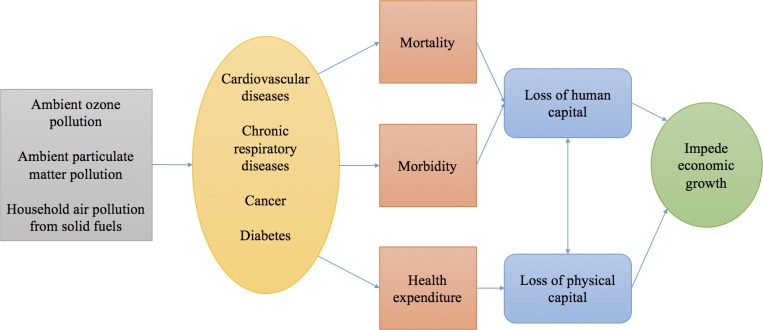
In our framework, aggregate output is produced according to a human capital-augmented production function that accounts for the effects of projected disease prevalence. NCDs associated with air pollution affect the aggregate output through three pathways: 1) Mortality effect-when working-age individuals die from a disease, aggregate output decreases because physical capital is an imperfect substitute for the loss of human capital in the production process. 2) Morbidity effect-when working-age individuals suffer from a disease but do not die from it, their contribution to overall output also decreases depending on disease severity; for example, they might work fewer hours or with lower productivity, or they might retire earlier. We also incorporate age-specific human capital to account for education-related productivity differences between members of different cohorts who are differentially affected by NCDs. 3) Treatment cost effect-when households in which members suffer from a disease use part of their savings to cover the out-of-pocket share of their treatment costs, physical capital accumulation diminishes. Our estimates are based on the recently updated Global Burden of Disease epidemiology data, which identify four pathways through which air pollution affects health: cardiovascular diseases, respiratory diseases, cancer, and diabetes.
Total losses from NCDs associated with air pollution in China in 1990-2030 are estimated to be $1,137 billion (constant 2010 USD) and in 2015-2030 are estimated to be $499 billion (constant 2010 USD). Cardiovascular diseases account for the highest burden, followed by chronic respiratory diseases, diabetes, and cancer. Treatment costs account for nearly 30% of the total economic burden of NCDs associated with air pollution. We also find that the share of economic burden associated with treatment costs is highest for diabetes. This is mainly driven by the fact that, on a per case basis, diabetes has a lower health burden than other diseases associated with air pollution.
The NCDs associated with air pollution impose a large economic burden on China.
虽然有一些研究试图估算与空气污染相关的非传染性疾病(NCDs)的经济负担,但大多数先前的研究都存在方法学上的局限性。例如,疾病成本法和生命价值法都没有考虑经济调整机制(即,它们没有包括因疾病而导致的劳动力损失被资本或其他工人替代的情况),而且这两种方法都没有考虑疾病对物力资本和人力资本的影响。此外,由于新的证据表明空气污染也与糖尿病有关,因此以前的研究没有估计与空气污染有关的糖尿病的经济成本。因此,在一个综合框架下,与空气污染相关的 NCDs 的总经济成本仍未得到探索。
本研究使用人力资本增强生产函数框架,分析和估算 1990-2030 年和 2015-2030 年中国与空气污染相关的 NCDs 的宏观经济影响。它通过考虑经济调整机制并将人力资本纳入模型,对理解与空气污染相关的 NCDs 的经济负担做出了超越现有文献的贡献。
在我们的框架中,总产出是根据一个人力资本增强的生产函数生产的,该函数考虑了预计疾病流行率的影响。与空气污染相关的 NCDs 通过以下三种途径影响总产出:1. 死亡率效应-当劳动年龄个体因疾病死亡时,由于物力资本不能完全替代生产过程中人力资本的损失,总产出减少。2. 发病率效应-当劳动年龄个体患有疾病但未死亡时,他们对总产出的贡献也会因疾病严重程度而降低;例如,他们可能工作时间减少或生产力降低,或者他们可能提前退休。我们还结合了特定年龄的人力资本,以说明不同队列中受 NCDs 不同影响的成员之间与教育相关的生产力差异。3. 治疗成本效应-当患有疾病的家庭使用部分储蓄来支付治疗费用的自付部分时,物力资本积累减少。我们的估计基于最近更新的全球疾病负担流行病学数据,该数据确定了空气污染影响健康的四种途径:心血管疾病、呼吸道疾病、癌症和糖尿病。
1990-2030 年中国与空气污染相关的 NCDs 造成的总损失估计为 11370 亿美元(2010 年不变美元),2015-2030 年估计为 4990 亿美元(2010 年不变美元)。心血管疾病负担最高,其次是慢性呼吸道疾病、糖尿病和癌症。治疗费用占与空气污染相关的 NCDs 总经济负担的近 30%。我们还发现,与治疗费用相关的经济负担份额在糖尿病方面最高。这主要是因为,就每例病例而言,糖尿病的健康负担低于与空气污染相关的其他疾病。
与空气污染相关的 NCDs 给中国带来了巨大的经济负担。