Singh Sweta, Khatri Anadi, Byanju Raghunandan, Kharel Muna, Joshi Kriti, Khadka Thapa Saru
Lumbini Eye Institute, Lumbini, Nepal.
Bharatpur Eye Hospital, Bharatpur, Nepal.
Ther Adv Ophthalmol. 2019 Apr 7;11:2515841419838662. doi: 10.1177/2515841419838662. eCollection 2019 Jan-Dec.
To evaluate the primary anatomic and physiological success of scleral buckling surgery for rhegmatogenous retinal detachment and factors influencing its outcomes.
This is a prospective analytical study of 92 eyes that underwent scleral buckling at the Lumbini Eye Institute and Research Center, in Lumbini, Nepal. Parameters evaluated which could influence the outcome of the surgery included the lens status, duration of symptoms, locations of breaks, the extent of retinal detachment, and preoperative proliferative vitreoretinopathy.
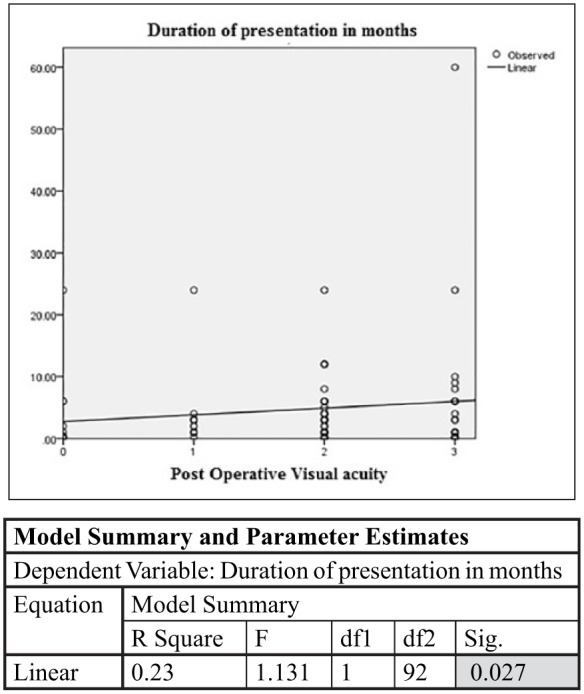
A total of 92 eyes from 88 patients with rhegmatogenous retinal detachment were evaluated; 68 (74%) eyes were of male and 24 (26%) were of female. The mean time of presentation was 4.71 ± 8.45 months. The overall primary anatomical and physiological success was achieved in 79 (84.9%) and 68 (73.9%) of the cases at 6 months. Sixteen cases developed re-detachment (mean duration of 2.8 ± 1.8 months). Eleven of the cases had a successful anatomical outcome and five of the patients had persistent detachment despite second surgery. In phakic patients, the primary success rate was 92.7% whereas in pseudophakic it was 71.4%. Proliferative vitreoretinopathy 10 (63%) was the most common cause of surgical failure. Bilateral buckling at the same setting was done to two patients-both achieving primary success.
Scleral buckling is a very good surgical option for rhegmatogenous retinal detachment and represents a surgical technique worth being trained, performed, practiced, and continued despite advancements in modern vitreoretinal surgical devices and preference for vitrectomy and tamponade agents. It may also be successfully tried in cases of bilateral rhegmatogenous retinal detachment if a doubt regarding compliance for follow-up and surgery for the fellow eye exists.
评估巩膜扣带术治疗孔源性视网膜脱离的初期解剖学和生理学成功率以及影响其疗效的因素。
这是一项对在尼泊尔蓝毗尼的蓝毗尼眼科学院和研究中心接受巩膜扣带术的92只眼进行的前瞻性分析研究。评估的可能影响手术疗效的参数包括晶状体状态、症状持续时间、裂孔位置、视网膜脱离范围以及术前增殖性玻璃体视网膜病变。
共评估了88例孔源性视网膜脱离患者的92只眼;其中男性68只眼(74%),女性24只眼(26%)。平均就诊时间为4.71±8.45个月。6个月时,79例(84.9%)病例取得了总体初期解剖学成功,68例(73.9%)病例取得了生理学成功。16例发生了再次脱离(平均持续时间为2.8±1.8个月)。其中11例病例取得了解剖学成功,5例患者尽管接受了二次手术仍持续脱离。在有晶状体眼患者中,初期成功率为92.7%,而在人工晶状体眼患者中为71.4%。增殖性玻璃体视网膜病变10例(63%)是手术失败的最常见原因。两名患者在同一次手术中进行了双侧扣带术,均取得了初期成功。
巩膜扣带术是治疗孔源性视网膜脱离的一种非常好的手术选择,尽管现代玻璃体视网膜手术设备有所进步且人们更倾向于玻璃体切除术和眼内填充剂,但它仍是一项值得培训、实施、实践和继续应用的手术技术。如果对另一只眼的随访和手术依从性存在疑问,对于双侧孔源性视网膜脱离病例也可成功尝试该手术。