
通道视紫红质-2 的光适应和阳离子电导的时间演化的统一光循环模型。
Unifying photocycle model for light adaptation and temporal evolution of cation conductance in channelrhodopsin-2.
机构信息
Department of Biophysics, Ruhr-Universität Bochum, 44780 Bochum, Germany.
Institute of Biology, Experimental Biophysics, Humboldt-Universität zu Berlin, 10115 Berlin, Germany.
出版信息
Proc Natl Acad Sci U S A. 2019 May 7;116(19):9380-9389. doi: 10.1073/pnas.1818707116. Epub 2019 Apr 19.
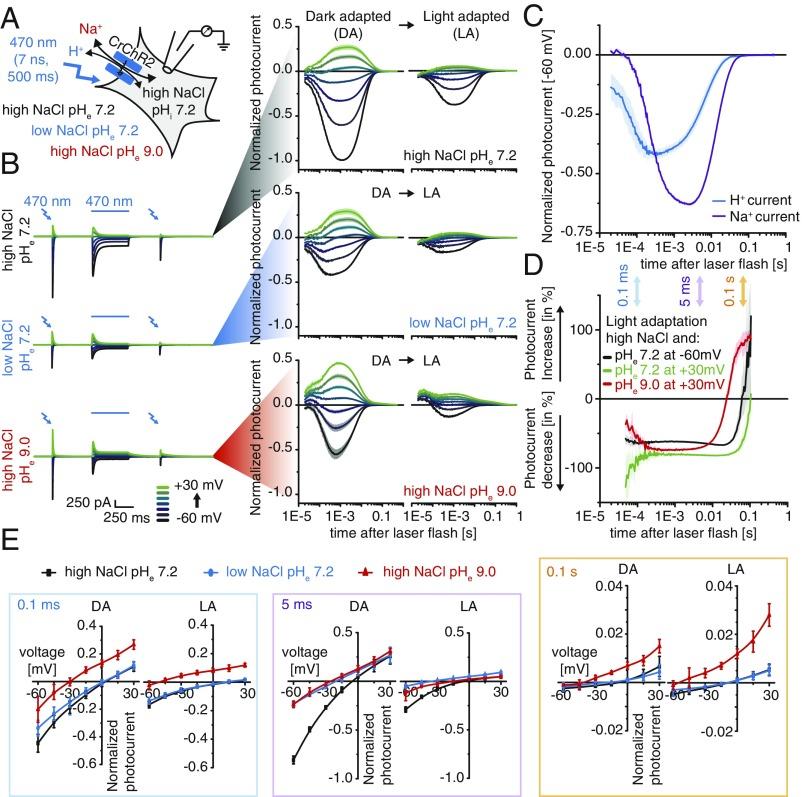
Although channelrhodopsin (ChR) is a widely applied light-activated ion channel, important properties such as light adaptation, photocurrent inactivation, and alteration of the ion selectivity during continuous illumination are not well understood from a molecular perspective. Herein, we address these open questions using single-turnover electrophysiology, time-resolved step-scan FTIR, and Raman spectroscopy of fully dark-adapted ChR2. This yields a unifying parallel photocycle model integrating now all so far controversial discussed data. In dark-adapted ChR2, the protonated retinal Schiff base chromophore (RSBH) adopts an all-,C=N- conformation only. Upon light activation, a branching reaction into either a 13-,C=N- or a 13-,C=N- retinal conformation occurs. The -cycle features sequential H and Na conductance in a late M-like state and an N-like open-channel state. In contrast, the 13-,C=N- isomer represents a second closed-channel state identical to the long-lived P state, which has been previously assigned to a late intermediate in a single-photocycle model. Light excitation of P induces a parallel -photocycle with an open-channel state of small conductance and high proton selectivity. E90 becomes deprotonated in P and stays deprotonated in the C=N- cycle. Deprotonation of E90 and successive pore hydration are crucial for late proton conductance following light adaptation. Parallel - and -photocycles now explain inactivation and ion selectivity changes of ChR2 during continuous illumination, fostering the future rational design of optogenetic tools.
尽管通道视紫红质(ChR)是一种广泛应用的光激活离子通道,但从分子角度来看,其重要性质,如光适应、光电流失活以及在连续光照下离子选择性的改变等,仍未得到很好的理解。在此,我们使用单 turnover 电生理学、全暗适应 ChR2 的时间分辨分步扫描 FTIR 和拉曼光谱学来解决这些悬而未决的问题。这产生了一个统一的平行光循环模型,该模型整合了迄今为止所有有争议的讨论数据。在暗适应的 ChR2 中,质子化的视黄醛 Schiff 碱发色团(RSBH)仅采用全-C=N-构象。在光激活后,分支反应发生在 13-C=N-或 13-C=N-视黄醛构象中。-循环的特征是在晚期 M 样态和 N 样开放通道态中连续进行 H 和 Na 传导。相比之下,13-C=N-异构体代表了第二个与长寿命 P 态相同的关闭通道态,先前已将其分配给单光循环模型中的晚期中间态。P 态的光激发诱导具有小电导和高质子选择性的开放通道态的平行 -光循环。E90 在 P 中去质子化,并在 C=N-循环中保持去质子化。E90 的去质子化和随后的孔水合作用对于光适应后的晚期质子传导至关重要。平行的 -和 -光循环现在可以解释 ChR2 在连续光照下的失活和离子选择性变化,为未来光遗传学工具的合理设计提供了支持。




 Zotero 插件