Department of Psychology, Arizona State University, Tempe, AZ, USA.
Br J Health Psychol. 2019 Sep;24(3):629-650. doi: 10.1111/bjhp.12372. Epub 2019 Apr 19.
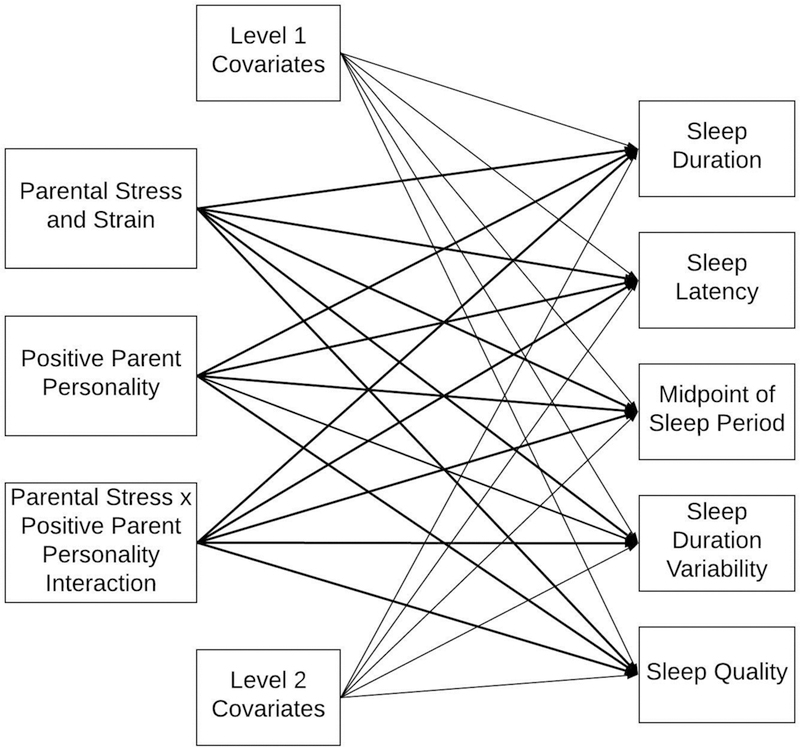
The current study examined the influence of early parental stress and positive parent personality during infancy on sleep in middle childhood. Further, the role of positive parent personality as a buffer of the association between parental stress and sleep was considered.
Participants included 381 twins and their primary caregivers who were recruited from birth records in the United States. Primary caregivers completed survey assessments via phone when twins were 12 and 30 months of age to assess multiple dimensions of parental stress and positive parent personality. Approximately 6 years later (M = 5.78, SD = 0.42), twins participated in an intensive assessment that included wearing actigraph watches to provide an objective measurement of sleep, while primary caregivers completed daily diaries regarding twins' sleep.
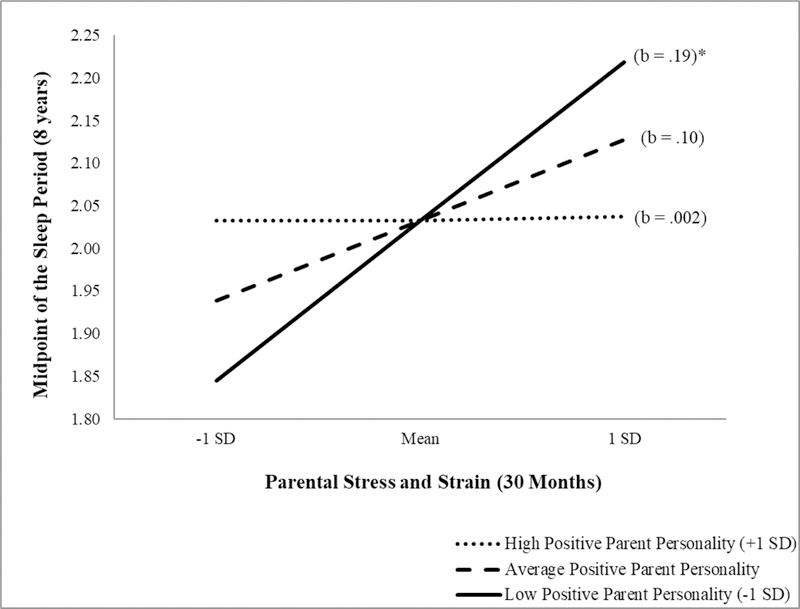
Positive parent personality was associated prospectively with longer actigraphy sleep duration and higher parent-reported sleep quality/daytime functioning. Parental stress was associated prospectively with greater variability in sleep duration. Positive parent personality moderated the parental stress - sleep-timing relation, such that greater parental stress was associated with a later midpoint of the sleep period only for children with parents low on positive personality (e.g., low optimism). All other findings were non-significant.
Findings suggest that both positive attributes and stress may influence sleep in middle childhood and that low parent positive personality may exacerbate associations between parental stress and later timing of sleep periods in children. Early interventions to promote healthy sleeping may consider focusing on decreasing parental stress and increasing parental empathy and optimism as early as infancy. Statement of contribution What is already known on this subject? Early-life experiences, especially adversity, have been related to health outcomes among adults and children, such that negative experiences are associated with poor health outcomes. Poor sleep (e.g., short duration, poor quality) among children is associated with negative outcomes including poorer cognitive performance and higher adiposity. What does this study add? This study used a prospective design to understand relations between early parent-related factors and child sleep. Early parental stress and positive parent personality were associated with objective sleep quality. Positive parent personality during infancy may have promotive/protective influences on sleep later in childhood.
本研究考察了婴儿期早期父母压力和积极的父母人格对儿童中期睡眠的影响。此外,还考虑了积极的父母人格作为父母压力与睡眠之间关联的缓冲因素。
参与者包括 381 对双胞胎及其主要照顾者,他们是从美国的出生记录中招募的。主要照顾者在双胞胎 12 个月和 30 个月大时通过电话完成了调查评估,以评估父母压力和积极父母人格的多个维度。大约 6 年后(M=5.78,SD=0.42),双胞胎参加了一项密集评估,其中包括佩戴活动记录仪以提供睡眠的客观测量,而主要照顾者则完成了关于双胞胎睡眠的日常日记。
积极的父母人格与更长的活动记录仪睡眠时间和更高的父母报告的睡眠质量/日间功能呈前瞻性相关。父母压力与睡眠时间的更大变异性呈前瞻性相关。积极的父母人格调节了父母压力与睡眠时间的关系,即只有父母积极人格较低(例如,乐观程度较低)的孩子,较高的父母压力与睡眠周期的中点较晚相关。所有其他发现均无统计学意义。
研究结果表明,积极的特质和压力都可能影响儿童中期的睡眠,而父母积极人格较低可能会加剧父母压力与儿童睡眠周期后期时间的关联。早期干预措施可能会考虑从婴儿期开始,重点关注降低父母压力和提高父母同理心和乐观程度,以促进健康睡眠。
关于这个主题已经知道些什么?
生命早期的经历,尤其是逆境,与成年人和儿童的健康结果有关,即负面经历与健康结果较差有关。儿童睡眠质量差(例如,睡眠时间短、质量差)与认知表现较差和肥胖率较高等负面结果有关。
这项研究增加了什么新的内容?
这项研究使用前瞻性设计来了解早期与父母相关的因素与儿童睡眠之间的关系。婴儿期早期父母压力和积极的父母人格与客观睡眠质量有关。婴儿期积极的父母人格可能对儿童后期睡眠有促进/保护作用。