Wedd Joel, Basu Mohua, Curtis Laura M, Smith Kayla, Lo Denise J, Serper Marina, Wolf Michael S, Parker Ruth, Patzer Rachel E
Department of Medicine, Emory University, Atlanta, GA, United States.
Emory Transplant Center, Atlanta, GA, United States.
J Med Internet Res. 2019 Apr 22;21(4):e11864. doi: 10.2196/11864.
Kidney and liver transplant recipients must manage a complex care regimen after kidney transplant. Although the use of Web-based patient portals is known to improve patient-provider communication and health outcomes in chronic disease populations by helping patients manage posttransplant care, disparities in access to and use of portals have been reported. Little is known about portal usage and disparities among kidney and liver transplant recipients.
The aim of this study was to examine patient racial/ethnic, socioeconomic, and clinical characteristics associated with portal usage among kidney and liver transplant recipients.
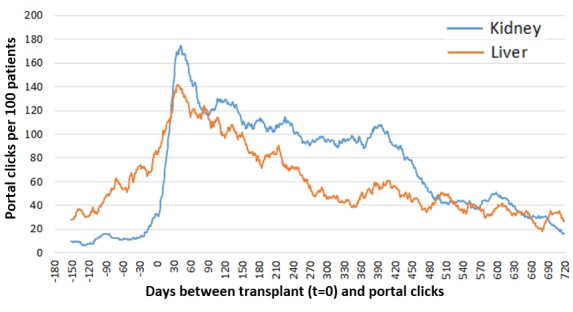
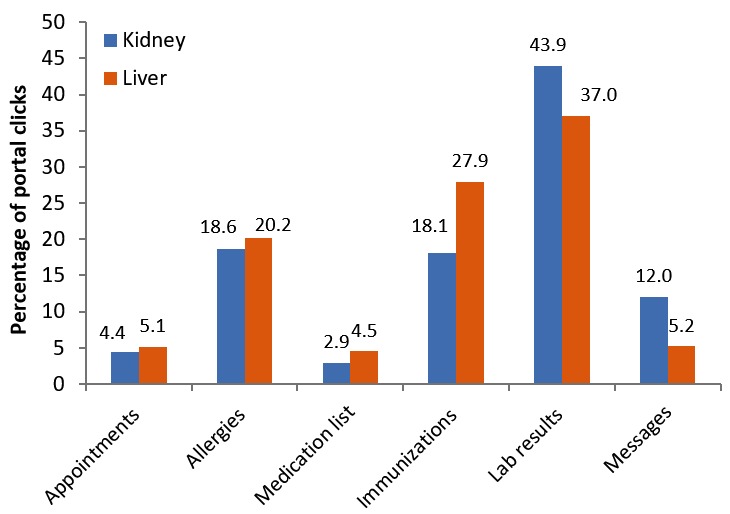
The study included all adult kidney and liver transplant recipients (n=710) at a large academic transplant center in the Southeastern United States between March 2014 and November 2016. Electronic medical record data were linked with Cerner portal usage data. Patient portal use was defined as any portal activity (vs no activity) recorded in the Cerner Web-based portal, including viewing of health records, lab results, medication lists, and the use of secure messaging. Multivariable log-binomial regression was used to determine the patient demographic, clinical, and socioeconomic characteristics associated with portal usage, stratified by organ.
Among 710 transplant recipients (n=455 kidney, n=255 liver), 55.4% (252/455) of kidney recipients and 48.2% (123/255) of liver recipients used the patient portal. Black patients were less likely to use the portal versus white patients among both kidney (57% black vs 74% white) and liver (28% black vs 55% white) transplant recipients. In adjusted multivariable analyses, kidney transplant recipients were more likely to use the portal if they had higher education; among liver recipients, patients who were white versus black and had higher education were more likely to use the portal.
Despite studies showing that patient portals have the potential to benefit transplant recipients as a tool for health management, racial and socioeconomic disparities should be considered before widespread implementation. Transplant centers should include portal training and support to all patients to encourage use, given its potential to improve outcomes.
肾移植和肝移植受者在肾移植后必须管理复杂的护理方案。虽然已知使用基于网络的患者门户通过帮助患者管理移植后护理来改善慢性病患者群体中的医患沟通和健康结局,但有关门户访问和使用方面的差异已有报道。关于肾移植和肝移植受者中门户使用情况及差异知之甚少。
本研究的目的是检查肾移植和肝移植受者中与门户使用相关的患者种族/族裔、社会经济和临床特征。
该研究纳入了2014年3月至2016年11月期间美国东南部一家大型学术移植中心的所有成年肾移植和肝移植受者(n = 710)。电子病历数据与Cerner门户使用数据相关联。患者门户使用被定义为Cerner基于网络的门户中记录的任何门户活动(与无活动相对),包括查看健康记录、实验室结果、用药清单以及使用安全消息传递。多变量对数二项回归用于确定与门户使用相关的患者人口统计学、临床和社会经济特征,并按器官分层。
在710名移植受者中(n = 肾移植455例,n = 肝移植255例),55.4%(252/455)的肾移植受者和48.2%(123/255)的肝移植受者使用了患者门户。在肾移植(黑人57% 对白人74%)和肝移植(黑人28% 对白人55%)受者中黑人患者使用门户的可能性低于白人患者。在调整后的多变量分析中,肾移植受者如果受教育程度较高则更有可能使用门户;在肝移植受者中,白人患者比黑人患者且受教育程度较高者更有可能使用门户。
尽管研究表明患者门户作为健康管理工具有可能使移植受者受益,但在广泛实施之前应考虑种族和社会经济差异。鉴于患者门户有改善结局的潜力,移植中心应向所有患者提供门户培训和支持以鼓励使用。