Department of Medicine, School of Medicine & Health Sciences, The George Washington University, Washington, DC, United States.
Department of Epidemiology and Biostatistics, Milken Institute School of Public Health, The George Washington University, Washington, DC, United States.
JMIR Mhealth Uhealth. 2019 Apr 23;7(4):e10755. doi: 10.2196/10755.
Randomized controlled trials conducted in Mediterranean countries have shown that the Mediterranean diet lowers adverse cardiovascular events. In the American population, diet remains the biggest uncontrolled risk factor for cardiovascular disease.
This study aimed to test the hypothesis that asynchronous dietary counseling supplied through a custom smartphone app results in better adherence to a Mediterranean diet in a non-Mediterranean population than traditional standard-of-care (SOC) counseling.
In total, 100 patients presenting to the cardiology clinic of an academic medical center were randomized to either the SOC or smartphone app-based experimental (EXP) Mediterranean diet intervention after informed consent and 1 hour of individual face-to-face dietary counseling with a registered dietitian. Participants in EXP received a custom smartphone app that reinforced the Mediterranean diet, whereas participants in SOC received 2 additional sessions of in-person dietary counseling with the registered dietitian-30 min at 1 month and 30 min at 3 months. Preexisting knowledge of a Mediterranean diet was measured by the validated Mediterranean Diet Score (MDS) instrument. Baseline height, weight, blood pressure (BP), and laboratory biomarkers were collected. At 1, 3, and 6 months, participants presented for a follow-up appointment to assess compliance to the Mediterranean diet using the MDS as well as a patient satisfaction survey, BP, and weight. Repeat laboratory biomarkers were performed at 3 and 6 months.
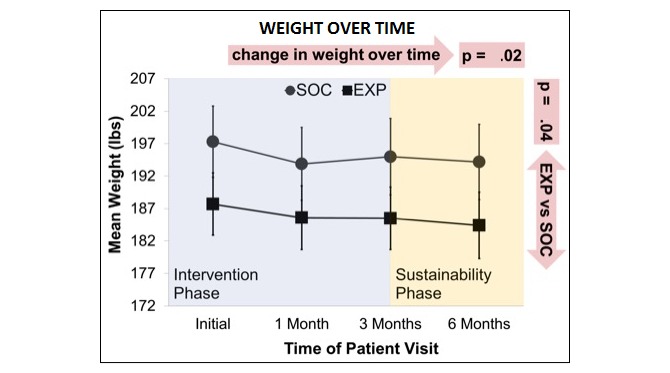
Enrolled participants had a mean age with SE of 56.6 (SD 1.7) for SOC and 57.2 (SD 1.8) for EXP; 65.3% of SOC and 56.9% of EXP were male, and 20.4% of SOC and 35.3% of EXP had coronary artery disease. There were no significant differences between EXP and SOC with regard to BP, lipid parameters, hemoglobin A, or C-reactive protein (CRP). Participants in EXP achieved a significantly greater weight loss on average of 3.3 pounds versus 3.1 pounds for participants in SOC, P=.04. Adherence to the Mediterranean diet increased significantly over time for both groups (P<.001), but there was no significant difference between groups (P=.69). Similarly, there was no significant difference in diet satisfaction between EXP and SOC, although diet satisfaction increased significantly over time for both groups. The proportion of participants with high Mediterranean diet compliance (defined as the MDS ≥9) increased significantly over time (P<.001)-from 18.4% to 57.1% for SOC and 27.5% to 64.7% for EXP; however, there was no significant difference between the groups.
Both traditional SOC counseling and smartphone-based counseling were effective in getting participants to adhere to a Mediterranean diet, and these dietary changes persisted even after counseling had ended. However, neither method was more effective than the other. This pilot study demonstrates that patients can change to and maintain a Mediterranean diet with either traditional or smartphone app-based nutrition counseling.
ClinicalTrials.gov NCT03897426;https://clinicaltrials.gov/ct2/show/NCT03897426.
在地中海国家进行的随机对照试验表明,地中海饮食可降低不良心血管事件的发生风险。在美国人群中,饮食仍然是心血管疾病最大的不可控危险因素。
本研究旨在检验以下假设,即通过自定义智能手机应用程序进行异步饮食咨询,相较于传统标准护理(SOC)咨询,在非地中海人群中更能提高对地中海饮食的依从性。
共有 100 名患者在知情同意后,于学术医疗中心的心脏病学诊所接受了 1 小时的个体面对面营养师饮食咨询,然后被随机分配至 SOC 或基于智能手机应用程序的实验(EXP)地中海饮食干预组。EXP 组的参与者收到了一款定制的智能手机应用程序,该应用程序强化了地中海饮食,而 SOC 组的参与者则接受了另外 2 次营养师的面对面饮食咨询,分别在 1 个月和 3 个月时进行,每次 30 分钟。地中海饮食的预先知识通过经过验证的地中海饮食评分(MDS)工具进行测量。收集基线身高、体重、血压(BP)和实验室生物标志物。在 1、3 和 6 个月时,参与者进行了随访预约,使用 MDS 以及患者满意度调查、BP 和体重来评估对地中海饮食的依从性。在 3 个月和 6 个月时进行了重复的实验室生物标志物检测。
纳入的参与者平均年龄为 56.6(SE 1.7)岁(SOC 组)和 57.2(SE 1.8)岁(EXP 组);SOC 组 65.3%的参与者和 EXP 组 56.9%的参与者为男性,SOC 组 20.4%和 EXP 组 35.3%的参与者患有冠状动脉疾病。EXP 组和 SOC 组之间的 BP、血脂参数、血红蛋白 A 和 C 反应蛋白(CRP)均无显著差异。EXP 组的平均体重减轻了 3.3 磅,而 SOC 组的平均体重减轻了 3.1 磅,EXP 组的体重减轻更为显著,P=.04。两组的地中海饮食依从性均随时间显著增加(P<.001),但组间无显著差异(P=.69)。同样,EXP 组和 SOC 组的饮食满意度均随时间显著增加,但组间无显著差异。地中海饮食高依从性(定义为 MDS≥9)的参与者比例随时间显著增加(P<.001)-SOC 组从 18.4%增加到 57.1%,EXP 组从 27.5%增加到 64.7%;然而,两组之间没有显著差异。
传统的 SOC 咨询和基于智能手机的咨询都能有效地让参与者遵循地中海饮食,并且这些饮食变化在咨询结束后仍然持续。然而,这两种方法都没有比另一种更有效。这项试点研究表明,患者可以通过传统或基于智能手机应用程序的营养咨询来改变并维持地中海饮食。
ClinicalTrials.gov NCT03897426;https://clinicaltrials.gov/ct2/show/NCT03897426。