1 Department of Epidemiology, College of Public Health, University of Kentucky, Lexington, KY, USA.
2 Department of Toxicology and Cancer Biology, Markey Cancer Center, College of Medicine, University of Kentucky, Lexington, KY, USA.
Cancer Control. 2019 Jan-Dec;26(1):1073274819845873. doi: 10.1177/1073274819845873.
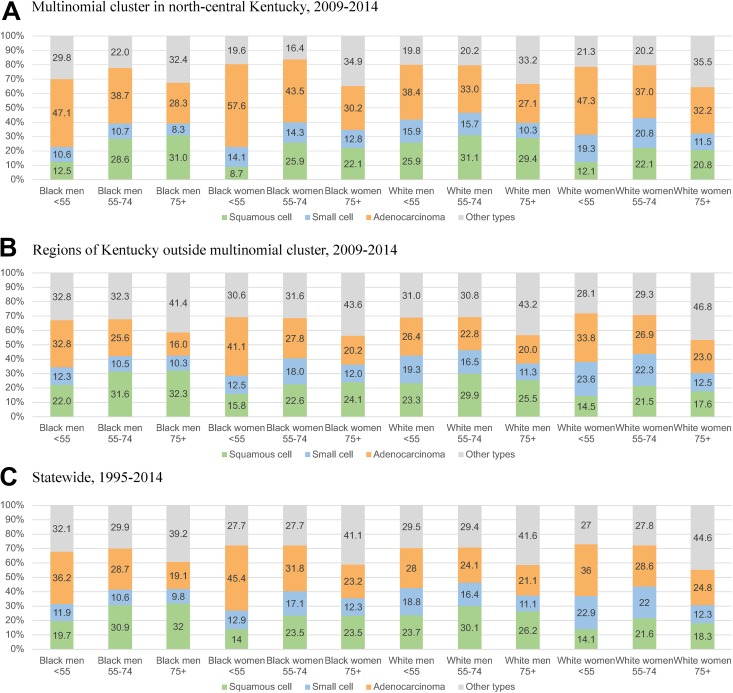
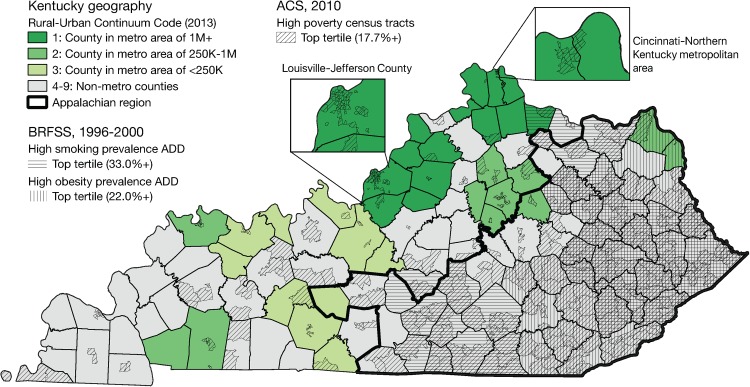
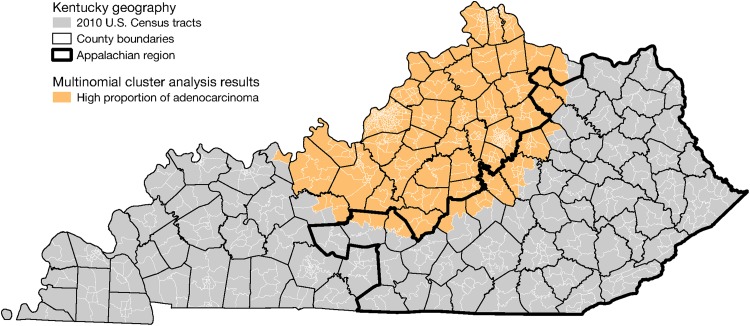
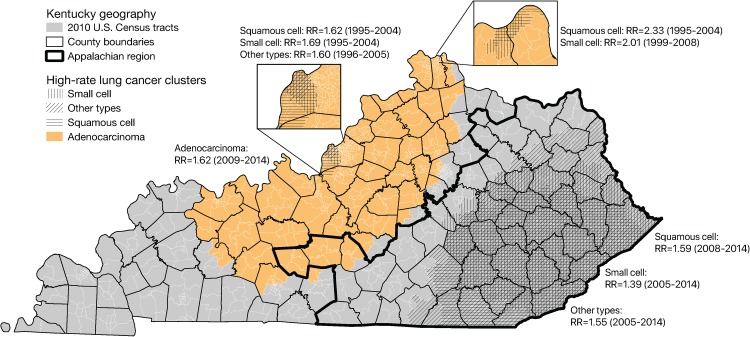
Recent metabolic and genetic research has demonstrated that risk for specific histological types of lung cancer varies in relation to cigarette smoking and obesity. This study investigated the spatial and temporal distribution of lung cancer histological types in Kentucky, a largely rural state with high rates of smoking and obesity, to discern population-level trends that might reflect variation in these and other risk factors. The Kentucky Cancer Registry provided residential geographic coordinates for lung cancer cases diagnosed from 1995 through 2014. We used multinomial and discrete Poisson spatiotemporal scan statistics, adjusted for age, gender, and race, to characterize risk for specific histological types-small cell, adenocarcinoma, squamous cell, and other types-throughout Kentucky and compared to maps of risk factors. Toward the end of the study period, adenocarcinoma was more common among all population subgroups in north-central Kentucky, where smoking and obesity are less prevalent. During the same time frame, squamous cell, small cell, and other types were more common in rural Appalachia, where smoking and obesity are more prevalent, and in some high poverty urban areas. Spatial and temporal patterns in the distribution of histological types of lung cancer are likely related to regional variation in multiple risk factors. High smoking and obesity rates in the Appalachian region, and likely in high poverty urban areas, appeared to coincide with high rates of squamous cell and small cell lung cancer. In north-central Kentucky, environmental exposures might have resulted in higher risk for adenocarcinoma specifically.
最近的代谢和遗传研究表明,特定组织学类型的肺癌风险与吸烟和肥胖有关。本研究调查了肯塔基州肺癌组织学类型的时空分布,该州是一个以农村为主、吸烟和肥胖率高的州,以发现可能反映这些和其他风险因素变化的人群水平趋势。肯塔基州癌症登记处提供了 1995 年至 2014 年诊断的肺癌病例的居住地理坐标。我们使用多项和离散泊松时空扫描统计数据,根据年龄、性别和种族进行调整,以描述整个肯塔基州特定组织学类型(小细胞、腺癌、鳞状细胞和其他类型)的风险,并与风险因素图进行比较。在研究结束时,在吸烟和肥胖不太流行的肯塔基州中北部,所有人群亚组中腺癌更为常见。在同一时期,在吸烟和肥胖更为普遍的阿巴拉契亚农村地区以及一些高贫困城市地区,鳞状细胞癌、小细胞癌和其他类型更为常见。肺癌组织学类型分布的时空模式可能与多种风险因素的区域变化有关。阿巴拉契亚地区的高吸烟和肥胖率,以及可能在高贫困城市地区,似乎与鳞状细胞癌和小细胞癌的高发病率有关。在肯塔基州中北部,环境暴露可能导致特定的腺癌风险增加。