Department of Structural Biology, Stanford University School of Medicine, Stanford, California 94305, USA.
Department of Chemical and Systems Biology, Stanford University School of Medicine, Stanford, California 94305, USA.
RNA. 2019 Jul;25(7):881-895. doi: 10.1261/rna.071217.119. Epub 2019 Apr 25.
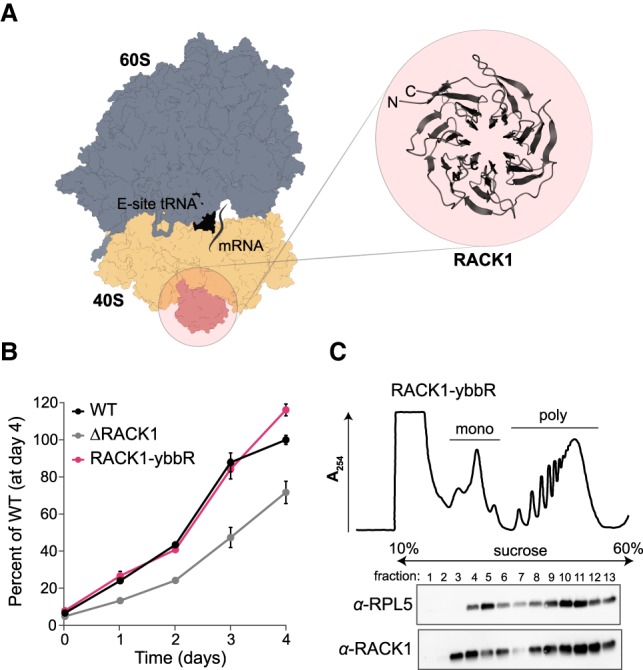
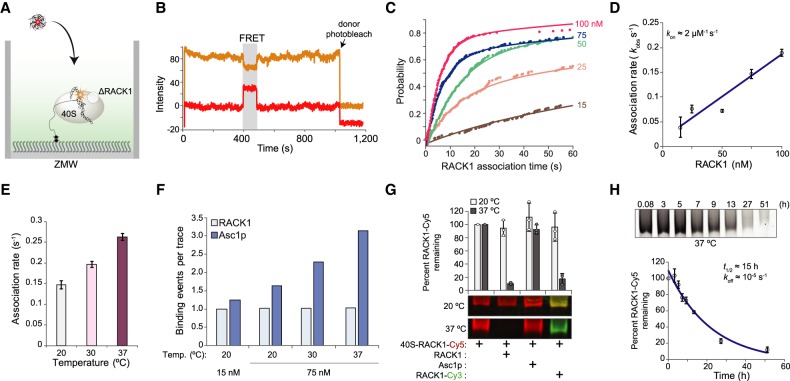
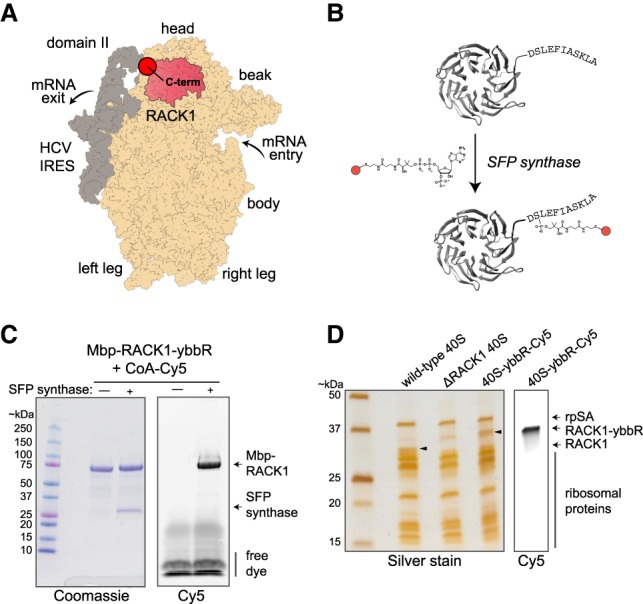
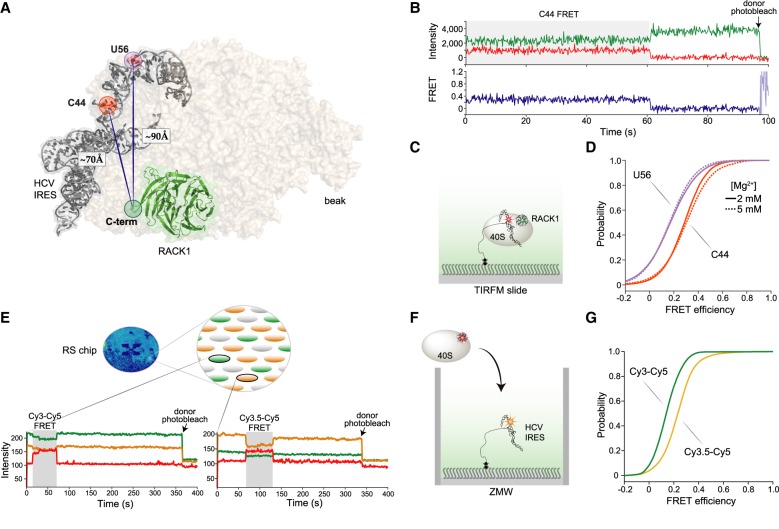
Receptor for activated C kinase 1 (RACK1) is a eukaryote-specific ribosomal protein (RP) implicated in diverse biological functions. To engineer ribosomes for specific fluorescent labeling, we selected RACK1 as a target given its location on the small ribosomal subunit and other properties. However, prior results suggested that RACK1 has roles both on and off the ribosome, and such an exchange might be related to its various cellular functions and hinder our ability to use RACK1 as a stable fluorescent tag for the ribosome. In addition, the kinetics of spontaneous exchange of RACK1 or any RP from a mature ribosome in vitro remain unclear. To address these issues, we engineered fluorescently labeled human ribosomes via RACK1, and applied bulk and single-molecule biochemical analyses to track RACK1 on and off the human ribosome. Our results demonstrate that, despite its cellular nonessentiality from yeast to humans, RACK1 readily reassociates with the ribosome, displays limited conformational dynamics, and remains stably bound to the ribosome for hours in vitro. This work sheds insight into the biochemical basis of RPs exchange on and off a mature ribosome and provides tools for single-molecule analysis of human translation.
激活蛋白激酶 C 受体 1(RACK1)是一种真核生物特有的核糖体蛋白(RP),参与多种生物学功能。为了对核糖体进行特定的荧光标记,我们选择 RACK1 作为目标,因为它位于小核糖体亚基上,并且具有其他特性。然而,先前的结果表明,RACK1 在核糖体上和核糖体外都有作用,这种交换可能与其各种细胞功能有关,并阻碍我们将 RACK1 用作核糖体的稳定荧光标记的能力。此外,RACK1 或任何 RP 从成熟核糖体中外在自发交换的动力学在体外仍然不清楚。为了解决这些问题,我们通过 RACK1 工程化了荧光标记的人类核糖体,并应用批量和单分子生化分析来追踪人类核糖体上和核糖体外的 RACK1。我们的结果表明,尽管从酵母到人,RACK1 在细胞中是非必需的,但它很容易重新与核糖体结合,显示出有限的构象动力学,并且在体外数小时内仍然稳定地结合在核糖体上。这项工作深入了解了 RP 在成熟核糖体上和核糖体外交换的生化基础,并为人类翻译的单分子分析提供了工具。