Liu Renyuan, Chen Haifeng, Qin Ruomeng, Gu Yucheng, Chen Xin, Zou Junhui, Jiang YongCheng, Li Weikai, Bai Feng, Zhang Bing, Wang Xiaoying, Xu Yun
Department of Neurology, Drum Tower Hospital, Medical School and The State Key Laboratory of Pharmaceutical Biotechnology, Institute of Brain Science, Nanjing University, Nanjing, China.
Jiangsu Province Stroke Center for Diagnosis and Therapy, Nanjing, China.
Front Neurol. 2019 Apr 5;10:324. doi: 10.3389/fneur.2019.00324. eCollection 2019.
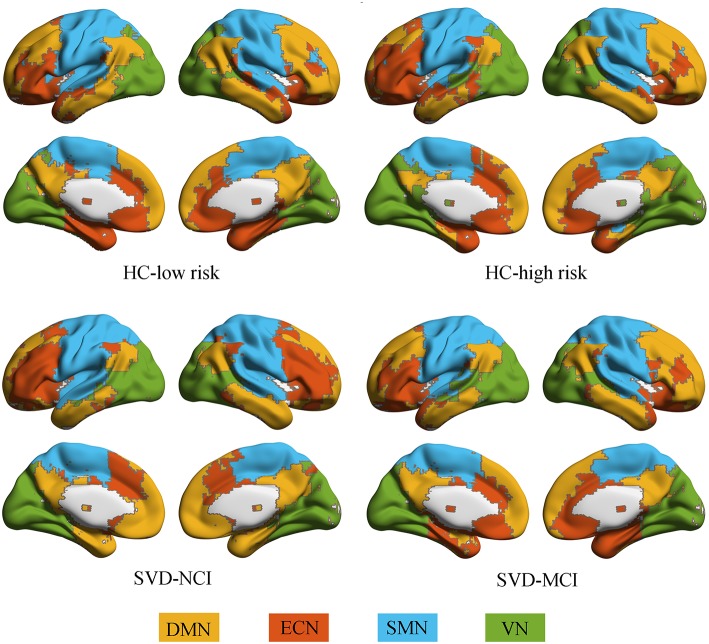
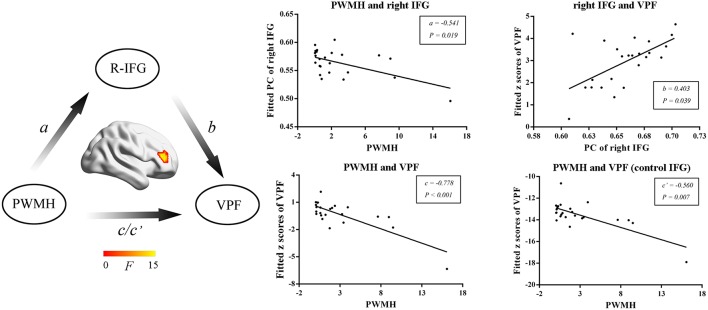
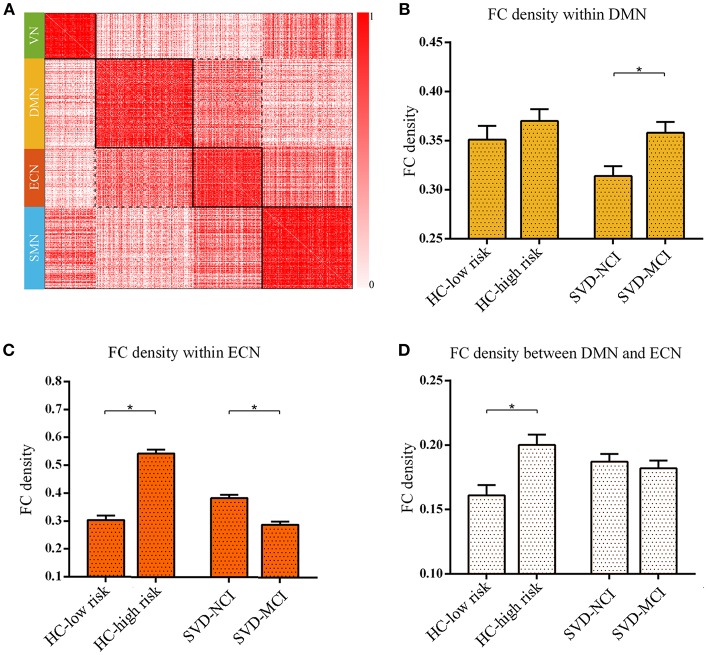
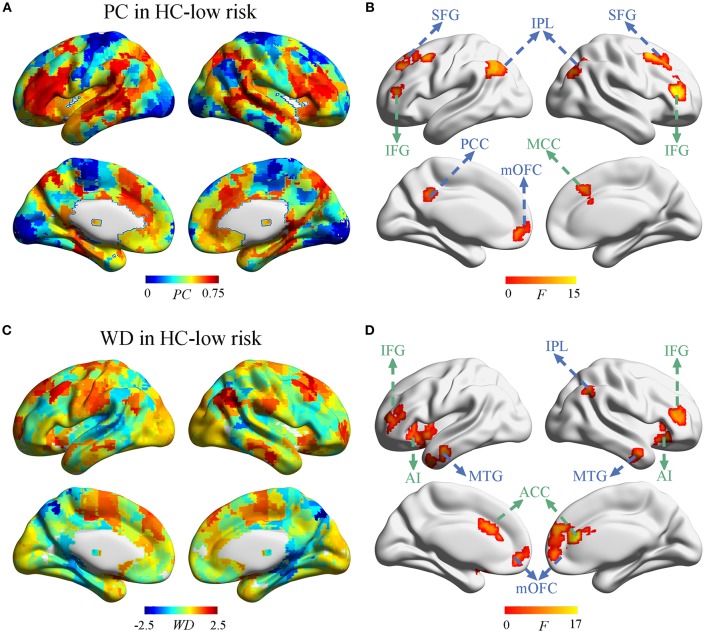
Cerebral small vessel disease (SVD) is a common cause of cognitive dysfunction. However, little is known whether the altered reconfiguration pattern of brain modular architecture regulates cognitive dysfunction in SVD. We recruited 25 cases of SVD without cognitive impairment (SVD-NCI) and 24 cases of SVD with mild cognitive impairment (SVD-MCI). According to the Framingham Stroke Risk Profile, healthy controls (HC) were divided into 17 subjects (HC-low risk) and 19 subjects (HC-high risk). All individuals underwent resting-state functional magnetic resonance imaging and cognitive assessments. Graph-theoretical analysis was used to explore alterations in the modular organization of functional brain networks. Multiple regression and mediation analyses were performed to investigate the relationship between MRI markers, network metrics and cognitive performance. We identified four modules corresponding to the default mode network (DMN), executive control network (ECN), sensorimotor network and visual network. With increasing vascular risk factors, the inter- and intranetwork compensation of the ECN and a relatively reserved DMN itself were observed in individuals at high risk for SVD. With declining cognitive ability, SVD-MCI showed a disrupted ECN intranetwork and increased DMN connection. Furthermore, the intermodule connectivity of the right inferior frontal gyrus of the ECN mediated the relationship between periventricular white matter hyperintensities and visuospatial processing in SVD-MCI. The reconfiguration pattern of the modular architecture within/between the DMN and ECN advances our understanding of the neural underpinning in response to vascular risk and SVD burden. These observations may provide novel insight into the underlying neural mechanism of SVD-related cognitive impairment and may serve as a potential non-invasive biomarker to predict and monitor disease progression.
脑小血管病(SVD)是认知功能障碍的常见原因。然而,关于脑模块化结构的改变重构模式是否调节SVD中的认知功能障碍,我们知之甚少。我们招募了25例无认知障碍的SVD患者(SVD-NCI)和24例轻度认知障碍的SVD患者(SVD-MCI)。根据弗雷明汉姆卒中风险概况,将健康对照(HC)分为17名受试者(HC低风险)和19名受试者(HC高风险)。所有个体均接受静息态功能磁共振成像和认知评估。采用图论分析来探索功能性脑网络模块化组织的改变。进行多元回归和中介分析以研究MRI标记、网络指标与认知表现之间的关系。我们识别出了与默认模式网络(DMN)、执行控制网络(ECN)、感觉运动网络和视觉网络相对应的四个模块。随着血管危险因素的增加,在SVD高风险个体中观察到ECN的网络间和网络内补偿以及相对保留的DMN本身。随着认知能力下降,SVD-MCI显示出ECN网络内中断和DMN连接增加。此外,ECN右额下回的模块间连通性介导了SVD-MCI中脑室周围白质高信号与视觉空间处理之间的关系。DMN和ECN内/之间模块化结构的重构模式推进了我们对响应血管风险和SVD负担的神经基础的理解。这些观察结果可能为SVD相关认知障碍的潜在神经机制提供新的见解,并可能作为预测和监测疾病进展的潜在非侵入性生物标志物。