Pan Feixia, Chen Tianhui, Sun Xiaohui, Li Kuanrong, Jiang Xiyi, Försti Asta, Zhu Yimin, Lai Maode
Department of Epidemiology & Biostatistics, School of Public Health, Zhejiang University, Hangzhou, China.
Sir Run Run Shaw Hospital, College of Medicine, Zhejiang University, Hangzhou, China.
Front Oncol. 2019 Apr 9;9:252. doi: 10.3389/fonc.2019.00252. eCollection 2019.
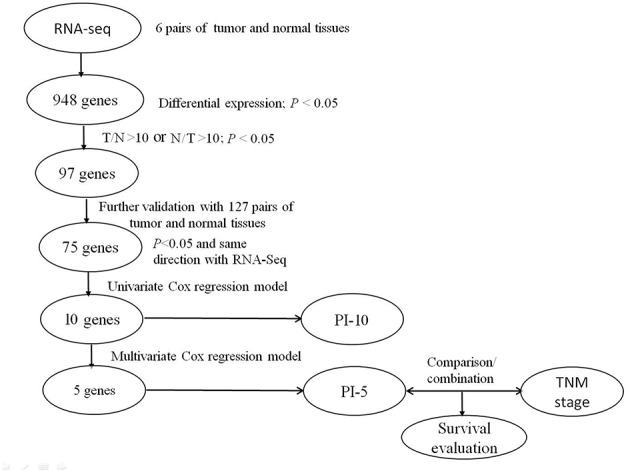
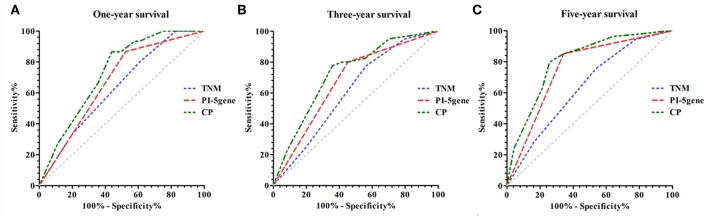
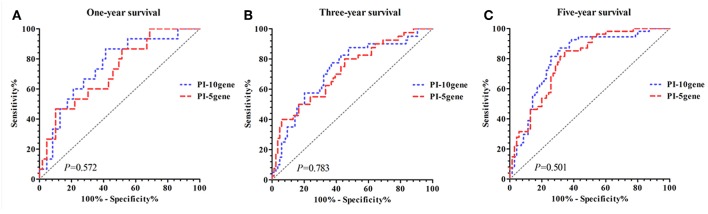
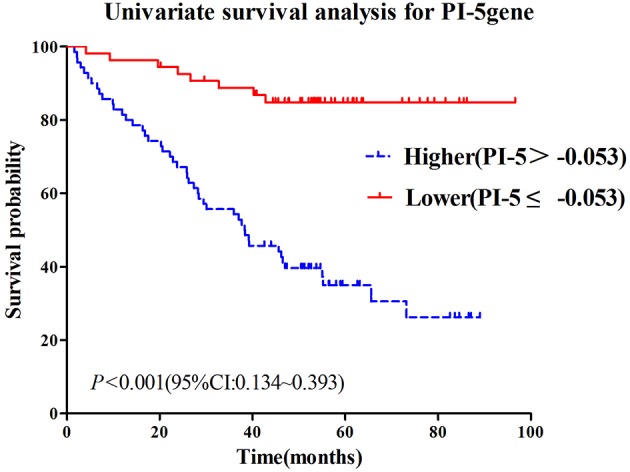
Investigation on prognostic markers for colorectal cancer (CRC) deserves efforts, but data from China are scarce. This study aimed to build a prognostic algorithm using differentially expressed gene (DEG) profiles and to compare it with the TNM staging system in their predictive accuracy for CRC prognosis in Chinese patients. DEGs in six paired tumor and corresponding normal tissues were determined using RNA-Sequencing. Subsequently, matched tumor and normal tissues from 127 Chinese patients were assayed for further validation. Univariate and multivariate Cox regressions were used to identify informative DEGs. A predictive index (PI) was derived as a linear combination of the products of the DEGs and their Cox regression coefficients. The combined predictive accuracy of the DEGs-based PI and tumors' TNM stages was also examined by a logistic regression model including the two predictors. The predictive performance was evaluated with the area under the receiver operating characteristics (AUCs). Out of 75 candidate DEGs, we identified 10 DEGs showing statistically significant associations with CRC survival. A PI based on these 10 DEGs (PI-10) predicted CRC survival probability more accurately than the TNM staging system [AUCs for 3-year survival probability 0.73 (95% confidence interval: 0.64, 0.81) vs. 0.68 (0.59, 0.76)] but comparable to a simplified PI (PI-5) using five DEGs (LOC646627, BEST4, KLF9, ATP6V1A, and DNMT3B). The predictive accuracy was improved further by combining PI-5 and the TNM staging system [AUC for 3-year survival probability: 0.72 (0.63, 0.80)]. Prognosis prediction based on informative DEGs might yield a higher predictive accuracy in CRC prognosis than the TNM staging system does.
对结直肠癌(CRC)预后标志物的研究值得付出努力,但来自中国的数据却很匮乏。本研究旨在利用差异表达基因(DEG)谱构建一种预后算法,并将其与TNM分期系统在预测中国患者CRC预后的准确性方面进行比较。使用RNA测序确定六对肿瘤及相应正常组织中的DEG。随后,对127例中国患者的配对肿瘤和正常组织进行检测以进一步验证。采用单变量和多变量Cox回归来识别信息丰富的DEG。推导预测指数(PI)作为DEG及其Cox回归系数乘积的线性组合。还通过包含这两个预测因子的逻辑回归模型检验基于DEG的PI与肿瘤TNM分期的联合预测准确性。用受试者工作特征曲线下面积(AUC)评估预测性能。在75个候选DEG中,我们鉴定出10个与CRC生存具有统计学显著关联的DEG。基于这10个DEG的PI(PI - 10)比TNM分期系统更准确地预测CRC生存概率[3年生存概率的AUC分别为0.73(95%置信区间:0.64,0.81)和0.68(0.59,0.76)],但与使用五个DEG(LOC646627、BEST4、KLF9、ATP6V1A和DNMT3B)的简化PI(PI - 5)相当。通过将PI - 5与TNM分期系统相结合,预测准确性进一步提高[3年生存概率的AUC为0.72(0.63,0.80)]。基于信息丰富的DEG进行预后预测在CRC预后方面可能比TNM分期系统具有更高的预测准确性。