Plexousakis Stefanos Stylianos, Kourkoutas Elias, Giovazolias Theodoros, Chatira Kalliopi, Nikolopoulos Dimitrios
Department of Psychology, University of Crete, Rethymno, Greece.
Front Public Health. 2019 Apr 9;7:75. doi: 10.3389/fpubh.2019.00075. eCollection 2019.
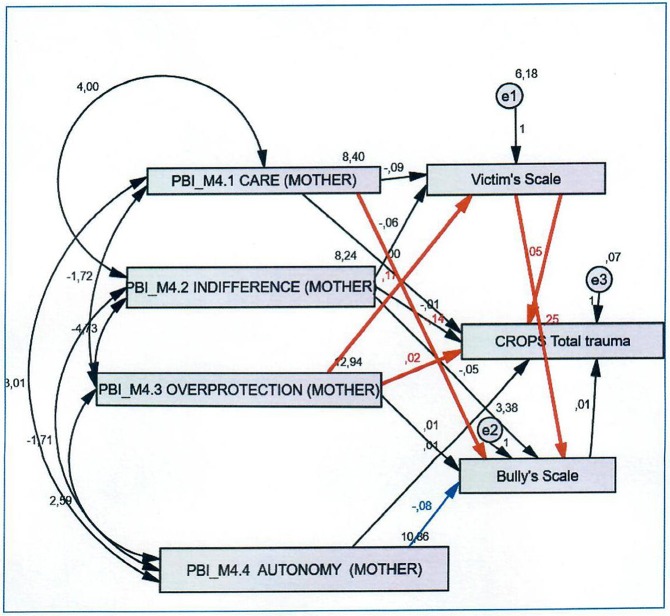
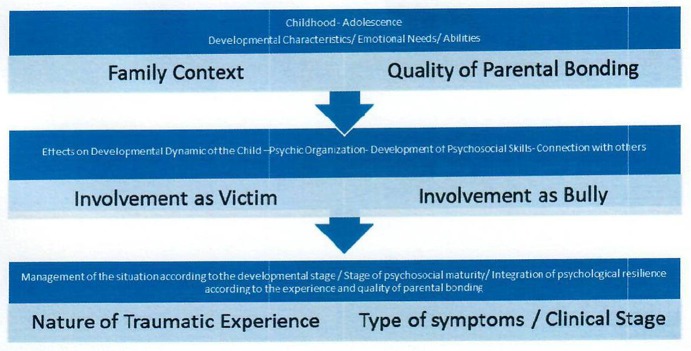
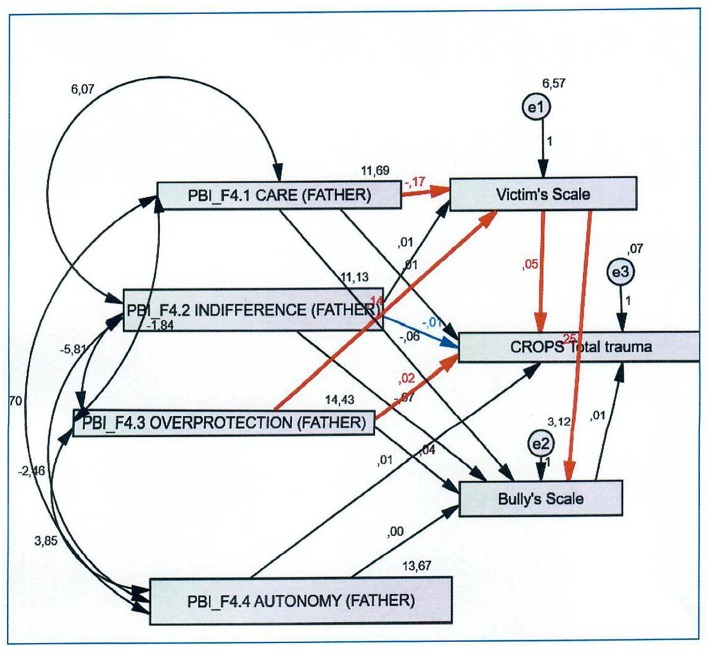
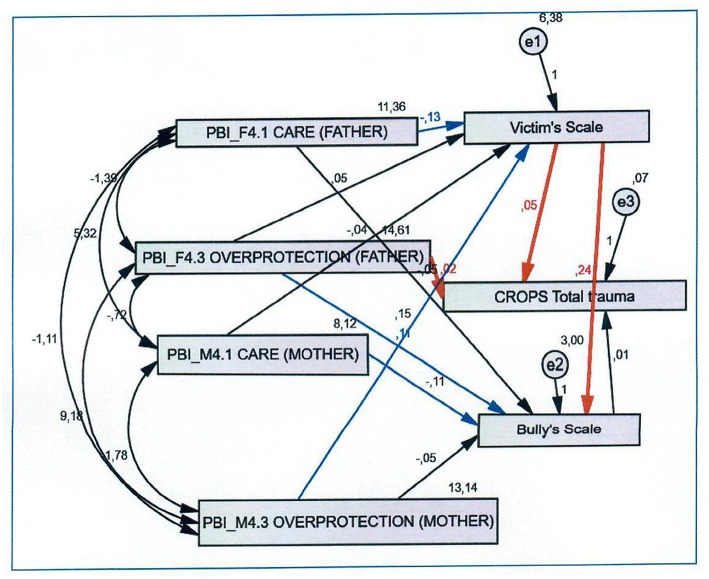
Much research on school bullying and victimization have outlined several individual, family, and school parameters that function as risk factors for developing further psychosocial and psychopathological problems. Bullying and victimization are interrelated with symptoms of psychological trauma, as well as emotional/ behavioural reactions, which can destabilize psychosocial and scholastic pathways for children and adolescents. The current study explored the various dimensions of psychological trauma (depressive symptoms, somatization, dissociation, avoidance behaviours) associated with school bullying/victimization in relation to parental bonding among 433 students (8-16 years old) from representative large cities in Greece. The following scales were employed: (a) Olweus Bully/Victim Questionnaire, (b) Child Report of Post-traumatic Symptoms (CROPS), and (c) Parental Bonding Inventory instrument (PBI). Pathways analysis extracted a series of models which showed that maternal and paternal overprotection (anxious-controlling/aggressive) had positive association with post-traumatic stress symptoms. Specifically, the quality of parental bonding was related with children's bullying/victimization experiences and post-traumatic symptomology. Conversely, results indicated that maternal and paternal care can reduce the manifestation of post-traumatic stress symptoms. Implications for interventions are discussed.
许多关于校园欺凌和受欺负的研究已经概述了几个个人、家庭和学校方面的因素,这些因素是导致进一步出现心理社会和精神病理问题的风险因素。欺凌和受欺负与心理创伤症状以及情绪/行为反应相互关联,这可能会破坏儿童和青少年的心理社会和学业发展路径。本研究探讨了希腊代表性大城市中433名8至16岁学生的校园欺凌/受欺负相关的心理创伤的各个维度(抑郁症状、躯体化、解离、回避行为)与父母依恋的关系。使用了以下量表:(a)奥维斯欺凌/受欺负问卷,(b)儿童创伤后症状报告(CROPS),以及(c)父母依恋量表(PBI)。路径分析提取了一系列模型,这些模型表明母亲和父亲的过度保护(焦虑控制/攻击性)与创伤后应激症状呈正相关。具体而言,父母依恋的质量与儿童的欺凌/受欺负经历以及创伤后症状学有关。相反,结果表明母亲和父亲的关爱可以减少创伤后应激症状的表现。讨论了干预措施的意义。