Siva Niroshan, Thavarajah Pushparajah, Kumar Shiv, Thavarajah Dil
Plant and Environmental Sciences, Poole Agricultural Center, Clemson University, Clemson, SC, United States.
Biodiversity and Integrated Gene Management Program, International Centre for Agricultural Research in the Dry Areas (ICARDA), Rabat-Institute, Rabat, Morocco.
Front Nutr. 2019 Apr 3;6:38. doi: 10.3389/fnut.2019.00038. eCollection 2019.
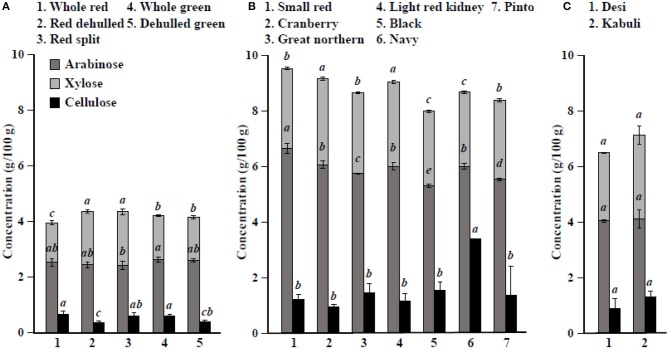
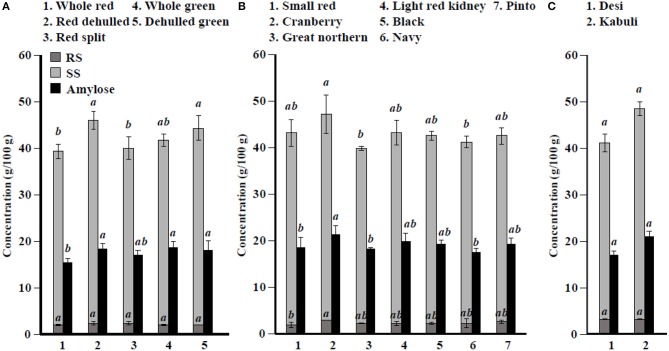
Pulse crops such as lentil, common bean, and chickpea are rich in protein, low digestible carbohydrates, and range of micronutrients. The detailed information of low digestible carbohydrates also known as "prebiotic carbohydrate" profiles of commonly consumed pulse market classes and their impact on human health are yet to be studied. The objective of this study was to determine the profiles of prebiotic carbohydrates in two commonly consumed lentil market classes, seven common bean market classes, and two chickpea market classes. After removing fat and protein, total carbohydrates averaged 51/100 g for lentil, 53/100 g for common bean, and 54/100 g for chickpea. Among the portion of total carbohydrates, lentil showed 12/100 g of prebiotic carbohydrates (sugar alcohols, raffinose family oligosaccharides, fructooligosaccharides, hemicellulose, cellulose, and resistant starch), 15/100 g in common bean, and 12/100 g in chickpea. Prebiotic carbohydrate concentrations within the market classes for each crop were significantly different ( < 0.05). In conclusion, these three pulses are rich in prebiotic carbohydrates, and considering the variation in these concentrations in the present materials, it is possible to breed appropriate market classes of pulses with high levels of prebiotic carbohydrates.
诸如小扁豆、普通菜豆和鹰嘴豆等豆类作物富含蛋白质、低消化性碳水化合物以及多种微量营养素。常见消费豆类市场类别中低消化性碳水化合物(也称为“益生元碳水化合物”)的详细信息及其对人体健康的影响尚未得到研究。本研究的目的是确定两种常见消费小扁豆市场类别、七种普通菜豆市场类别和两种鹰嘴豆市场类别中的益生元碳水化合物概况。去除脂肪和蛋白质后,小扁豆的总碳水化合物平均含量为51/100克,普通菜豆为53/100克,鹰嘴豆为54/100克。在总碳水化合物部分中,小扁豆含有12/100克益生元碳水化合物(糖醇、棉子糖家族寡糖、低聚果糖、半纤维素、纤维素和抗性淀粉),普通菜豆为15/100克,鹰嘴豆为12/100克。每种作物市场类别中的益生元碳水化合物浓度存在显著差异(<0.05)。总之,这三种豆类富含益生元碳水化合物,考虑到本材料中这些浓度的差异,有可能培育出益生元碳水化合物含量高的合适豆类市场类别。