Nosworthy Matthew G, Medina Gerardo, Lu Zhan-Hui, House James D
Guelph Research and Development Center, Agriculture and Agri-Food Canada, Guelph, ON N1G 5C9, Canada.
College of Pharmacy and Nutrition, University of Saskatchewan, Saskatoon, SK S7N 5E5, Canada.
Foods. 2023 Jul 25;12(15):2816. doi: 10.3390/foods12152816.
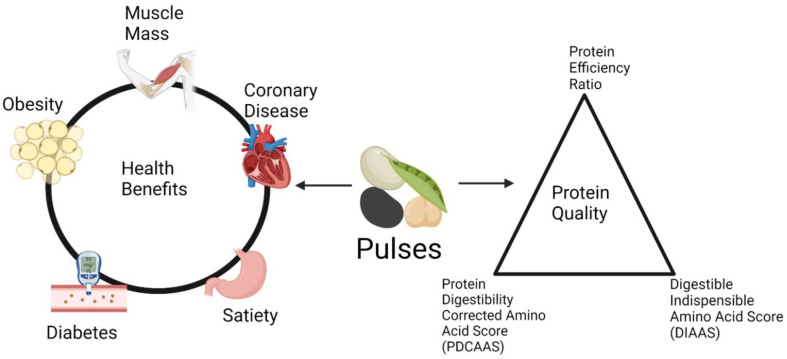
As countries increase their standard of living and individual income levels rise, there is a concomitant increase in the demand for animal-based protein. However, there are alternative sources. One of the alternatives available is that of increased direct human consumption of plant proteins. The quality of a dietary protein is an important consideration when discussing the merits of one protein source over another. The three most commonly used methods to express protein quality are the protein efficiency ratio (PER), a weight gain measurement; protein digestibility-corrected amino acid score (PDCAAS); and the digestible indispensable amino acid score (DIAAS). The possibility that alterations in the quality and quantity of protein in the diet could generate specific health outcomes is one being actively researched. Plant-based proteins may have additional beneficial properties for human health when compared to animal protein sources, including reductions in risk factors for cardiovascular disease and contributions to increased satiety. In this paper, the methods for the determination of protein quality and the potential beneficial qualities of plant proteins to human health will be described.
随着各国生活水平的提高以及个人收入水平的上升,对动物蛋白的需求也随之增加。然而,也有其他替代来源。其中一个替代方案是增加人类直接对植物蛋白的消费量。在讨论一种蛋白质来源优于另一种蛋白质来源的优点时,膳食蛋白质的质量是一个重要的考虑因素。表达蛋白质质量最常用的三种方法是蛋白质效率比(PER),一种体重增加测量方法;蛋白质消化率校正氨基酸评分(PDCAAS);以及可消化必需氨基酸评分(DIAAS)。饮食中蛋白质的质量和数量的改变可能产生特定健康结果这一可能性正在被积极研究。与动物蛋白来源相比,植物性蛋白质可能对人类健康具有额外的有益特性,包括降低心血管疾病的风险因素以及有助于增加饱腹感。在本文中,将描述蛋白质质量的测定方法以及植物蛋白对人类健康的潜在有益特性。