Ma Zhimin, Wang Yunfeng, Xu Chaonan, Ai Feiling, Huang Ling, Wang Jieping, Peng Ji, Zhou Yanming, Yin Meihua, Zhang Shan, Yang Xinghua
School of Public Health, Capital Medical University, Beijing, China.
Shenzhen Center for Chronic Disease Control, Shenzhen, China.
Front Endocrinol (Lausanne). 2019 Apr 12;10:230. doi: 10.3389/fendo.2019.00230. eCollection 2019.
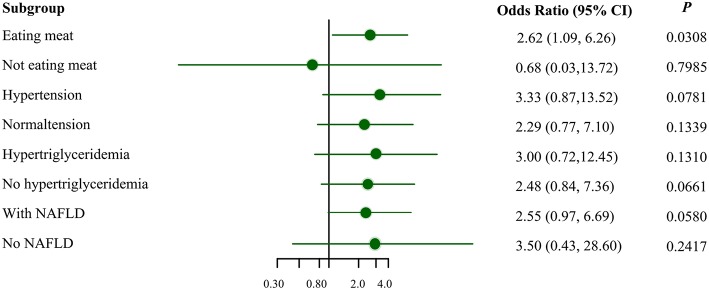
Obesity/metabolic syndrome and hyperuricemia are clinically associated; however, the association of obesity/metabolic syndrome-related genetic variants with hyperuricemia is not clear. Therefore, we assessed this association in Chinese men diagnosed with hyperuricemia in comparison to a non-hyperuricemia group. We genotyped 47 single nucleotide polymorphisms (SNPs) previously identified to be associated with obesity or metabolic syndrome in 474 adult males (aged ≥ 18 years) using multiplex polymerase chain reaction. Multivariate logistic regression was used to investigate the association between the genetic variations and hyperuricemia. Stratified analyses were applied to further assess the associations. The obesity-related SNP in MSRA rs545854 significantly affected serum uric acid levels. In addition, the G-allele of rs545854 was positively associated with the risk of hyperuricemia [odds ratio (OR) = 2.80, 95% confidence interval (CI) = 1.19-6.64, = 0.0188]. After adjusting the model for body mass index and central obesity, rs545854 was shown to be an independent factor increasing the risk of hyperuricemia (OR = 2.81, 95%CI = 1.18-6.70, = 0.0196). Stratified analyses also showed a significant association between rs545854 and hyperuricemia among meat eaters (OR = 2.62, 95%CI = 1.09-6.26, = 0.0308). The obesity-related SNP rs545854 was correlated with the serum uric acid level and risk of hyperuricemia in a male Chinese population. Therefore, men carrying this SNP could benefit from limiting their meat consumption to prevent hyperuricemia. These findings suggest an underlying genetic link between obesity and hyperuricemia worthy of further exploration.
肥胖/代谢综合征与高尿酸血症在临床上存在关联;然而,肥胖/代谢综合征相关基因变异与高尿酸血症之间的关联尚不清楚。因此,我们在中国男性高尿酸血症患者中评估了这种关联,并与非高尿酸血症组进行了比较。我们使用多重聚合酶链反应对474名成年男性(年龄≥18岁)中先前确定与肥胖或代谢综合征相关的47个单核苷酸多态性(SNP)进行了基因分型。采用多变量逻辑回归研究基因变异与高尿酸血症之间的关联。应用分层分析进一步评估这种关联。MSRA基因中与肥胖相关的SNP rs545854显著影响血清尿酸水平。此外,rs545854的G等位基因与高尿酸血症风险呈正相关[比值比(OR)=2.80,95%置信区间(CI)=1.19 - 6.64,P = 0.0188]。在对体重指数和中心性肥胖进行模型调整后,rs545854被证明是增加高尿酸血症风险的独立因素(OR = 2.81,95%CI = 1.18 - 6.70,P = 0.0196)。分层分析还显示,在肉食者中rs545854与高尿酸血症之间存在显著关联(OR = 2.62,95%CI = 1.09 - 6.26,P = 0.0308)。肥胖相关SNP rs545854与中国男性人群的血清尿酸水平及高尿酸血症风险相关。因此,携带该SNP的男性可能通过限制肉类摄入来预防高尿酸血症。这些发现表明肥胖与高尿酸血症之间存在潜在的遗传联系,值得进一步探索。