Mukherjee Anubhab, Paul Manash, Mukherjee Sudip
Department of Translational Neurosciences and Neurotherapeutics, John Wayne Cancer Institute, Providence Saint John's Health Center, 2200 Santa Monica Boulevard, Santa Monica, CA 90404, USA.
Division of Pulmonary and Critical Care Medicine, David Geffen School of Medicine, The University of California, Los Angeles (UCLA) Factor Bldg. 10-240, 621 Charles E. Young Dr., Los Angeles, CA 90095, USA.
Cancers (Basel). 2019 Apr 29;11(5):597. doi: 10.3390/cancers11050597.
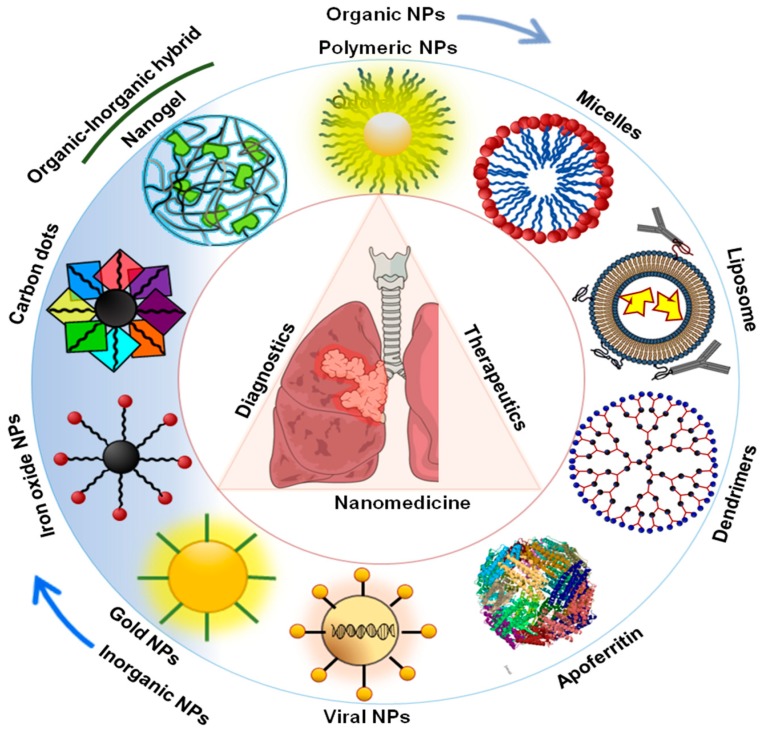
Lung cancer is one of the leading causes of cancer-related death worldwide. Non-small cell lung cancer (NSCLC) causes around 80% to 90% of deaths. The lack of an early diagnosis and inefficiency in conventional therapies causes poor prognosis and overall survival of lung cancer patients. Recent progress in nanomedicine has encouraged the development of an alternative theranostics strategy using nanotechnology. The interesting physico-chemical properties in the nanoscale have generated immense advantages for nanoparticulate systems for the early detection and active delivery of drugs for a better theranostics strategy for lung cancer. This present review provides a detailed overview of the recent progress in the theranostics application of nanoparticles including liposomes, polymeric, metal and bio-nanoparticles. Further, we summarize the advantages and disadvantages of each approach considering the improvement for the lung cancer theranostics.
肺癌是全球癌症相关死亡的主要原因之一。非小细胞肺癌(NSCLC)导致约80%至90%的死亡。早期诊断的缺乏以及传统疗法的低效导致肺癌患者预后不良和总体生存率较低。纳米医学的最新进展推动了使用纳米技术的替代诊疗策略的发展。纳米尺度有趣的物理化学性质为纳米颗粒系统在肺癌早期检测和药物主动递送方面带来了巨大优势,从而实现更好的诊疗策略。本综述详细概述了纳米颗粒(包括脂质体、聚合物、金属和生物纳米颗粒)在诊疗应用方面的最新进展。此外,我们在考虑肺癌诊疗改善的情况下总结了每种方法的优缺点。