Souza Carlos Dornels Freire de, Paiva João Paulo Silva de, Silva Leonardo Feitosa da, Leal Thiago Cavalcanti, Magalhães Mônica de Avelar Figueiredo Mafra
. Curso de Medicina, Universidade Federal de Alagoas, Campus Arapiraca, Arapiraca (AL) Brasil.
. Fundação Oswaldo Cruz - Fiocruz - Rio de Janeiro (RJ) Brasil.
J Bras Pneumol. 2019 Apr 25;45(2):e20180393. doi: 10.1590/1806-3713/e20180393.
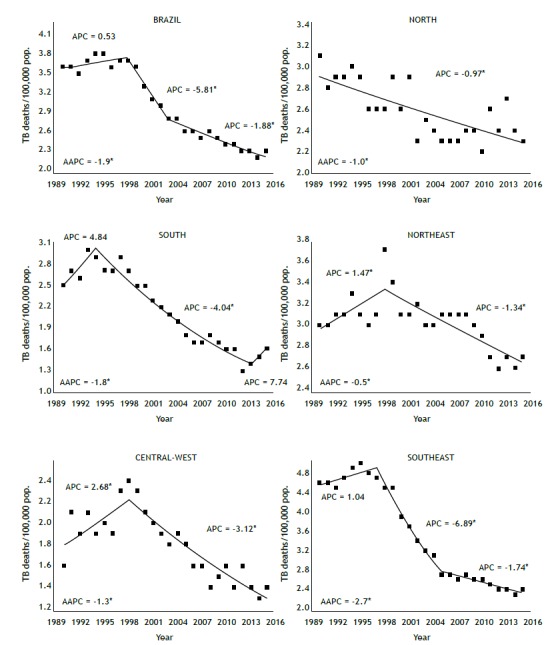
The objective of this study was to analyze trends in the tuberculosis mortality rate in Brazil (1990-2015) in an ecological time-series analysis. The indicators were obtained from the Brazilian National Ministry of Health. A joinpoint regression model was applied for the temporal analysis, with a level of significance of 5%. During the period in question, there was a trend toward a reduction in mortality in the country as a whole (p < 0.001) and in each of its five regions. The states with the highest tuberculosis mortality rates were Rio de Janeiro (7.0/100,000 population) and Pernambuco (5.0/100,000 population). Eleven states and the Federal District of Brasília showed downward trends. Only the state of Alagoas showed a significant increase (p < 0.001). The temporal behavior observed indicates that tuberculosis continues to be a major public health problem in Brazil.
本研究的目的是通过生态时间序列分析,分析巴西1990 - 2015年结核病死亡率的趋势。指标来自巴西国家卫生部。采用连接点回归模型进行时间分析,显著性水平为5%。在所述期间,全国以及其五个地区中的每一个地区的死亡率都呈下降趋势(p < 0.001)。结核病死亡率最高的州是里约热内卢(每10万人口中有7.0人)和伯南布哥州(每10万人口中有5.0人)。11个州和巴西利亚联邦区呈下降趋势。只有阿拉戈斯州显示出显著上升(p < 0.001)。观察到的时间行为表明,结核病在巴西仍然是一个主要的公共卫生问题。