Singh Anita, Bedore Stacy R, Sharma Nilesh K, Lee Sarah A, Eiteman Mark A, Neidle Ellen L
1Department of Environmental Sciences, Central University of Jammu, Rahya-Suchani, Bagla, India.
2School of Chemical, Materials and Biomedical Engineering, University of Georgia, Athens, GA 30602 USA.
Biotechnol Biofuels. 2019 Apr 23;12:91. doi: 10.1186/s13068-019-1434-7. eCollection 2019.
Lignocellulosic biomass is an attractive, inexpensive source of potentially fermentable sugars. However, hydrolysis of lignocellulose results in a complex mixture containing microbial inhibitors at variable composition. A single microbial species is unable to detoxify or even tolerate these non-sugar components while converting the sugar mixtures effectively to a product of interest. Often multiple substrates are metabolized sequentially because of microbial regulatory mechanisms. To overcome these problems, we engineered strains of ADP1 to comprise a consortium able to degrade benzoate and 4-hydroxybenzoate simultaneously under batch and continuous conditions in the presence of sugars. We furthermore used a thermotolerant yeast, , to convert the glucose remaining after detoxification to ethanol.
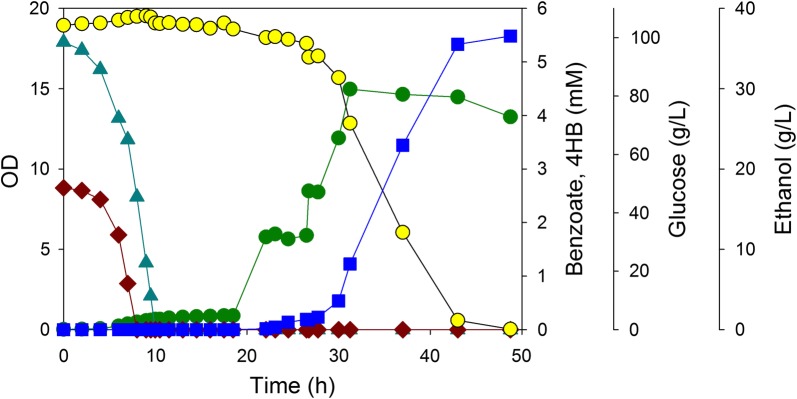
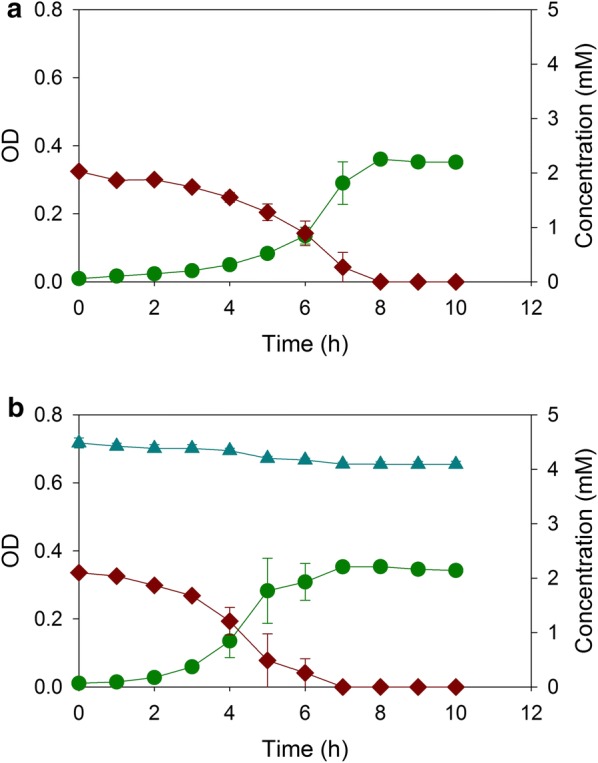
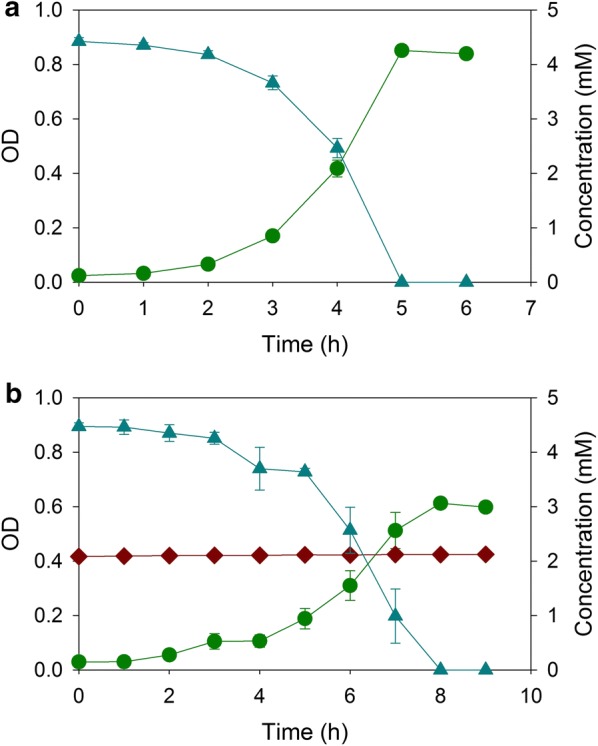
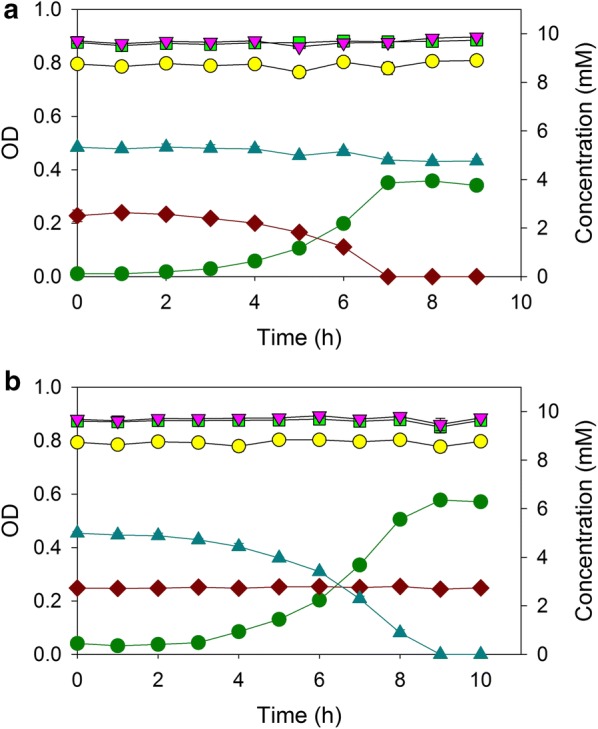
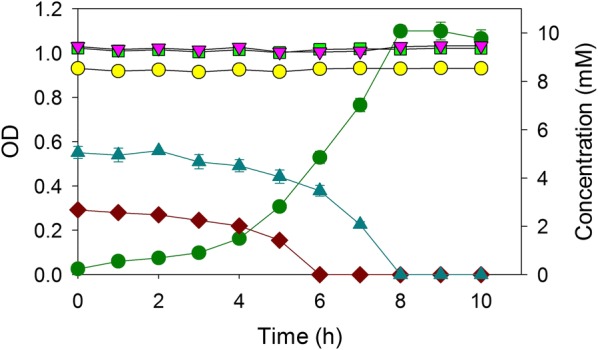
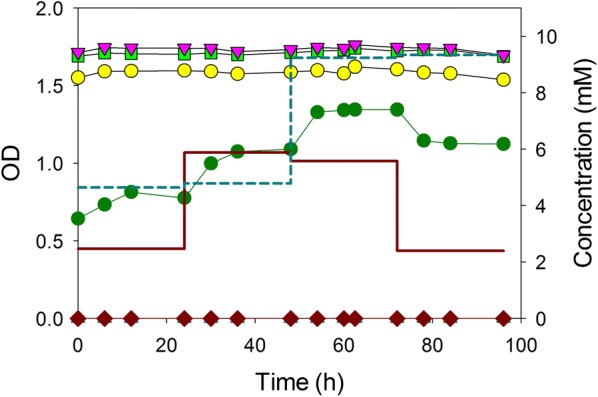
The two engineered strains, one unable to metabolize benzoate and another unable to metabolize 4-hydroxybenzoate, when grown together removed these two inhibitors simultaneously under batch conditions. Under continuous conditions, a single strain with a deletion in the gene metabolized both inhibitors in the presence of sugars. After this batch detoxification using ADP1-derived mutants, generated 36.6 g/L ethanol.
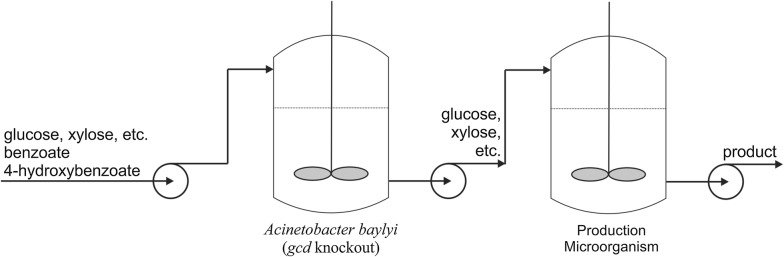
We demonstrated approaches for the simultaneous removal of two aromatic inhibitors from a simulated lignocellulosic hydrolysate. A two-stage batch process converted the residual sugar into a non-growth-associated product, ethanol. Such a two-stage process with bacteria ( and yeast () is advantageous, because the yeast fermentation occurs at a higher temperature which prevents growth and ethanol consumption of Conceptually, the process can be extended to other inhibitors or sugars found in real hydrolysates. That is, additional strains which degrade components of lignocellulosic hydrolysates could be made substrate-selective and targeted for use with specific complex mixtures found in a hydrolysate.
木质纤维素生物质是一种有吸引力的、廉价的潜在可发酵糖来源。然而,木质纤维素的水解会产生一种成分可变且含有微生物抑制剂的复杂混合物。单一微生物物种在将糖混合物有效转化为目标产物的同时,无法解毒甚至耐受这些非糖成分。由于微生物调控机制,多种底物通常会被依次代谢。为克服这些问题,我们对ADP1菌株进行工程改造,使其在糖存在的情况下,能在分批和连续条件下同时降解苯甲酸盐和4 - 羟基苯甲酸盐。此外,我们还使用了一种耐热酵母将解毒后剩余的葡萄糖转化为乙醇。
两种工程菌株,一种不能代谢苯甲酸盐,另一种不能代谢4 - 羟基苯甲酸盐,共同培养时在分批条件下能同时去除这两种抑制剂。在连续条件下,一个在 基因中存在缺失的单一菌株在糖存在的情况下能代谢这两种抑制剂。使用源自ADP1的突变体进行分批解毒后, 产生了36.6 g/L乙醇。
我们展示了从模拟木质纤维素水解物中同时去除两种芳香族抑制剂的方法。一个两阶段分批过程将残留糖转化为与生长无关的产物乙醇。这种由细菌( 和酵母()组成的两阶段过程具有优势,因为酵母发酵在较高温度下进行,可防止 的生长和乙醇消耗。从概念上讲,该过程可扩展到实际水解物中发现的其他抑制剂或糖。也就是说,可以使降解木质纤维素水解物成分的其他菌株具有底物选择性,并针对水解物中发现的特定复杂混合物使用。