Department of Industrial & Systems Engineering, University of Wisconsin-Madison, USA; Center for Quality and Productivity Improvement, University of Wisconsin-Madison, USA.
Center for Quality and Productivity Improvement, University of Wisconsin-Madison, USA.
Appl Ergon. 2019 Jul;78:240-247. doi: 10.1016/j.apergo.2019.03.009. Epub 2019 Apr 2.
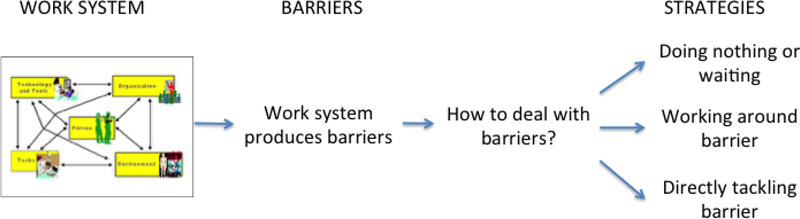
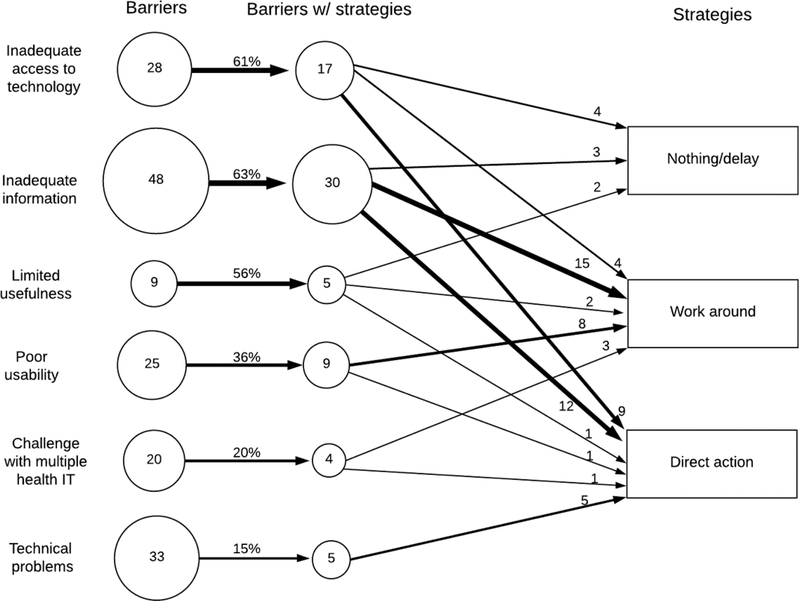
Care managers who coordinate care for chronically ill patients in hospitals and outpatient settings use multiple health information technologies for accessing, processing, documenting, and communicating patient-related information. Using a combination of 41 interviews and observations of 15 care managers, we identified a range of technology-related barriers experienced by care managers (total of 163 occurrences). The barriers are related to (lack of) access to information, inadequate information, limited usefulness and usability of the technologies, challenges associated with using multiple health IT, and technical problems. In 43% of the occurrences, care managers describe strategies to deal with the technology barriers; these fit in three categories: nothing/delay (9 occurrences), work-arounds (32 occurrences), and direct action at the individual, team, and organization levels (29 occurrences). Our data show the adaptive capacity of care managers who develop various strategies to deal with technology barriers and are, therefore, able to care for chronically ill patients. This information can be used as input to work system redesigns.
在医院和门诊环境中协调慢性病患者护理的护理经理使用多种健康信息技术来获取、处理、记录和传达与患者相关的信息。通过对 15 名护理经理进行 41 次访谈和观察,我们确定了护理经理在使用健康信息技术时遇到的一系列与技术相关的障碍(共计 163 次)。这些障碍与(缺乏)信息访问、信息不足、技术的有限有用性和可用性、使用多种健康信息技术相关的挑战以及技术问题有关。在 43%的情况下,护理经理描述了应对技术障碍的策略;这些策略分为三类:不采取行动/延迟(9 次)、规避(32 次)和在个人、团队和组织层面采取直接行动(29 次)。我们的数据表明,护理经理具有适应能力,他们制定了各种策略来应对技术障碍,因此能够照顾慢性病患者。这些信息可作为工作系统重新设计的输入。