Oral Microbiology Laboratory, Department of Pathology and Oral Medicine, Faculty of Dentistry, Universidad de Chile, Santiago, Chile.
Mediators Inflamm. 2019 Mar 27;2019:1029857. doi: 10.1155/2019/1029857. eCollection 2019.
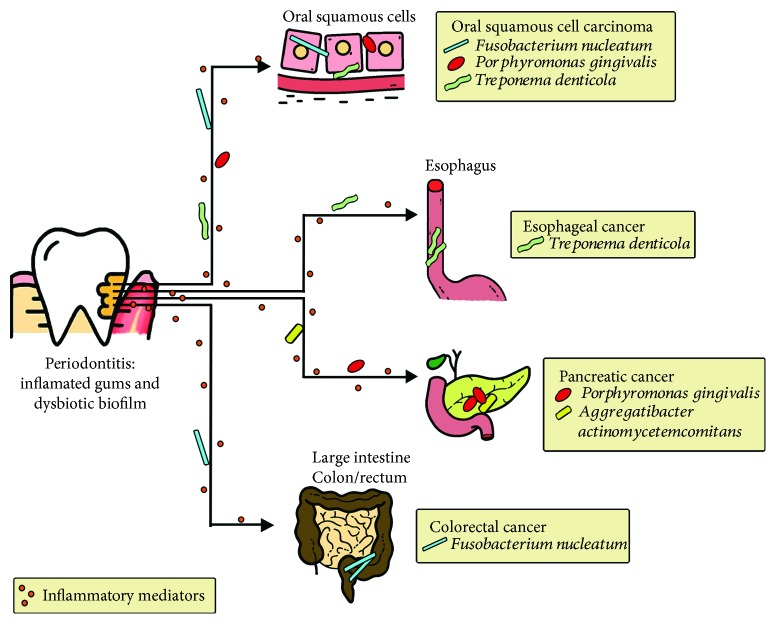
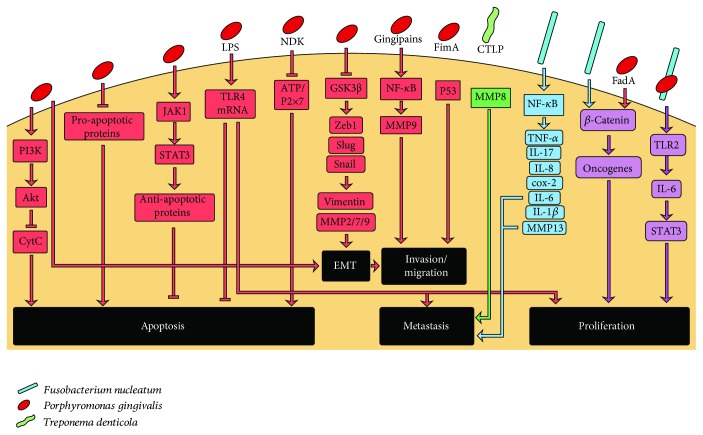
Periodontitis is characterized by a chronic inflammation produced in response to a disease-associated multispecies bacterial community in the subgingival region. Although the inflammatory processes occur locally in the oral cavity, several studies have determined that inflammatory mediators produced during periodontitis, as well as subgingival species and bacterial components, can disseminate from the oral cavity, contributing therefore, to various extraoral diseases like cancer. Interestingly, carcinogenesis associated with periodontal species has been observed in both the oral cavity and in extra oral sites. In this review, several studies were summarized showing a strong association between orodigestive cancers and poor oral health, presence of periodontitis-associated bacteria, tooth loss, and clinical signs of periodontitis. Proinflammatory pathways were also summarized. Such pathways are activated either by mono- or polymicrobial infections, resulting in an increase in the expression of proinflammatory molecules such as IL-6, IL-8, IL-1, and TNF-. In addition, it has been shown that several periodontitis-associated species induce the expression of genes related to cell proliferation, cell cycle, apoptosis, transport, and immune and inflammatory responses. Intriguingly, many of these pathways are linked to carcinogenesis. Among them, the activation of Toll-like receptors (TLRs) and antiapoptotic pathways (such as the PI3K/Akt, JAK/STAT, and MAPK pathways), the reduction of proapoptotic protein expression, the increase in cell migration and invasion, and the enhancement in metastasis are addressed. Considering that periodontitis is a polymicrobial disease, it is likely that mixed species promote carcinogenesis both in the oral cavity and in extra oral tissues and probably-as observed in periodontitis-synergistic and/or antagonistic interactions occur between microbes in the community. To date, a good amount of studies has allowed us to understand how monospecies infections activate pathways involved in tumorigenesis; however, more studies are needed to determine the combined effect of oral species in carcinogenesis.
牙周炎的特征是一种慢性炎症,是对龈下区域与疾病相关的多种细菌群落的反应。尽管炎症过程在口腔局部发生,但有几项研究已经确定,牙周炎期间产生的炎症介质以及龈下物种和细菌成分可以从口腔传播,从而导致各种口腔外疾病,如癌症。有趣的是,与牙周病相关的物种与口腔和口腔外部位的癌症发生有关。在这篇综述中,总结了几项研究,这些研究表明,口咽癌与口腔健康不良、牙周病相关细菌的存在、牙齿缺失以及牙周炎的临床体征之间存在很强的关联。还总结了促炎途径。这些途径要么由单微生物或多微生物感染激活,导致促炎分子如 IL-6、IL-8、IL-1 和 TNF-α的表达增加。此外,已经表明,几种牙周病相关物种诱导与细胞增殖、细胞周期、细胞凋亡、运输以及免疫和炎症反应相关的基因的表达。有趣的是,许多这些途径与癌症发生有关。其中,Toll 样受体 (TLR) 和抗细胞凋亡途径(如 PI3K/Akt、JAK/STAT 和 MAPK 途径)的激活、促凋亡蛋白表达的减少、细胞迁移和侵袭的增加以及转移的增强都得到了阐述。鉴于牙周炎是一种多微生物疾病,混合物种可能会在口腔和口腔外组织中促进癌症发生,并且可能在社区中的微生物之间发生协同和/或拮抗相互作用,就像在牙周炎中观察到的那样。迄今为止,大量的研究使我们能够了解单物种感染如何激活肿瘤发生相关途径;然而,需要更多的研究来确定口腔物种在癌症发生中的联合效应。