Center for Music in the Brain (MIB), Department of Clinical Medicine, Aarhus University & The Royal Academy of Music Aarhus/Aalborg (RAMA), Aarhus, Denmark.
BioMag Laboratory, HUS Medical Imaging Center, University of Helsinki and Helsinki University Hospital, Helsinki, Finland.
PLoS One. 2019 May 3;14(5):e0216499. doi: 10.1371/journal.pone.0216499. eCollection 2019.
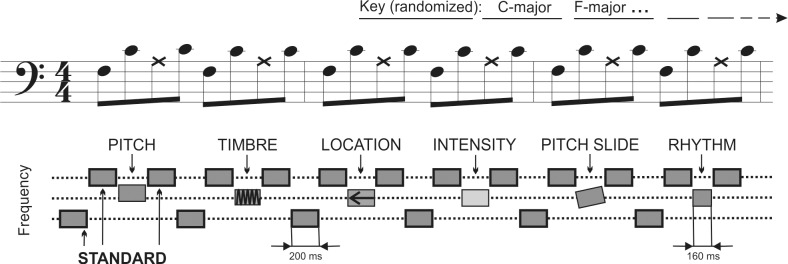
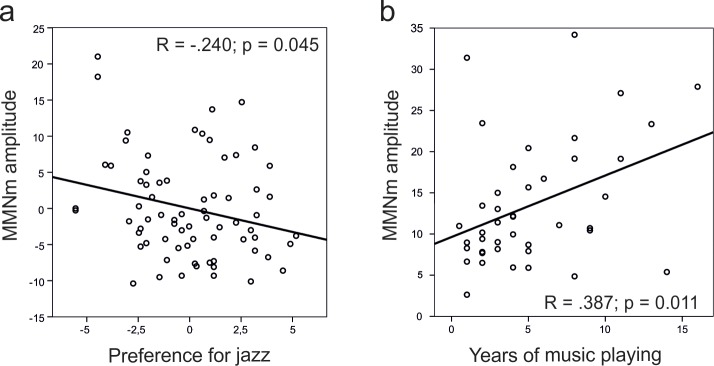
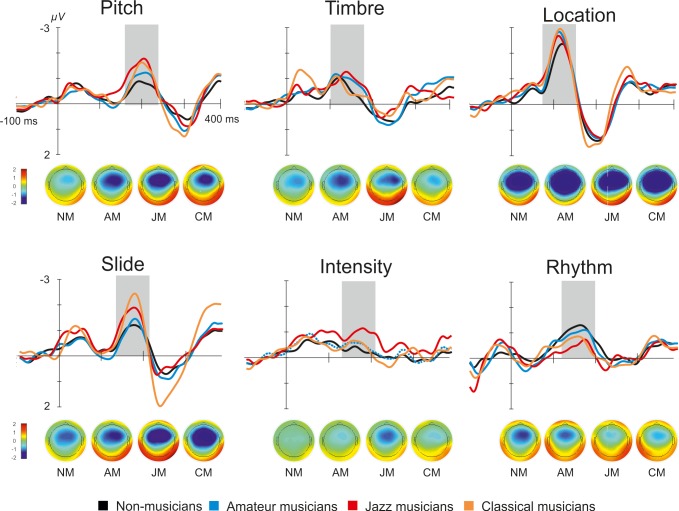
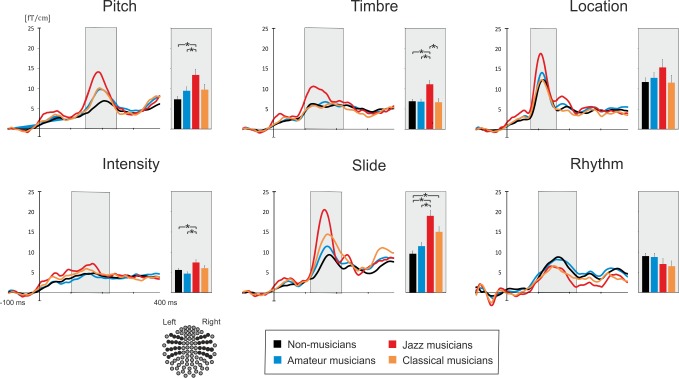
Learning, attention and action play a crucial role in determining how stimulus predictions are formed, stored, and updated. Years-long experience with the specific repertoires of sounds of one or more musical styles is what characterizes professional musicians. Here we contrasted active experience with sounds, namely long-lasting motor practice, theoretical study and engaged listening to the acoustic features characterizing a musical style of choice in professional musicians with mainly passive experience of sounds in laypersons. We hypothesized that long-term active experience of sounds would influence the neural predictions of the stylistic features in professional musicians in a distinct way from the mainly passive experience of sounds in laypersons. Participants with different musical backgrounds were recruited: professional jazz and classical musicians, amateur musicians and non-musicians. They were presented with a musical multi-feature paradigm eliciting mismatch negativity (MMN), a prediction error signal to changes in six sound features for only 12 minutes of electroencephalography (EEG) and magnetoencephalography (MEG) recordings. We observed a generally larger MMN amplitudes-indicative of stronger automatic neural signals to violated priors-in jazz musicians (but not in classical musicians) as compared to non-musicians and amateurs. The specific MMN enhancements were found for spectral features (timbre, pitch, slide) and sound intensity. In participants who were not musicians, the higher preference for jazz music was associated with reduced MMN to pitch slide (a feature common in jazz music style). Our results suggest that long-lasting, active experience of a musical style is associated with accurate neural priors for the sound features of the preferred style, in contrast to passive listening.
学习、注意力和行动在确定刺激预测如何形成、存储和更新方面起着至关重要的作用。多年来,专业音乐家一直在学习一种或多种音乐风格的特定曲目。在这里,我们将专业音乐家对声音的主动体验,即持久的运动练习、理论学习和积极倾听所选择音乐风格的声学特征,与非专业人士对声音的主要被动体验进行了对比。我们假设,长期的主动声音体验将以一种与非专业人士主要被动声音体验截然不同的方式影响专业音乐家对风格特征的神经预测。我们招募了具有不同音乐背景的参与者:职业爵士和古典音乐家、业余音乐家和非音乐家。他们接受了一种多特征音乐范式的刺激,该范式引发了失匹配负波(MMN),这是一种对六种声音特征变化的预测误差信号,仅在脑电图(EEG)和脑磁图(MEG)记录 12 分钟内。我们观察到,与非音乐家和业余音乐家相比,爵士乐音乐家(但不是古典音乐家)的 MMN 振幅普遍更大(表明违反先验的自动神经信号更强)。特定的 MMN 增强被发现用于频谱特征(音色、音高、滑音)和声音强度。在非音乐家参与者中,对爵士乐的较高偏好与 Pitch Slide(爵士乐风格中常见的特征)的 MMN 减少有关。我们的结果表明,与被动聆听相比,长期的、主动的音乐风格体验与对偏好风格的声音特征的准确神经先验有关。