Crop Development Centre/Department of Plant Science, University of Saskatchewan, 51 Campus Dr, Saskatoon, SK, S7N 5A8, Canada.
Department of Plant Science, University of Manitoba, 66 Dafoe Road, Winnipeg, MB, R3T 2N2, Canada.
BMC Plant Biol. 2019 May 3;19(1):179. doi: 10.1186/s12870-019-1782-2.
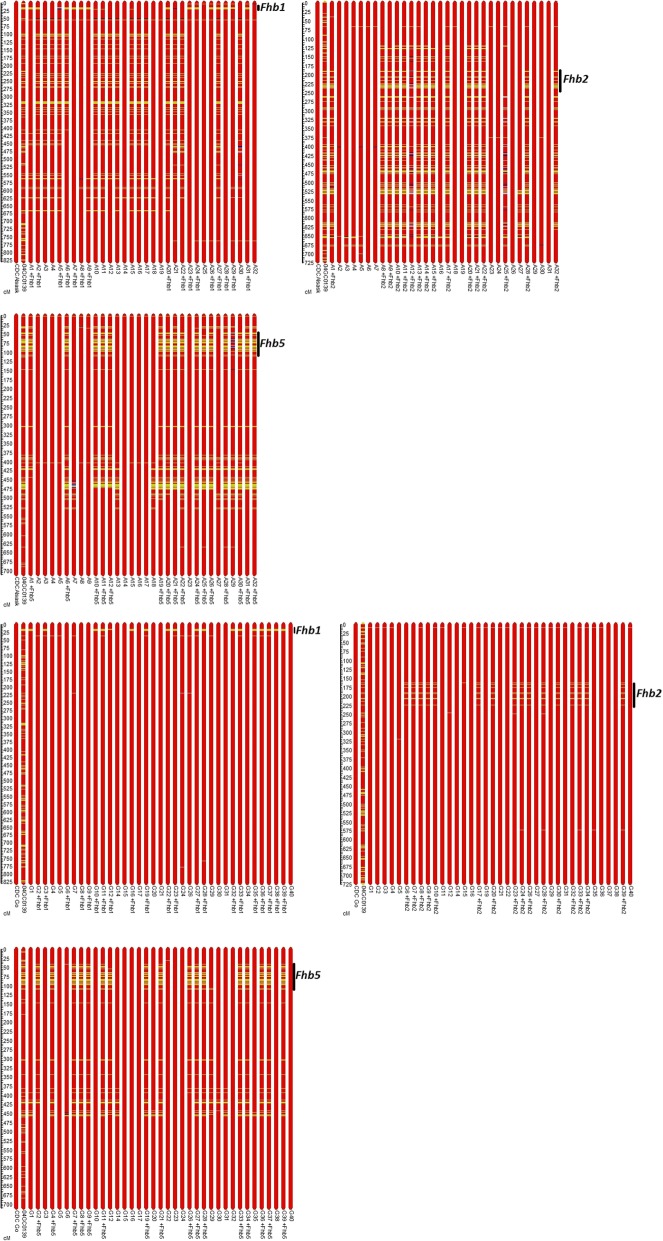
Fusarium head blight resistance genes, Fhb1 (for Type-II resistance), Fhb2 (Type-II), and Fhb5 (Type-I plus some Type-II), which originate from Sumai 3, are among the most important that confer resistance in hexaploid wheat. Near-isogenic lines (NILs), in the CDC Alsask (susceptible; n = 32) and CDC Go (moderately susceptible; n = 38) backgrounds, carrying these genes in all possible combinations were developed using flanking microsatellite markers and evaluated for their response to FHB and deoxynivalenol (DON) accumulation in eight environments. NILs were haplotyped with wheat 90 K iSelect assay to elucidate the genomic composition and confirm alleles' presence. Other than evaluating the effects of three major genes in common genetic background, the study elucidated the epistatic gene interactions as they influence FHB measurements; identified loci other than Fhb1, Fhb2, and Fhb5, in both recurrent and donor parents and examined annotated proteins in gene intervals.
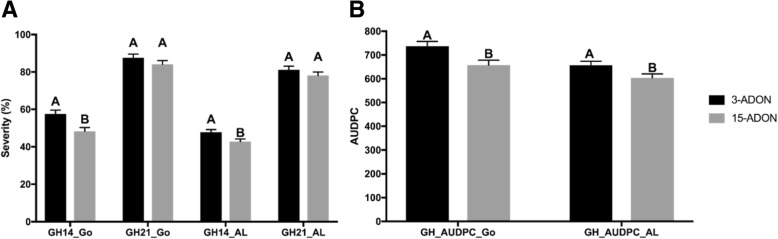
Genotyping using 81,857 single nucleotide polymorphism (SNP) markers revealed polymorphism on all chromosomes and that the NILs carried < 3% of alleles from the resistant donor. Significant improvement in field resistance (Type-I + Type-II) resulted only among the CDC Alsask NILs, not the CDC Go NILs. The phenotypic response of NILs carrying combinations of Sumai 3 derived genes suggested non-additive responses and Fhb5 was as good as Fhb1 in conferring field resistance in both populations. In addition to Fhb1, Fhb2, and Fhb5, four to five resistance improving alleles in both populations were identified and three of five in CDC Go were contributed by the susceptible parent. The introgressed chromosome regions carried genes encoding disease resistance proteins, protein kinases, nucleotide-binding and leucine rich repeats' domains. Complex epistatic gene-gene interactions among marker loci (including Fhb1, Fhb2, Fhb5) explained > 20% of the phenotypic variation in FHB measurements.
Immediate Sumai 3 derivatives carry a number of resistance improving minor effect alleles, other than Fhb1, Fhb2, Fhb5. Results verified that marker-assisted selection is possible for the introgression of exotic FHB resistance genes, however, the genetic background of the recipient line and epistatic interactions can have a strong influence on expression and penetrance of any given gene.
来自 Sumai 3 的 Fusarium 头腐病抗性基因 Fhb1(用于 II 型抗性)、Fhb2(II 型)和 Fhb5(I 型加一些 II 型)是六倍体小麦中最重要的抗性基因之一。使用侧翼微卫星标记在 CDC Alsask(易感;n=32)和 CDC Go(中度易感;n=38)背景下开发了近等基因系(NIL),这些基因以所有可能的组合携带,并在八个环境中评估了它们对 FHB 和脱氧雪腐镰刀菌烯醇(DON)积累的反应。使用小麦 90K iSelect 测定法对 NIL 进行单体型分析,以阐明基因组组成并确认等位基因的存在。除了评估三个主要基因在共同遗传背景下的影响外,该研究还阐明了影响 FHB 测量的上位基因相互作用;在轮回和供体亲本中鉴定了除 Fhb1、Fhb2 和 Fhb5 之外的其他基因座,并检查了基因区间中注释的蛋白质。
使用 81,857 个单核苷酸多态性(SNP)标记进行基因分型显示所有染色体都存在多态性,并且 NIL 携带的抗性供体等位基因<3%。仅在 CDC Alsask NIL 中观察到田间抗性(I 型+II 型)的显著改善,而在 CDC Go NIL 中则没有。携带 Sumai 3 衍生基因组合的 NIL 的表型反应表明存在非加性反应,并且 Fhb5 在两个群体中与 Fhb1 一样能够赋予田间抗性。除了 Fhb1、Fhb2 和 Fhb5 之外,在两个群体中还鉴定出了四到五个改善抗性的等位基因,在 CDC Go 中,有三个等位基因来自易感亲本。导入的染色体区域携带编码疾病抗性蛋白、蛋白激酶、核苷酸结合和富含亮氨酸重复区的基因。标记位点(包括 Fhb1、Fhb2、Fhb5)之间复杂的上位基因-基因相互作用解释了 FHB 测量表型变异的>20%。
直接来自 Sumai 3 的衍生品种携带了许多除 Fhb1、Fhb2 和 Fhb5 之外的改善抗性的微小效应等位基因。结果证实,标记辅助选择可用于导入外来 FHB 抗性基因,然而,受体系的遗传背景和上位基因相互作用会对任何给定基因的表达和表现产生强烈影响。