Infectious Hazard Management Unit, Department of Health Emergencies, World Health Organization Regional Office for the Eastern Mediterranean, Cairo, Egypt.
Centre for Global Health, Institut Pasteur, Paris, France; Department of Infectious Hazard Management, WHO Health Emergencies Programme, World Health Organization, Geneva, Switzerland.
J Infect Public Health. 2020 Mar;13(3):418-422. doi: 10.1016/j.jiph.2019.04.011. Epub 2019 May 2.
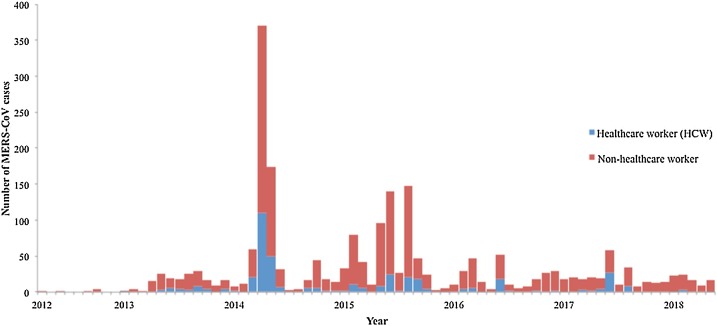
Approximately half of the reported laboratory-confirmed infections of Middle East respiratory syndrome coronavirus (MERS-CoV) have occurred in healthcare settings, and healthcare workers constitute over one third of all secondary infections. This study aimed to describe secondary cases of MERS-CoV infection among healthcare workers and to identify risk factors for death.
A retrospective analysis was conducted on epidemiological data of laboratory-confirmed MERS-CoV cases reported to the World Health Organization from September 2012 to 2 June 2018. We compared all secondary cases among healthcare workers with secondary cases among non-healthcare workers. Multivariable logistic regression identified risk factors for death.
Of the 2223 laboratory-confirmed MERS-CoV cases reported to WHO, 415 were healthcare workers and 1783 were non-healthcare workers. Compared with non-healthcare workers cases, healthcare workers cases were younger (P < 0.001), more likely to be female (P < 0.001), non-nationals (P < 0.001) and asymptomatic (P < 0.001), and have fewer comorbidities (P < 0.001) and higher rates of survival (P < 0.001). Year of infection (2013-2018) and having no comorbidities were independent protective factors against death among secondary healthcare workers cases.
Being able to protect healthcare workers from high threat respiratory pathogens, such as MERS-CoV is important for being able to reduce secondary transmission of MERS-CoV in healthcare-associated outbreaks. By extension, reducing infection in healthcare workers improves continuity of care for all patients within healthcare facilities.
据报道,中东呼吸综合征冠状病毒(MERS-CoV)的实验室确诊感染病例中约有一半发生在医疗机构中,医护人员占所有二次感染的三分之一以上。本研究旨在描述医护人员中东呼吸综合征冠状病毒感染的二次感染病例,并确定死亡的危险因素。
对 2012 年 9 月至 2018 年 6 月 2 日向世界卫生组织报告的中东呼吸综合征冠状病毒实验室确诊病例的流行病学数据进行回顾性分析。我们比较了医护人员中的所有二次感染病例与非医护人员中的二次感染病例。多变量逻辑回归确定了死亡的危险因素。
在向世界卫生组织报告的 2223 例实验室确诊的中东呼吸综合征冠状病毒病例中,有 415 例是医护人员,1783 例是非医护人员。与非医护人员病例相比,医护人员病例更年轻(P<0.001),更有可能是女性(P<0.001)、非本国公民(P<0.001)和无症状(P<0.001),合并症较少(P<0.001),存活率较高(P<0.001)。感染年份(2013-2018 年)和无合并症是二次医护人员病例死亡的独立保护因素。
保护医护人员免受高威胁呼吸道病原体(如中东呼吸综合征冠状病毒)的侵害对于减少医疗机构相关暴发中中东呼吸综合征冠状病毒的二次传播非常重要。通过减少医护人员的感染,可以提高医疗机构内所有患者的护理连续性。