School of Public Health, College of Pharmacy and Nutrition, University of Saskatchewan, Saskatoon, SK S7N 4Z2, Canada.
Bell Institute of Health and Nutrition, General Mills, Minneapolis, MN 55427-3870, USA.
Nutrients. 2019 May 3;11(5):1009. doi: 10.3390/nu11051009.
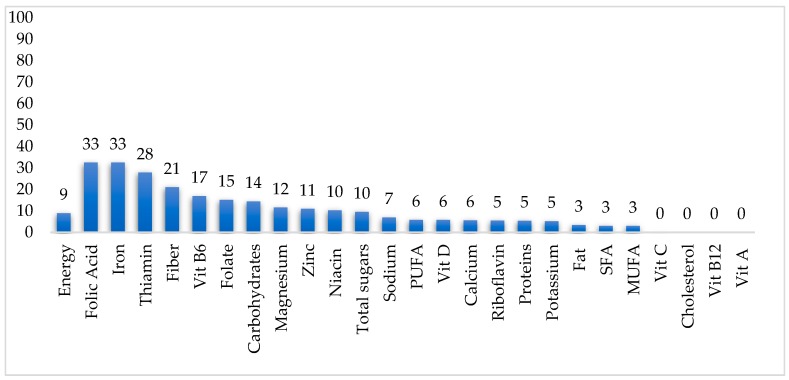
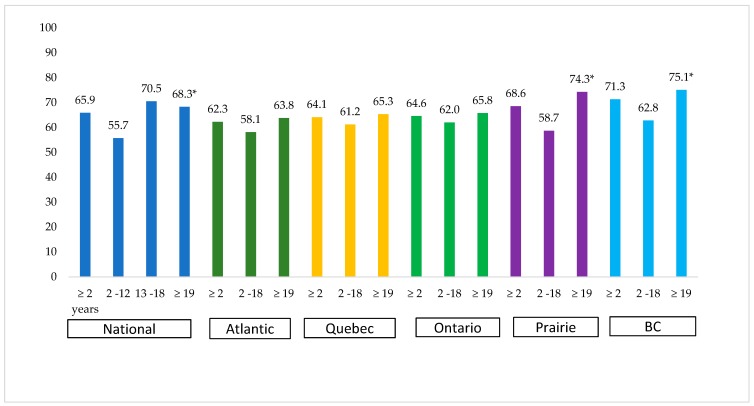
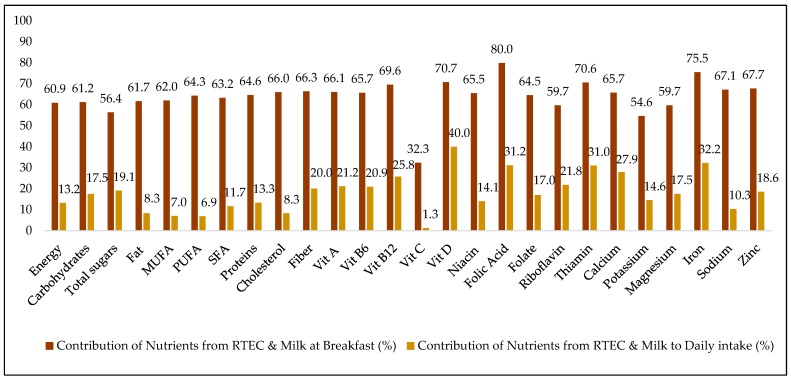
In recent years, ready-to-eat cereal (RTEC) has become a common breakfast option in Canada and worldwide. This study used the nationally representative cross-sectional data from the Canadian Community Health Survey (CCHS) 2015-Nutrition to determine patterns of RTEC consumption in Canada and the contribution to nutrient intake among Canadians who were ≥2 years, of whom 22 ± 0.6% consumed RTEC on any given day. The prevalence of RTEC consumption was highest in children aged two to 12 years (37.6 ± 1.2%), followed by adolescents aged 13 to 18 years (28.8 ± 1.4%), and then by adults ≥19 years (18.9 ± 0.6%). RTEC consumers had higher intakes of "nutrients to encourage" compared to the RTEC non-consumers. More than 15% of the daily intake of some nutrients, such as folic acid, iron, thiamin, and vitamin B, were contributed by RTEC. It was noted that nearly 66% of milk consumption was co-consumed with RTEC among RTEC consumers. The nutrient density of the diet, as defined by Nutrient-Rich Food Index (NRF 9.3), was significantly higher among RTEC consumers compared to non-consumers. RTEC consumption was not associated with overweight/obesity. RTEC consumption considerably contributed to the intake of some key nutrients among all age groups in Canada.
近年来,即食谷物(RTEC)已成为加拿大和全球常见的早餐选择。本研究使用了来自加拿大社区健康调查(CCHS)2015-营养的全国代表性横断面数据,以确定加拿大 RTEC 的消费模式以及其对≥2 岁的加拿大居民营养摄入的贡献,其中 22±0.6%的人在任何一天食用 RTEC。食用 RTEC 的比例在 2 至 12 岁的儿童中最高(37.6±1.2%),其次是 13 至 18 岁的青少年(28.8±1.4%),然后是≥19 岁的成年人(18.9±0.6%)。与 RTEC 非消费者相比,RTEC 消费者摄入的“鼓励摄入的营养素”更多。超过 15%的某些营养素的日常摄入量,如叶酸、铁、硫胺素和维生素 B,是由 RTEC 贡献的。值得注意的是,在 RTEC 消费者中,近 66%的牛奶消费与 RTEC 同时进行。与非消费者相比,RTEC 消费者的饮食营养密度(由富含营养的食物指数 NRF 9.3 定义)显著更高。RTEC 的消费与超重/肥胖无关。RTEC 的消费对加拿大所有年龄段人群的某些关键营养素的摄入量都有很大贡献。