Barr Susan I, DiFrancesco Loretta, Fulgoni Victor L
Department of Food,Nutrition and Health, University of British Columbia,2205 East Mall,Vancouver,BC,CanadaV6T 1Z4.
Source! Nutrition,Toronto,ON,Canada.
Br J Nutr. 2014 Oct 28;112(8):1373-83. doi: 10.1017/S0007114514002190. Epub 2014 Sep 8.
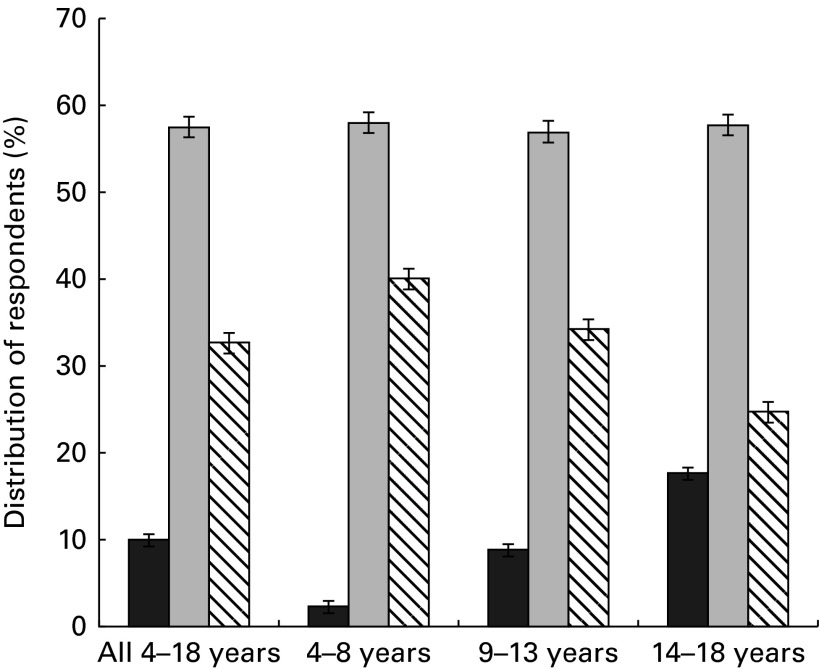
Although breakfast is associated with more favourable nutrient intake profiles in children, limited data exist on the impact of breakfast on nutrient adequacy and the potential risk of excessive intakes. Accordingly, we assessed differences in nutrient intake and adequacy among breakfast non-consumers, consumers of breakfasts with ready-to-eat cereal (RTEC) and consumers of other types of breakfasts. We used cross-sectional data from 12,281 children and adolescents aged 4-18 years who took part in the nationally representative Canadian Community Health Survey, 2004. Mean nutrient intakes (obtained using a multiple-pass 24 h recall method) were compared among the breakfast groups using covariate-adjusted regression analysis. Usual nutrient intake distributions, generated using the National Cancer Institute method, were used to determine the prevalence of nutrient inadequacy or the potential risk of excessive intakes from food sources alone and from the combination of food plus supplements. Of these Canadian children, 10% were breakfast non-consumers, 33% were consumers of RTEC breakfasts and 57% were consumers of other types of breakfasts. Non-consumption of breakfast increased with age (4-8 years: 2%; 9-13 years: 9%; 14-18 years: 18%). Breakfast consumers had higher covariate-adjusted intakes of energy, many nutrients and fibre, and lower fat intakes. The prevalence of nutrient inadequacy for vitamin D, Ca, Fe and Mg (from food alone or from the combination of food plus supplements) was highest in breakfast non-consumers, intermediate in consumers of other types of breakfasts and lowest in consumers of RTEC breakfast. For vitamin A, P and Zn, breakfast non-consumers had a higher prevalence of nutrient inadequacy than both breakfast groups. The potential risk of excessive nutrient intakes was low in all groups. Efforts to encourage and maintain breakfast consumption in children and adolescents are warranted.
尽管早餐与儿童更有利的营养摄入状况相关,但关于早餐对营养充足性的影响以及过量摄入的潜在风险的数据有限。因此,我们评估了不吃早餐者、食用即食谷物(RTEC)早餐者和其他类型早餐食用者在营养摄入和充足性方面的差异。我们使用了来自参加2004年具有全国代表性的加拿大社区健康调查的12281名4至18岁儿童和青少年的横断面数据。使用协变量调整回归分析比较了早餐组之间的平均营养摄入量(采用多次24小时回顾法获得)。使用美国国立癌症研究所的方法生成的通常营养摄入分布,用于确定仅从食物来源以及食物加补充剂组合中营养不足的患病率或过量摄入的潜在风险。在这些加拿大儿童中,10%不吃早餐,33%是RTEC早餐食用者,57%是其他类型早餐食用者。不吃早餐的比例随年龄增加(4至8岁:2%;9至13岁:9%;14至18岁:18%)。早餐食用者经协变量调整后的能量、多种营养素和纤维摄入量较高,脂肪摄入量较低。不吃早餐者中维生素D、钙、铁和镁(仅从食物或食物加补充剂组合中)营养不足的患病率最高,其他类型早餐食用者次之,RTEC早餐食用者最低。对于维生素A、磷和锌,不吃早餐者营养不足的患病率高于两个早餐组。所有组中营养过量摄入的潜在风险都较低。有必要努力鼓励和维持儿童和青少年的早餐消费。