1Department of Psychology, University of Nevada, Reno, NV 89557, USA.
2Ernest J. Del Monte Institute for Neuroscience, Department of Neuroscience, University of Rochester School of Medicine and Dentistry, Rochester, NY 14642, USA.
Multisens Res. 2019 Dec 11;32(8):671-692. doi: 10.1163/22134808-20191343.
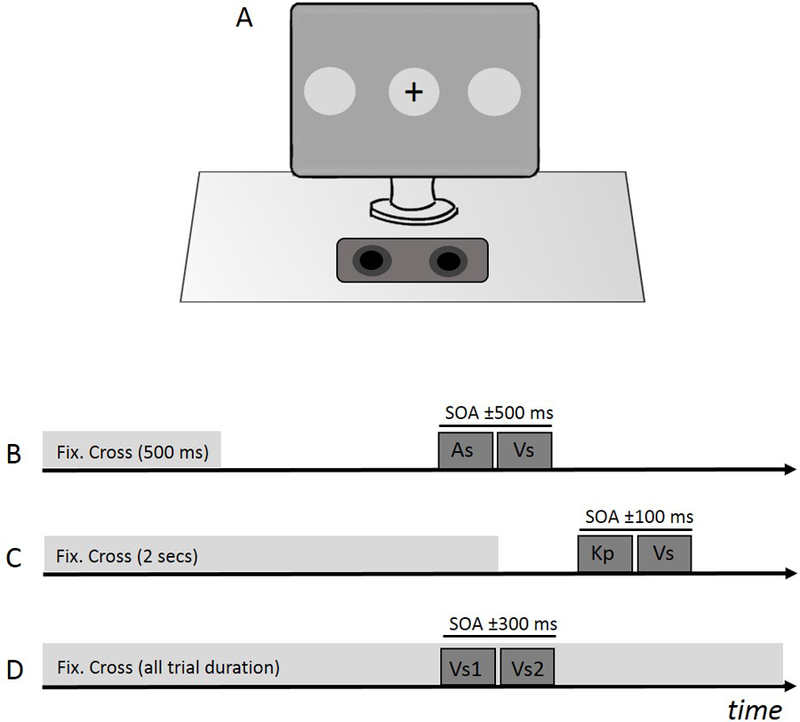
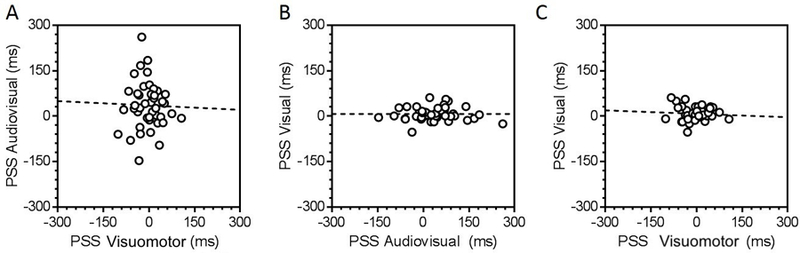
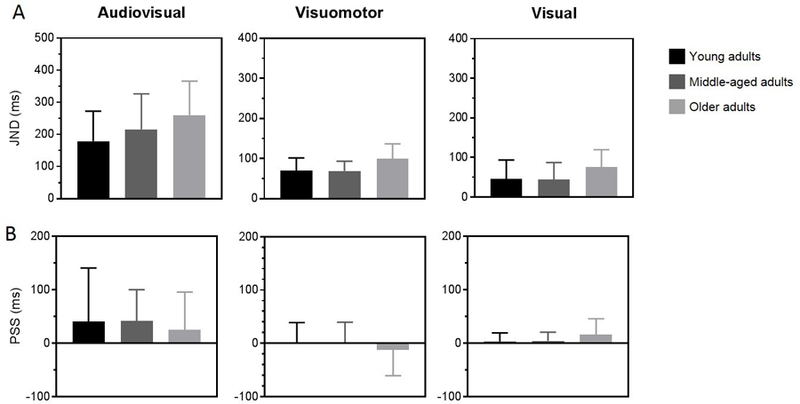
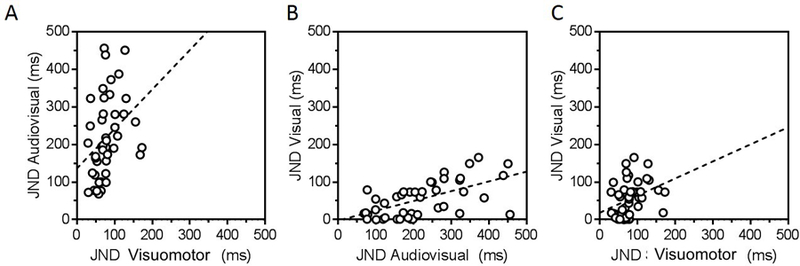
Encoding the temporal properties of external signals that comprise multimodal events is a major factor guiding everyday experience. However, during the natural aging process, impairments to sensory processing can profoundly affect multimodal temporal perception. Various mechanisms can contribute to temporal perception, and thus it is imperative to understand how each can be affected by age. In the current study, using three different temporal order judgement tasks (unisensory, multisensory, and sensorimotor), we investigated the effects of age on two separate temporal processes: synchronization and integration of multiple signals. These two processes rely on different aspects of temporal information, either the temporal alignment of processed signals or the integration/segregation of signals arising from different modalities, respectively. Results showed that the ability to integrate/segregate multiple signals decreased with age regardless of the task, and that the magnitude of such impairment correlated across tasks, suggesting a widespread mechanism affected by age. In contrast, perceptual synchrony remained stable with age, revealing a distinct intact mechanism. Overall, results from this study suggest that aging has differential effects on temporal processing, and general impairments with aging may impact global temporal sensitivity while context-dependent processes remain unaffected.
对构成多模态事件的外部信号的时间特性进行编码是指导日常体验的主要因素。然而,在自然衰老过程中,感觉处理的损伤会深刻地影响多模态时间感知。各种机制都可以对时间感知产生影响,因此了解每种机制如何受到年龄的影响是至关重要的。在当前的研究中,我们使用三种不同的时间顺序判断任务(单感觉、多感觉和感觉运动),研究了年龄对两个独立的时间过程的影响:多个信号的同步和整合。这两个过程依赖于时间信息的不同方面,分别是处理信号的时间对准或来自不同模态的信号的整合/分离。结果表明,无论任务如何,整合/分离多个信号的能力都会随着年龄的增长而下降,而且这种损伤的程度在任务之间存在相关性,这表明存在一个受年龄影响的广泛机制。相比之下,感知同步随年龄保持稳定,揭示了一个明显完整的机制。总的来说,这项研究的结果表明,衰老对时间处理有不同的影响,而与年龄相关的普遍损伤可能会影响全局时间敏感性,而上下文相关的过程则不受影响。