Mummert Anna, Otunuga Olusegun M
Department of Mathematics, Marshall University, One John Marshall Drive, Huntington, WV, USA.
J Math Biol. 2019 Jul;79(2):705-729. doi: 10.1007/s00285-019-01374-z. Epub 2019 May 6.
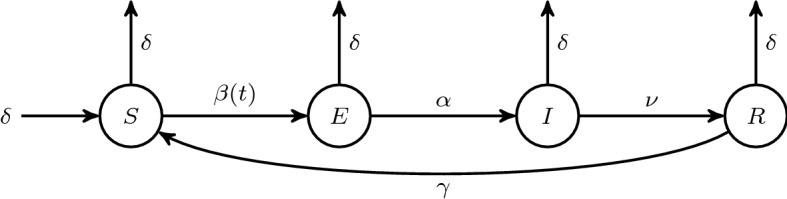
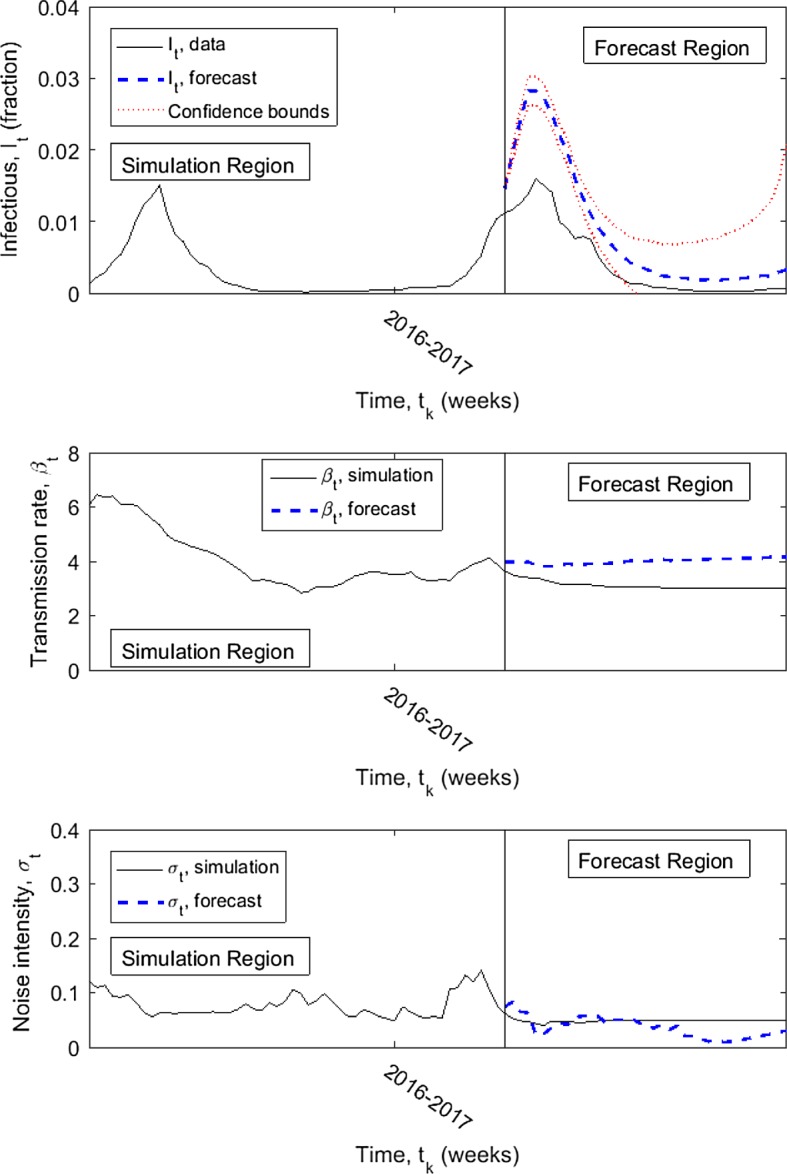
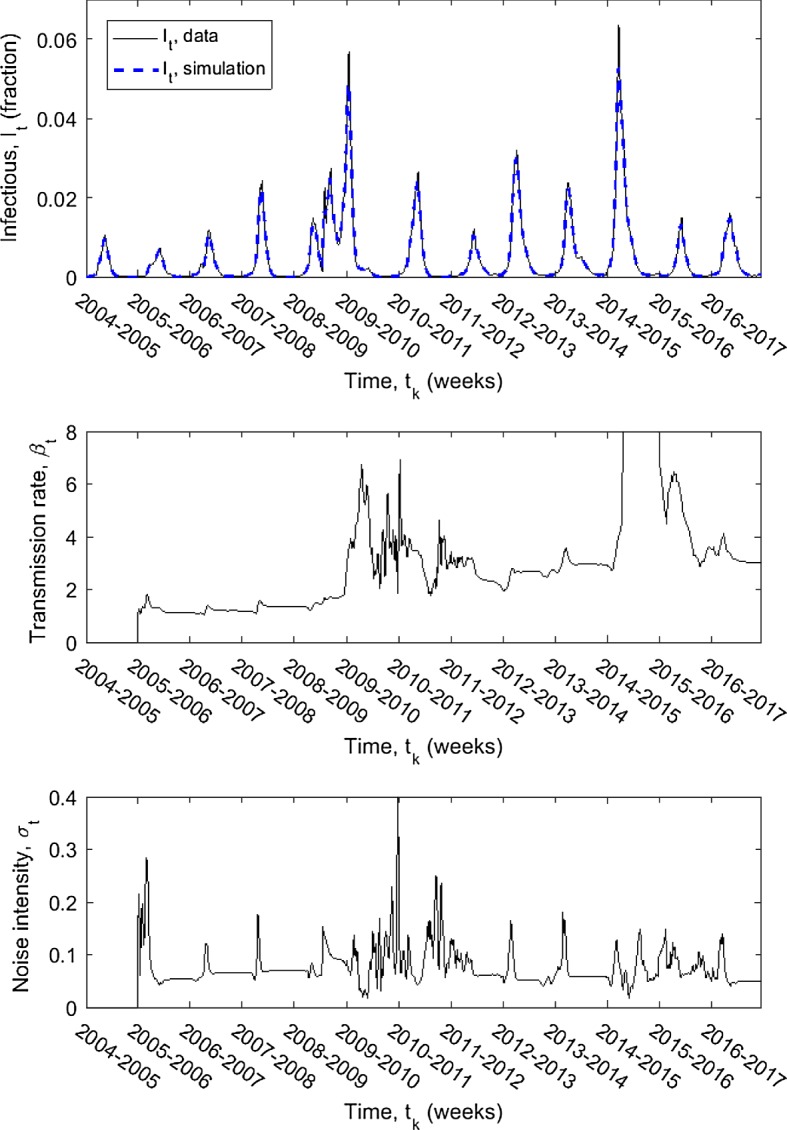
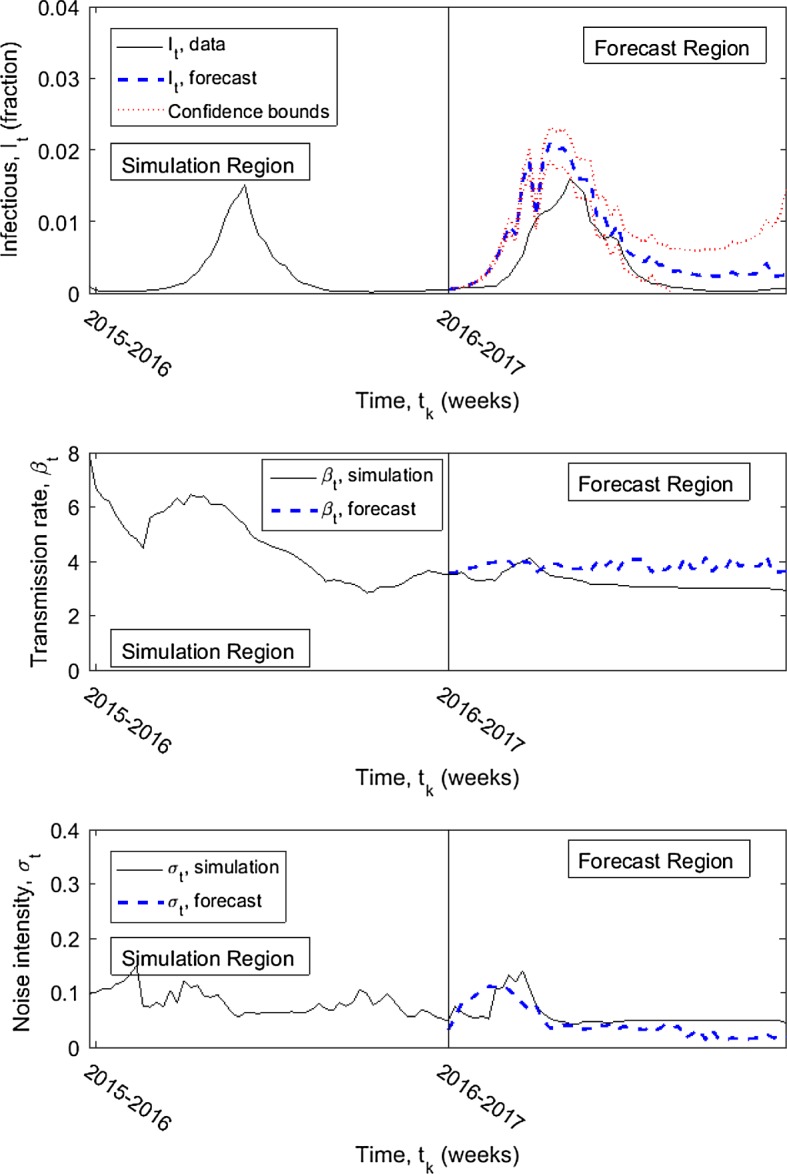
A recent parameter identification technique, the local lagged adapted generalized method of moments, is used to identify the time-dependent disease transmission rate and time-dependent noise for the stochastic susceptible, exposed, infectious, temporarily immune, susceptible disease model (SEIRS) with vital rates. The stochasticity appears in the model due to fluctuations in the time-dependent transmission rate of the disease. All other parameter values are assumed to be fixed, known constants. The method is demonstrated with US influenza data from the 2004-2005 through 2016-2017 influenza seasons. The transmission rate and noise intensity stochastically work together to generate the yearly peaks in infections. The local lagged adapted generalized method of moments is tested for forecasting ability. Forecasts are made for the 2016-2017 influenza season and for infection data in year 2017. The forecast method qualitatively matches a single influenza season. Confidence intervals are given for possible future infectious levels.
一种最新的参数识别技术,即局部滞后自适应广义矩量法,被用于识别具有生命率的随机易感、潜伏、感染、暂时免疫、易感疾病模型(SEIRS)的时间依赖性疾病传播率和时间依赖性噪声。由于疾病时间依赖性传播率的波动,模型中出现了随机性。假定所有其他参数值为固定的已知常数。该方法通过2004 - 2005年至2016 - 2017年流感季节的美国流感数据进行了验证。传播率和噪声强度共同随机作用,产生了每年的感染高峰。对局部滞后自适应广义矩量法的预测能力进行了测试。对2016 - 2017年流感季节以及2017年的感染数据进行了预测。该预测方法在定性上与单个流感季节相匹配。给出了未来可能感染水平的置信区间。