Human Sciences Research Centre, University of Derby, Kedleston Road, Derby, DE22 1GB, UK.
Centre for Applied Biological and Exercise Sciences, Coventry University, Priory Street, Coventry, CV1 5FB, UK.
Eur J Pediatr. 2019 Jul;178(7):1043-1052. doi: 10.1007/s00431-019-03390-z. Epub 2019 May 7.
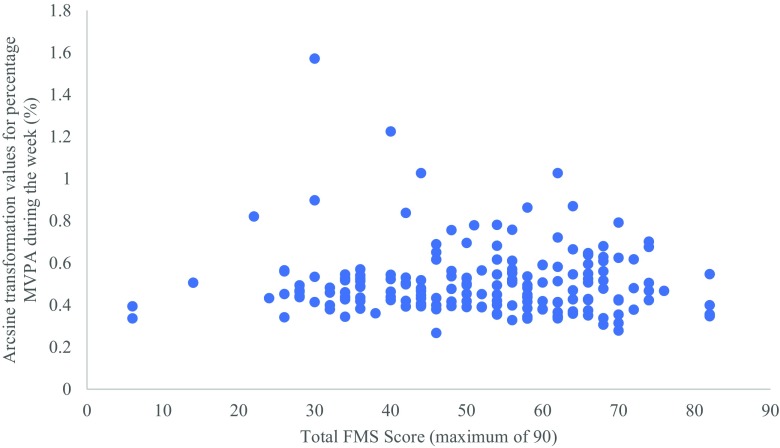
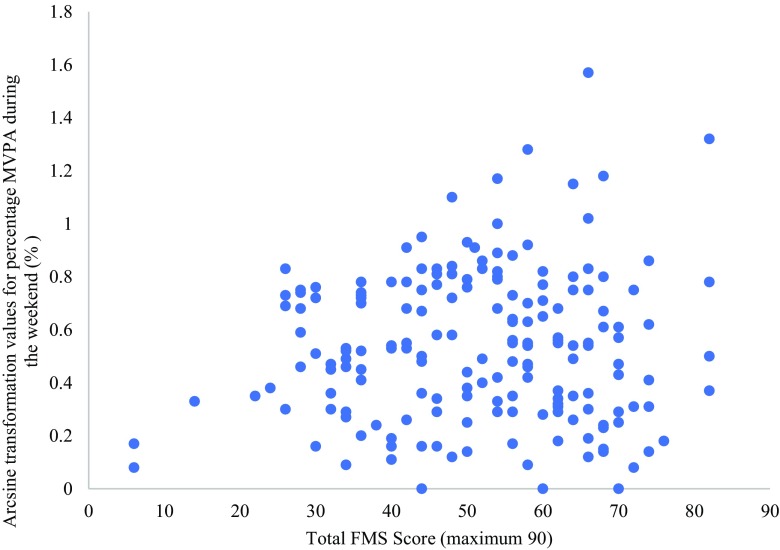
Preschool children are recommended to participate in a minimum of 180-min physical activity (PA) per day to enhance their development and overall health. Low PA and increased obesity are thought to be linked to low mastery of fundamental movement skills (FMS) in preschool children. This study sought to investigate whether FMS influences PA levels and weight status in preschool children, in an area of low socioeconomic status. Secondary aims of this study were to determine whether gender or day of the week affected the primary outcomes. One hundred eighty-five preschool children aged 3-4 years old, participated in the study. FMS proficiency was determined using the Test of Gross Motor Development-2. PA was determined using triaxial accelerometry over a 4-day period. None of the samples met the recommended 180 min of PA. There were no significant differences in PA or weight status between preschool children with high, medium or low FMS mastery (P < 0.05). There were also no significant correlations between overall FMS and moderate to vigorous PA during the week or weekend days.Conclusion: Girls scored significantly greater at the hop, leap, and skip (locomotor skills) and the boys significantly higher at the kick (object control) (P < 0.05). There were no significant differences in PA or weight status between preschool children with high, medium, or low FMS mastery, possibly because FMS mastery had not developed to a high enough level to affect PA and FMS are considered independent of physical fitness and physical features, such as weight and height. What is Known: •FMS are commonly developed in early childhood, providing the building blocks for future motor skills, good health and lifelong PA. •No study to date has measured FMS, PA levels and weight status in preschool children, to determine whether FMS competency influences PA levels and weight status in preschool children, in an area of low SES. What is New: •FMS competency did not appear to influence the level of PA or weight status in this sample of UK preschool children from a low SES area. •PA and FMS may not be fully established and consequently not strongly linked at the ages of 3-4 years, therefore, the preschool years could be influential in providing a window to maximise input of good/optimal development of motor competence before the proficiency barrier sets in and we need remedial intervention.
建议学龄前儿童每天至少进行 180 分钟的身体活动(PA),以促进他们的发展和整体健康。低水平的 PA 和肥胖的增加被认为与学龄前儿童基本运动技能(FMS)掌握程度低有关。这项研究旨在调查在社会经济地位较低的地区,FMS 是否会影响学龄前儿童的 PA 水平和体重状况。本研究的次要目的是确定性别或一周中的哪一天是否会影响主要结果。185 名 3-4 岁的学龄前儿童参加了这项研究。使用《粗大运动发育测试-2》确定 FMS 的熟练程度。使用三轴加速度计在 4 天内确定 PA。没有一个样本达到推荐的 180 分钟 PA。在 FMS 掌握程度较高、中等或较低的学龄前儿童中,PA 或体重状况没有显著差异(P<0.05)。在一周或周末的日常活动中,整体 FMS 与中等到剧烈 PA 之间也没有显著相关性。
女孩在单脚跳、跳跃和跳绳(移动技能)方面得分显著更高,而男孩在踢球(物体控制)方面得分显著更高(P<0.05)。在 FMS 掌握程度较高、中等或较低的学龄前儿童中,PA 或体重状况没有显著差异,这可能是因为 FMS 掌握程度还没有高到足以影响 PA 的程度,并且 FMS 被认为独立于身体状况和身体特征,如体重和身高。
FMS 在儿童早期普遍发展,为未来的运动技能、良好的健康和终身 PA 提供基础。
迄今为止,没有研究在 SES 较低的地区测量过学龄前儿童的 FMS、PA 水平和体重状况,以确定 FMS 能力是否会影响学龄前儿童的 PA 水平和体重状况。
在 SES 较低的英国学龄前儿童样本中,FMS 能力似乎不会影响 PA 水平或体重状况。
在 3-4 岁时,PA 和 FMS 可能尚未完全建立,因此没有很强的联系,因此,在熟练程度障碍出现之前,学龄前时期可能会有很大的影响,可以提供一个窗口,最大限度地投入良好/最佳的运动能力发展,而不是需要补救干预。