Venugopal Menon Nishanth, Tay Hui Min, Pang Kuin Tian, Dalan Rinkoo, Wong Siew Cheng, Wang Xiaomeng, Li King Ho Holden, Hou Han Wei
School of Mechanical and Aerospace Engineering, Nanyang Technological University, Singapore 639798.
Lee Kong Chian School of Medicine, Nanyang Technological University, Singapore 308232.
APL Bioeng. 2018 Jan 2;2(1):016103. doi: 10.1063/1.4993762. eCollection 2018 Mar.
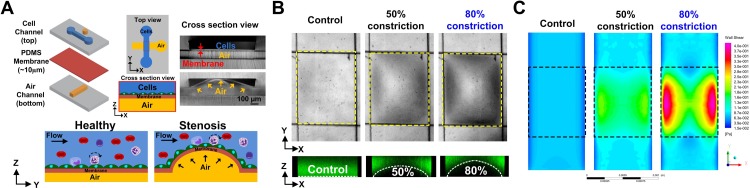
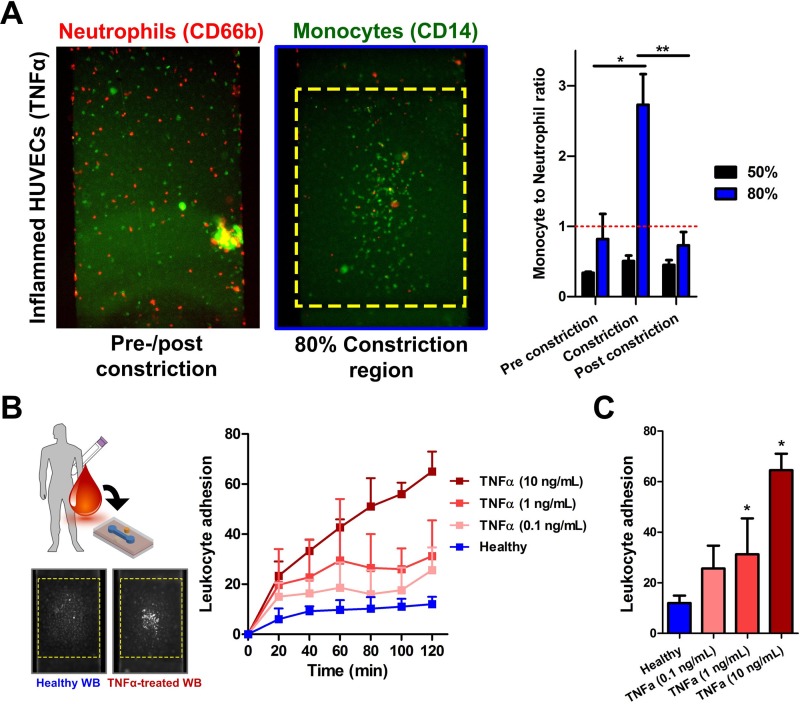
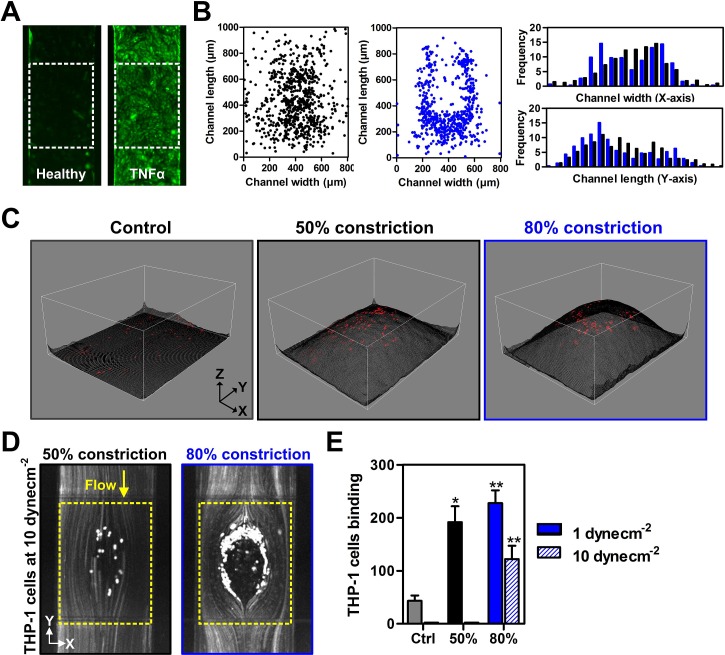
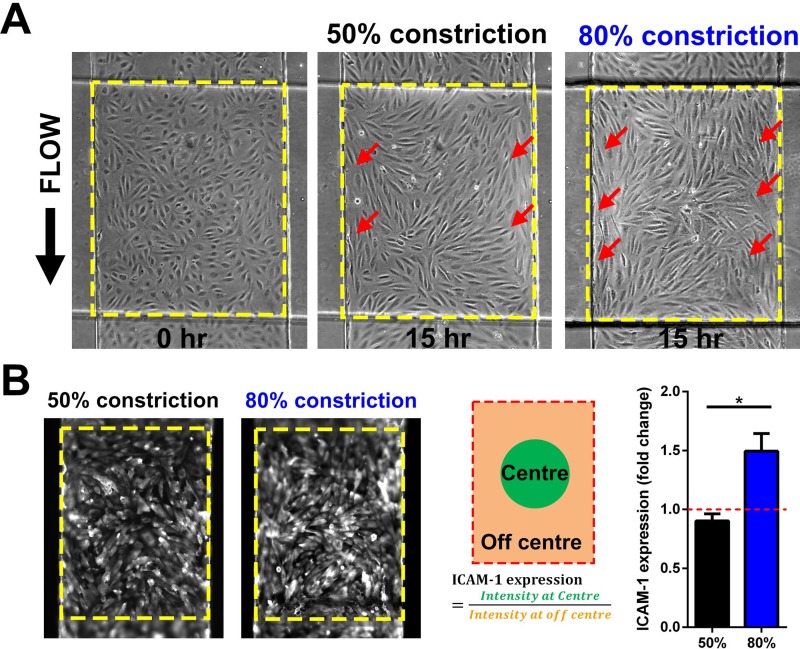
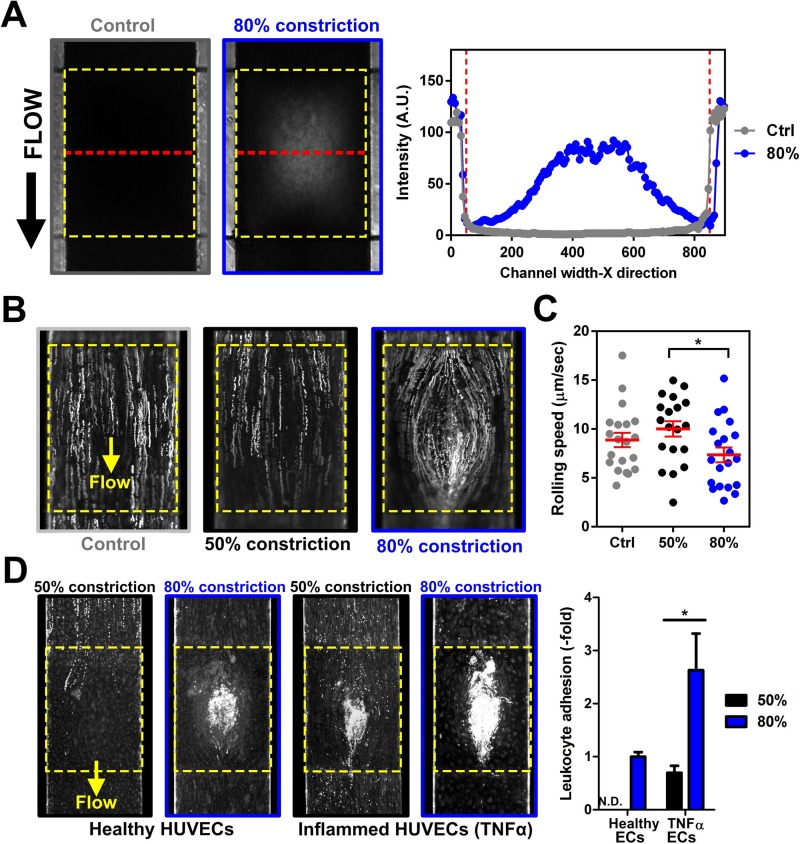
Atherosclerosis, a chronic inflammatory disorder characterized by endothelial dysfunction and blood vessel narrowing, is the leading cause of cardiovascular diseases including heart attack and stroke. Herein, we present a novel tunable microfluidic atherosclerosis model to study vascular inflammation and leukocyte-endothelial interactions in 3D vessel stenosis. Flow and shear stress profiles were characterized in pneumatic-controlled stenosis conditions (0%, 50% and 80% constriction) using fluid simulation and experimental beads perfusion. Due to non-uniform fluid flow at the 3D stenosis, distinct monocyte (THP-1) adhesion patterns on inflamed [tumor necrosis factor-α (TNF-α) treated] endothelium were observed, and there was a differential endothelial expression of intercellular adhesion molecule-1 (ICAM-1) at the constriction region. Whole blood perfusion studies also showed increased leukocyte interactions (cell rolling and adherence) at the stenosis of healthy and inflamed endothelium, clearly highlighting the importance of vascular inflammation, flow disturbance, and vessel geometry in recapitulating atherogenic microenvironment. To demonstrate inflammatory risk assessment using leukocytes as functional biomarkers, we perfused whole blood samples into the developed microdevices (80% constriction) and observed significant dose-dependent effects of leukocyte adhesion in healthy and inflamed (TNF-α treated) blood samples. Taken together, the 3D stenosis chip facilitates quantitative study of hemodynamics and leukocyte-endothelial interactions, and can be further developed into a point-of-care blood profiling device for atherosclerosis and other vascular diseases.
动脉粥样硬化是一种以血管内皮功能障碍和血管狭窄为特征的慢性炎症性疾病,是包括心脏病发作和中风在内的心血管疾病的主要原因。在此,我们提出了一种新型的可调谐微流控动脉粥样硬化模型,用于研究三维血管狭窄中的血管炎症和白细胞-内皮细胞相互作用。使用流体模拟和实验性微珠灌注,在气动控制的狭窄条件(0%、50%和80%收缩)下对血流和剪切应力分布进行了表征。由于三维狭窄处流体流动不均匀,在炎症(经肿瘤坏死因子-α(TNF-α)处理)的内皮上观察到不同的单核细胞(THP-1)黏附模式,并且在狭窄区域细胞间黏附分子-1(ICAM-1)的内皮表达存在差异。全血灌注研究还表明,在健康和炎症内皮的狭窄处白细胞相互作用(细胞滚动和黏附)增加,清楚地突出了血管炎症、血流紊乱和血管几何形状在重现动脉粥样硬化微环境中的重要性。为了证明使用白细胞作为功能生物标志物进行炎症风险评估,我们将全血样本灌注到已开发的微装置(80%收缩)中,并观察到健康和炎症(经TNF-α处理)血样中白细胞黏附的显著剂量依赖性效应。综上所述,三维狭窄芯片有助于对血流动力学和白细胞-内皮细胞相互作用进行定量研究,并且可以进一步开发成用于动脉粥样硬化和其他血管疾病的即时护理血液分析装置。