Integrated Science and Engineering Division, Yonsei University, Incheon, 21983, Republic of Korea.
Department of Pharmacy, Yonsei University, Incheon, 21983, Republic of Korea.
Exp Mol Med. 2019 May 9;51(5):1-10. doi: 10.1038/s12276-019-0250-2.
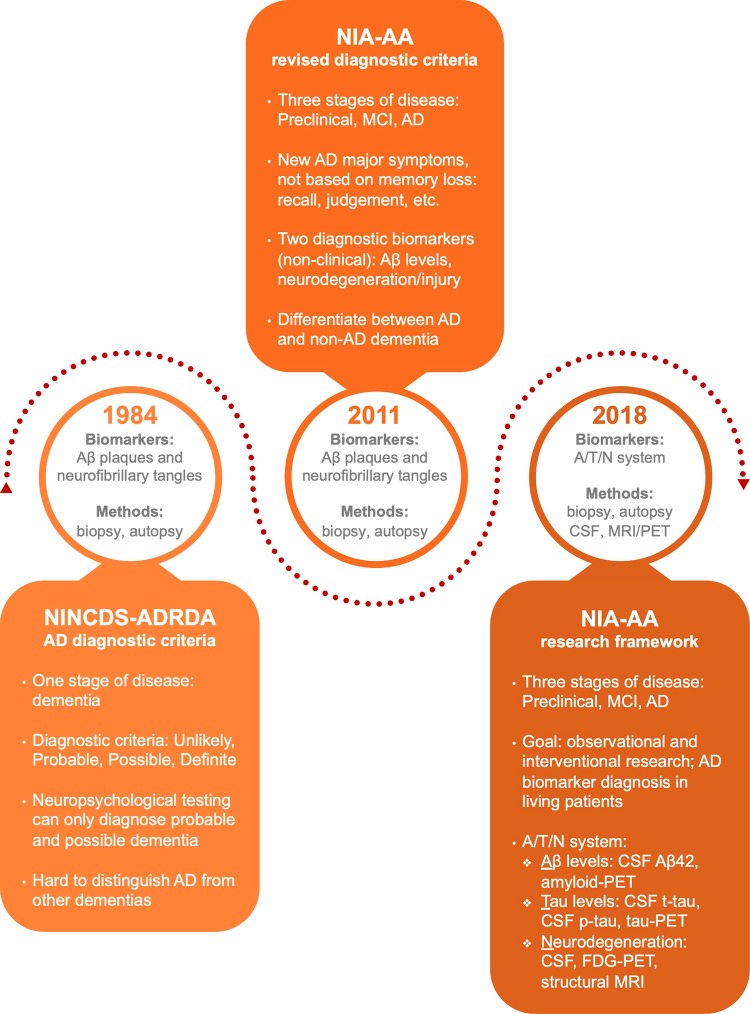
Current technological advancements in clinical and research settings have permitted a more intensive and comprehensive understanding of Alzheimer's disease (AD). This development in knowledge regarding AD pathogenesis has been implemented to produce disease-modifying drugs. The potential for accessible and effective therapeutic methods has generated a need for detecting this neurodegenerative disorder during early stages of progression because such remedial effects are more profound when implemented during the initial, prolonged prodromal stages of pathogenesis. The aggregation of amyloid-β (Aβ) and tau isoforms are characteristic of AD; thus, they are considered core candidate biomarkers. However, research attempting to establish the reliability of Aβ and tau as biomarkers has culminated in an amalgamation of contradictory results and theories regarding the biomarker concentrations necessary for an accurate diagnosis. In this review, we consider the capabilities and limitations of fluid biomarkers collected from cerebrospinal fluid, blood, and oral, ocular, and olfactory secretions as diagnostic tools for AD, along with the impact of the integration of these biomarkers in clinical settings. Furthermore, the evolution of diagnostic criteria and novel research findings are discussed. This review is a summary and reflection of the ongoing concerted efforts to establish fluid biomarkers as a diagnostic tool and implement them in diagnostic procedures.
目前,临床和研究环境中的技术进步使得人们能够更深入、更全面地了解阿尔茨海默病(AD)。这些关于 AD 发病机制的知识进步已经被用于开发能够改变疾病进程的药物。由于在发病的初始和漫长的前驱阶段实施这些治疗方法的效果更为显著,因此人们需要在疾病早期阶段进行检测,从而为研发出便于获取且有效的治疗方法提供了可能。淀粉样蛋白-β(Aβ)和 tau 异构体的聚集是 AD 的特征,因此它们被认为是核心候选生物标志物。然而,试图确定 Aβ和 tau 作为生物标志物的可靠性的研究最终得出了相互矛盾的结果和理论,这些结果和理论涉及到用于准确诊断所需的生物标志物浓度。在这篇综述中,我们考虑了从脑脊液、血液以及口腔、眼部和嗅觉分泌物中采集的液体生物标志物作为 AD 诊断工具的能力和局限性,以及这些生物标志物在临床环境中的整合所产生的影响。此外,还讨论了诊断标准的演变和新的研究发现。这篇综述总结和反映了目前为将液体生物标志物确立为一种诊断工具并将其纳入诊断程序而做出的共同努力。