Section of Environmental Health, Department of Public Health, University of Copenhagen, Copenhagen, Denmark.
Juliane Marie Center, Department of Growth and Reproduction, Rigshospitalet, Copenhagen, Denmark.
Environ Health Perspect. 2019 May;127(5):57006. doi: 10.1289/EHP4389.
Evidence on the association between road traffic noise and diabetes risk is sparse and inconsistent with respect to how confounding by air pollution was treated.
In this study, we aimed to examine whether long-term exposure to road traffic noise over 25 years is associated with incidence of diabetes, independent of air pollution.
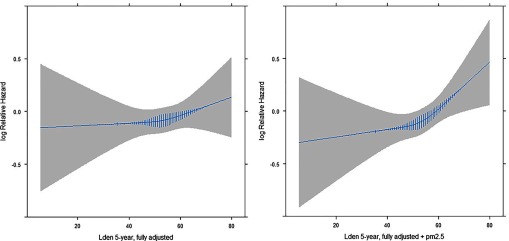
A total of 28,731 female nurses from the Danish Nurse cohort ([Formula: see text] at recruitment in 1993 or 1999) were linked to the Danish National Diabetes Register with information on incidence of diabetes from 1995 until 2013. The annual mean weighted levels of 24-h average road traffic noise ([Formula: see text]) at nurses' residences from 1970 until 2013 were estimated with the Nord2000 method and annual mean levels of particulate matter (PM) with diameter [Formula: see text] and [Formula: see text] ([Formula: see text] and [Formula: see text]), nitrogen dioxide ([Formula: see text]), and nitrogen oxide ([Formula: see text]) with the Danish AirGIS modeling system. Cox proportional hazards regression models were used to examine the association between residential [Formula: see text] in four different exposure windows (1-, 5-, 10-, and 25-years) and the incidence of diabetes, adjusted for lifestyle factors and air pollutants.
Of 23,762 nurses free of diabetes at the cohort baseline, 1,158 developed diabetes during a mean follow-up of 15.2 years. We found weak positive associations between 5-y mean exposure to [Formula: see text] (per [Formula: see text] increase) and diabetes incidence in a crude model [hazard ratio (HR): 1.07; 95% confidence interval (CI): 0.99, 1.12], which attenuated in a model adjusted for lifestyle factors (HR:1.04; 95% CI: 0.97, 1.12), and reached unity after additional adjustment for [Formula: see text] (HR: 0.99; 0.91, 1.08). In analyses by level of urbanization, we found a positive association between noise and diabetes in urban areas (HR:1.27; 95% CI: 0.98, 1.63) that was unchanged after adjusting for [Formula: see text] (HR: 1.25; 95% CI: 0.97, 1.62), but we found no apparent association in provincial (HR: 1.02; 95% CI: 0.88, 1.18) or rural areas (HR: 0.97; 95% CI: 0.87, 1.08).
In the nationwide cohort of Danish nurses 44 years of age and older, we found no association between long-term exposure to road traffic noise and diabetes incidence after adjustment for [Formula: see text] but found suggestive evidence of an association limited to urban areas. https://doi.org/10.1289/EHP4389.
有关道路交通噪声与糖尿病风险之间关联的证据很少,且关于空气污染的混杂因素处理方法也不一致。
本研究旨在检查在 25 年的时间里,长期暴露于道路交通噪声是否与糖尿病的发生有关,而与空气污染无关。
共有 28731 名来自丹麦护士队列的女性护士([Formula: see text]在 1993 年或 1999 年招募时)与丹麦国家糖尿病登记处相关联,可获得从 1995 年至 2013 年的糖尿病发病信息。使用 Nord2000 方法估计了护士居住地址在 1970 年至 2013 年期间 24 小时平均道路交通噪声([Formula: see text])的年平均加权水平,使用丹麦 AirGIS 建模系统估计了颗粒物(PM)[Formula: see text]和 [Formula: see text]([Formula: see text]和 [Formula: see text])、二氧化氮([Formula: see text])和氮氧化物([Formula: see text])的年平均水平。使用 Cox 比例风险回归模型,检验了居住[Formula: see text]在四个不同暴露窗口(1 年、5 年、10 年和 25 年)与糖尿病发病率之间的关系,调整了生活方式因素和空气污染物。
在队列基线时没有糖尿病的 23762 名护士中,有 1158 人在平均随访 15.2 年后患上了糖尿病。我们发现,在未经调整的模型中,5 年平均暴露于[Formula: see text](每增加[Formula: see text])与糖尿病发病呈弱正相关(危险比 [HR]:1.07;95%置信区间 [CI]:0.99,1.12),在调整了生活方式因素的模型中,这种相关性减弱(HR:1.04;95% CI:0.97,1.12),在进一步调整[Formula: see text]后,这种相关性达到一致(HR:0.99;0.91,1.08)。在按城市化水平进行的分析中,我们发现噪声与城市地区的糖尿病之间存在正相关(HR:1.27;95% CI:0.98,1.63),调整[Formula: see text]后,这种相关性保持不变(HR:1.25;95% CI:0.97,1.62),但在农村地区(HR:1.02;95% CI:0.88,1.18)和农村地区(HR:0.97;95% CI:0.87,1.08)并未发现明显的相关性。
在年龄在 44 岁及以上的丹麦全国性护士队列中,我们发现长期暴露于道路交通噪声与糖尿病发病率之间无关联,但在城市地区发现了与关联有关的证据。https://doi.org/10.1289/EHP4389.