Basu Shibom, Olieric Vincent, Leonarski Filip, Matsugaki Naohiro, Kawano Yoshiaki, Takashi Tomizaki, Huang Chia-Ying, Yamada Yusuke, Vera Laura, Olieric Natacha, Basquin Jerome, Wojdyla Justyna A, Bunk Oliver, Diederichs Kay, Yamamoto Masaki, Wang Meitian
Swiss Light Source, Paul Scherrer Institut, Villigen PSI, 5232, Switzerland.
Structural Biology Research Center, Photon Factory, Institute of Materials Structure Science, High Energy Accelerator Research Organization, Tsukuba, 305-0801, Japan.
IUCrJ. 2019 Apr 1;6(Pt 3):373-386. doi: 10.1107/S2052252519002756. eCollection 2019 May 1.
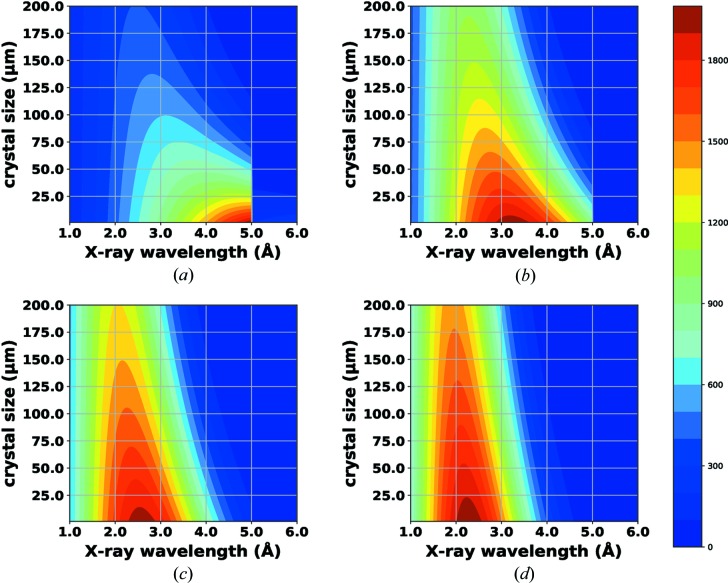
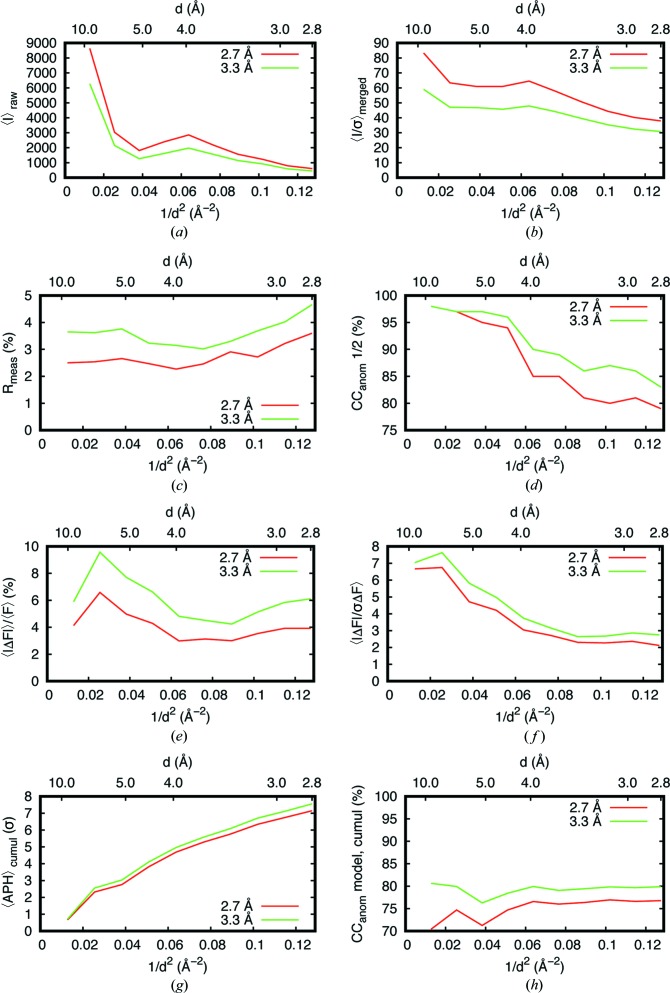
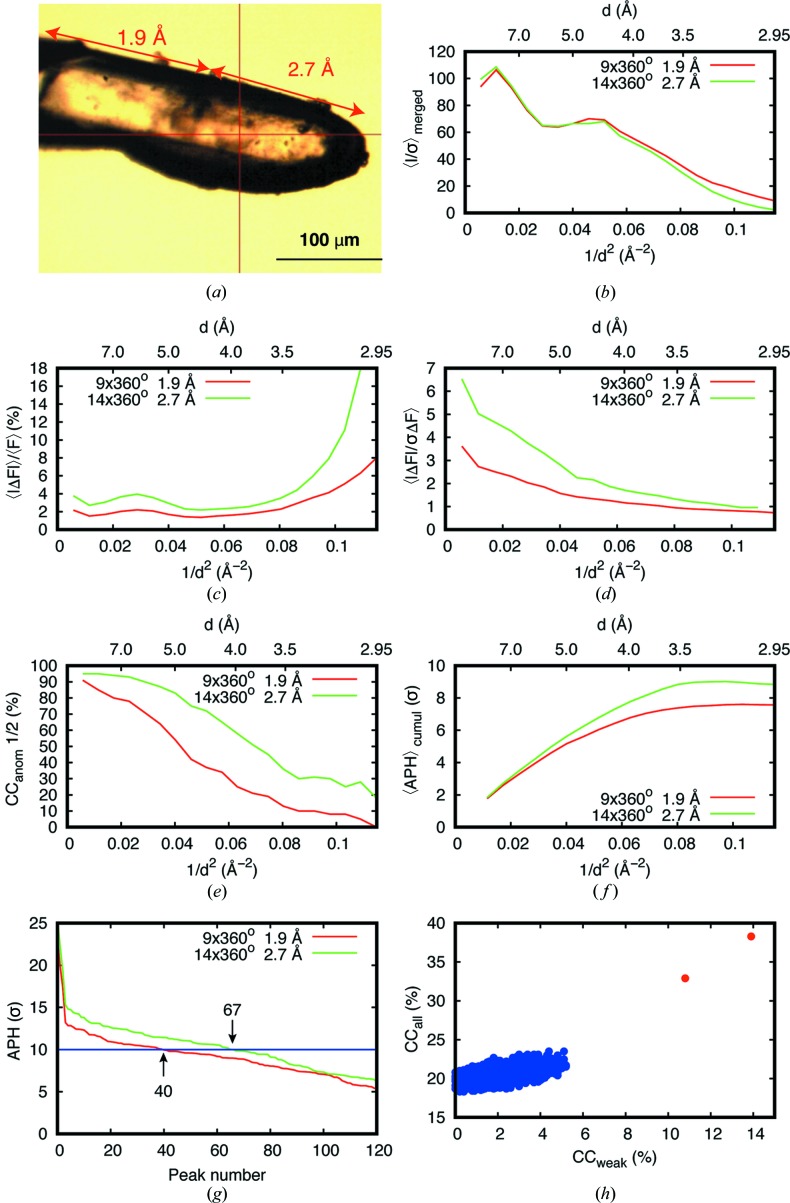
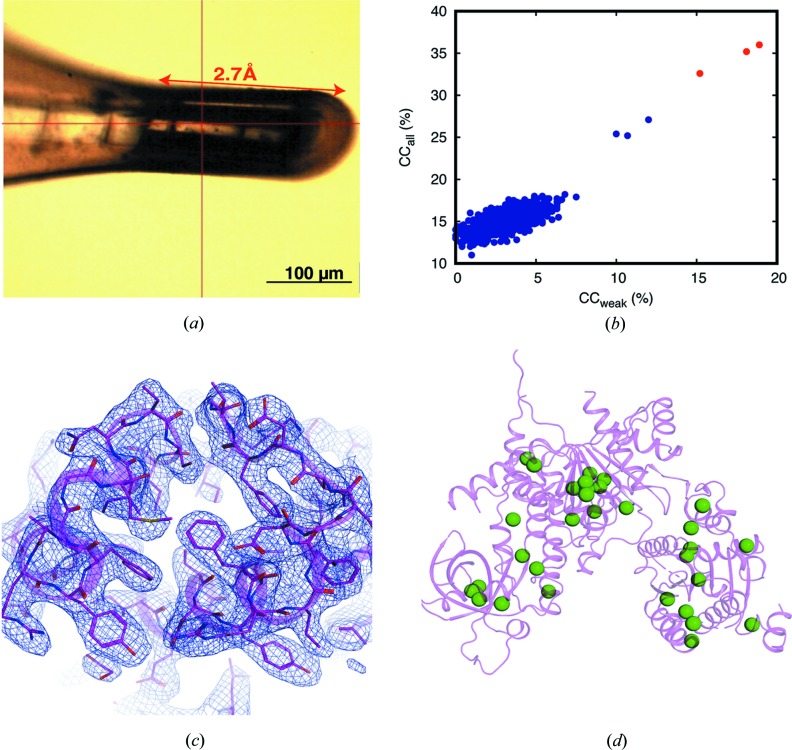
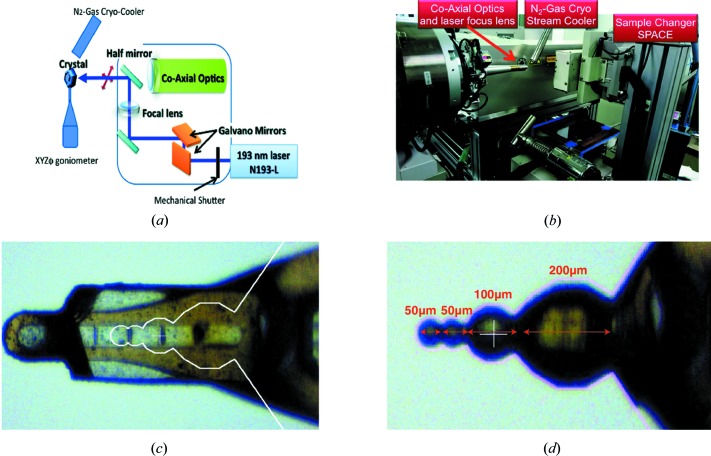
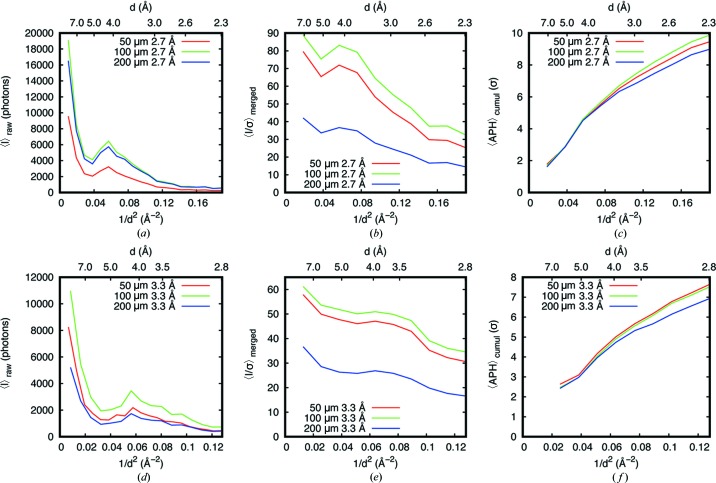
Native single-wavelength anomalous dispersion (SAD) is an attractive experimental phasing technique as it exploits weak anomalous signals from intrinsic light scatterers ( < 20). The anomalous signal of sulfur in particular, is enhanced at long wavelengths, however the absorption of diffracted X-rays owing to the crystal, the sample support and air affects the recorded intensities. Thereby, the optimal measurable anomalous signals primarily depend on the counterplay of the absorption and the anomalous scattering factor at a given X-ray wavelength. Here, the benefit of using a wavelength of 2.7 over 1.9 Å is demonstrated for native-SAD phasing on a 266 kDa multiprotein-ligand tubulin complex (TR-TTL) and is applied in the structure determination of an 86 kDa helicase Sen1 protein at beamline BL-1A of the KEK Photon Factory, Japan. Furthermore, X-ray absorption at long wavelengths was controlled by shaping a lysozyme crystal into spheres of defined thicknesses using a deep-UV laser, and a systematic comparison between wavelengths of 2.7 and 3.3 Å is reported for native SAD. The potential of laser-shaping technology and other challenges for an optimized native-SAD experiment at wavelengths >3 Å are discussed.
天然单波长反常散射(SAD)是一种颇具吸引力的实验相位测定技术,因为它利用了来自固有光散射体的微弱反常信号(<20)。特别是硫的反常信号在长波长处增强,然而,由于晶体、样品支撑物和空气对衍射X射线的吸收会影响记录的强度。因此,最佳可测量反常信号主要取决于在给定X射线波长下吸收与反常散射因子之间的相互作用。在此,展示了在266 kDa多蛋白-配体微管蛋白复合物(TR-TTL)上进行天然SAD相位测定时,使用2.7 Å波长优于1.9 Å波长的优势,并将其应用于日本高能加速器研究机构(KEK)光子工厂BL-1A光束线上86 kDa解旋酶Sen1蛋白的结构测定。此外,通过使用深紫外激光将溶菌酶晶体加工成具有特定厚度的球体来控制长波长处的X射线吸收,并报告了针对天然SAD在2.7 Å和3.3 Å波长之间的系统比较。讨论了激光成型技术的潜力以及在波长>3 Å时优化天然SAD实验面临的其他挑战。