
实现可持续发展目标的国家卫生信息系统。
National health information systems for achieving the Sustainable Development Goals.
机构信息
Center for Global Health, Centers for Disease Control and Prevention, Atlanta, Georgia, USA.
International Statistics Program, Centers for Disease Control and Prevention, Hyattsville, Maryland, USA.
出版信息
BMJ Open. 2019 May 16;9(5):e027689. doi: 10.1136/bmjopen-2018-027689.
OBJECTIVES
Achieving the Sustainable Development Goals will require data-driven public health action. There are limited publications on national health information systems that continuously generate health data. Given the need to develop these systems, we summarised their current status in low-income and middle-income countries.
SETTING
The survey team jointly developed a questionnaire covering policy, planning, legislation and organisation of case reporting, patient monitoring and civil registration and vital statistics (CRVS) systems. From January until May 2017, we administered the questionnaire to key informants in 51 Centers for Disease Control country offices. Countries were aggregated for descriptive analyses in Microsoft Excel.
RESULTS
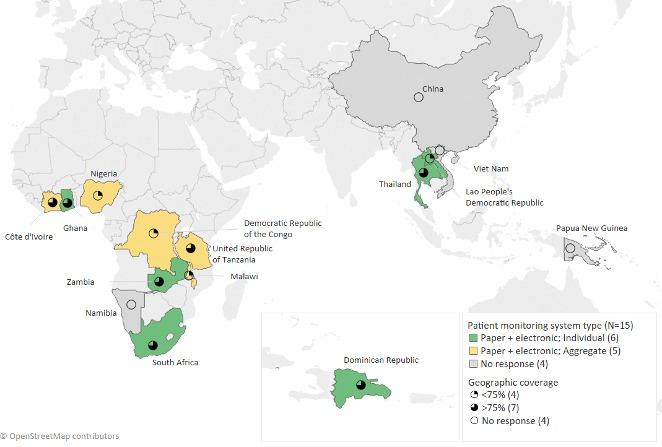
Key informants in 15 countries responded to the questionnaire. Several key informants did not answer all questions, leading to different denominators across questions. The Ministry of Health coordinated case reporting, patient monitoring and CRVS systems in 93% (14/15), 93% (13/14) and 53% (8/15) of responding countries, respectively. Domestic financing supported case reporting, patient monitoring and CRVS systems in 86% (12/14), 75% (9/12) and 92% (11/12) of responding countries, respectively. The most common uses for system-generated data were to guide programme response in 100% (15/15) of countries for case reporting, to calculate service coverage in 92% (12/13) of countries for patient monitoring and to estimate the national burden of disease in 83% (10/12) of countries for CRVS. Systems with an electronic component were being used for case reporting, patient monitoring, birth registration and death registration in 87% (13/15), 92% (11/12), 77% (10/13) and 64% (7/11) of responding countries, respectively.
CONCLUSIONS
Most responding countries have a solid foundation for policy, planning, legislation and organisation of health information systems. Further evaluation is needed to assess the quality of data generated from systems. Periodic evaluations may be useful in monitoring progress in strengthening and harmonising these systems over time.
目的
实现可持续发展目标需要基于数据的公共卫生行动。有关持续生成卫生数据的国家卫生信息系统的出版物有限。鉴于需要开发这些系统,我们总结了低收入和中等收入国家的现状。
背景
调查小组共同制定了一份涵盖政策、规划、立法以及病例报告、患者监测和民事登记与生命统计(CRVS)系统组织的问卷。2017 年 1 月至 5 月,我们向 51 个疾病控制中心国家办事处的主要信息提供者发放了问卷。在 Microsoft Excel 中,按国家汇总了描述性分析数据。
结果
15 个国家的主要信息提供者对问卷做出了回应。由于部分主要信息提供者未回答所有问题,因此不同问题的回答人数也不同。卫生部协调病例报告、患者监测和 CRVS 系统的国家分别为 93%(14/15)、93%(13/14)和 53%(15/15)。国内供资支持病例报告、患者监测和 CRVS 系统的国家分别为 86%(12/14)、75%(9/12)和 92%(11/12)。系统生成数据的最常见用途是为病例报告中的方案应对提供指导,在患者监测中为计算服务覆盖率提供指导,在 CRVS 中为估计国家疾病负担提供指导,分别占 100%(15/15)、92%(12/13)和 83%(10/12)的国家。在病例报告、患者监测、出生登记和死亡登记中使用电子组件的系统分别占 87%(13/15)、92%(11/12)、77%(10/13)和 64%(7/11)的国家。
结论
大多数有回应的国家在政策、规划、立法和卫生信息系统组织方面都有坚实的基础。需要进一步评估以评估系统生成数据的质量。定期评估可能有助于监测随着时间的推移加强和协调这些系统的进展。




 Zotero 插件