
在 7 个中低收入国家,肺炎严重程度评分对就诊于医院的人类免疫缺陷病毒阴性儿童的预测性能。
The Predictive Performance of a Pneumonia Severity Score in Human Immunodeficiency Virus-negative Children Presenting to Hospital in 7 Low- and Middle-income Countries.
机构信息
Department of Infectious Disease Epidemiology, Faculty of Epidemiology and Population Health, London School of Hygiene and Tropical Medicine, United Kingdom.
Department of International Health, International Vaccine Access Center, Johns Hopkins Bloomberg School of Public Health, Baltimore, Maryland.
出版信息
Clin Infect Dis. 2020 Mar 3;70(6):1050-1057. doi: 10.1093/cid/ciz350.
BACKGROUND
In 2015, pneumonia remained the leading cause of mortality in children aged 1-59 months.
METHODS
Data from 1802 human immunodeficiency virus (HIV)-negative children aged 1-59 months enrolled in the Pneumonia Etiology Research for Child Health (PERCH) study with severe or very severe pneumonia during 2011-2014 were used to build a parsimonious multivariable model predicting mortality using backwards stepwise logistic regression. The PERCH severity score, derived from model coefficients, was validated on a second, temporally discrete dataset of a further 1819 cases and compared to other available scores using the C statistic.
RESULTS
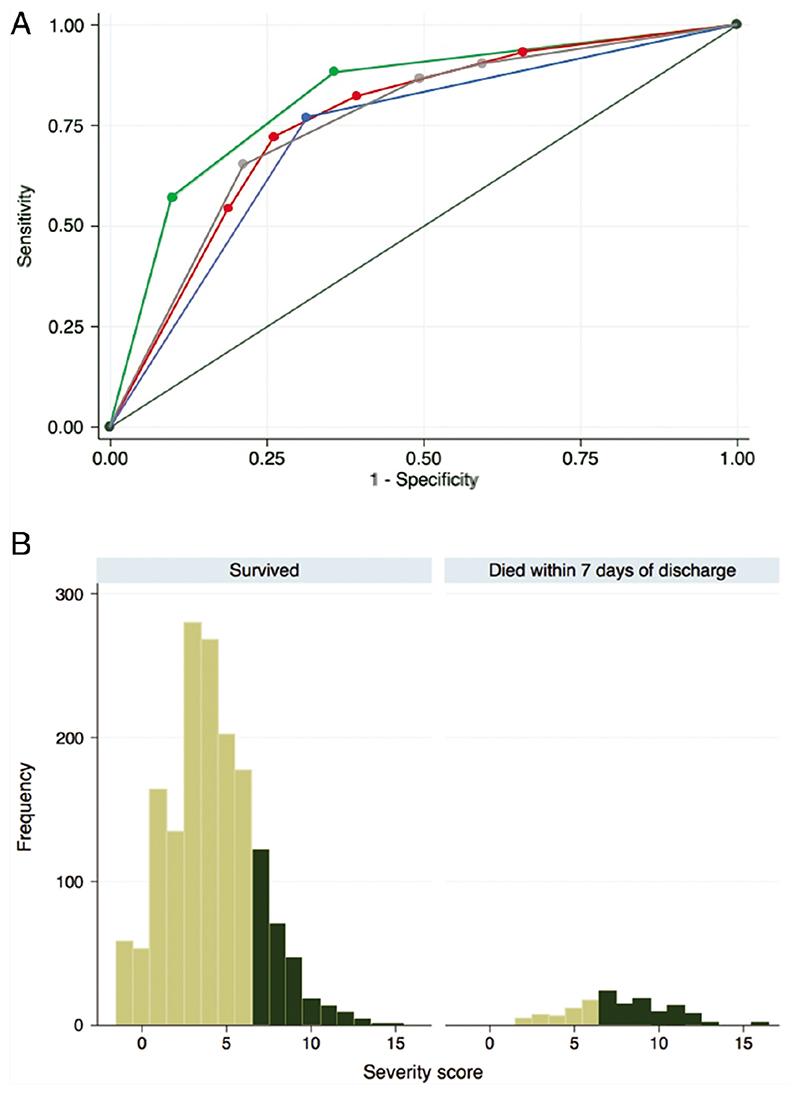
Predictors of mortality, across 7 low- and middle-income countries, were age <1 year, female sex, ≥3 days of illness prior to presentation to hospital, low weight for height, unresponsiveness, deep breathing, hypoxemia, grunting, and the absence of cough. The model discriminated well between those who died and those who survived (C statistic = 0.84), but the predictive capacity of the PERCH 5-stratum score derived from the coefficients was moderate (C statistic = 0.76). The performance of the Respiratory Index of Severity in Children score was similar (C statistic = 0.76). The number of World Health Organization (WHO) danger signs demonstrated the highest discrimination (C statistic = 0.82; 1.5% died if no danger signs, 10% if 1 danger sign, and 33% if ≥2 danger signs).
CONCLUSIONS
The PERCH severity score could be used to interpret geographic variations in pneumonia mortality and etiology. The number of WHO danger signs on presentation to hospital could be the most useful of the currently available tools to aid clinical management of pneumonia.
背景
2015 年,肺炎仍然是 1-59 个月儿童死亡的主要原因。
方法
使用来自 2011-2014 年期间在肺炎病因研究儿童健康(PERCH)研究中患有严重或非常严重肺炎的 1802 名人类免疫缺陷病毒(HIV)阴性 1-59 个月儿童的数据,建立一个简约的多变量模型,使用向后逐步逻辑回归预测死亡率。PERCH 严重程度评分,由模型系数得出,在第二个时间离散的数据集上进行验证,该数据集包含另外 1819 例病例,并使用 C 统计量与其他可用评分进行比较。
结果
在 7 个中低收入国家中,死亡率的预测因素为年龄<1 岁、女性、在就诊前患病≥3 天、低体重与身高比例、无反应性、深呼吸、低氧血症、呼噜声、无咳嗽。该模型在死亡和存活患者之间的区分度良好(C 统计量=0.84),但从系数得出的 PERCH 5 层评分的预测能力中等(C 统计量=0.76)。儿童呼吸严重程度指数评分的性能相似(C 统计量=0.76)。世界卫生组织(WHO)危险征象的数量表现出最高的区分度(C 统计量=0.82;如果没有危险征象,1.5%死亡,如果有 1 个危险征象,10%死亡,如果有≥2 个危险征象,33%死亡)。
结论
PERCH 严重程度评分可用于解释肺炎死亡率和病因的地理差异。就诊时出现的 WHO 危险征象数量可能是目前最有用的工具之一,可帮助临床管理肺炎。
 Zotero 插件