Maeng Hoyoung M, Berzofsky Jay A
Vaccine Branch, Center for Cancer Research, National Cancer Institute, National Institutes of Health, Bethesda, MD, 20892, USA.
F1000Res. 2019 May 13;8. doi: 10.12688/f1000research.18693.1. eCollection 2019.
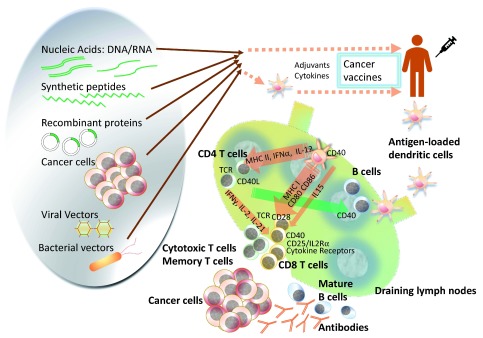
With the spotlight on cancer immunotherapy and the expanding use of immune checkpoint inhibitors, strategies to improve the response rate and duration of current cancer immunotherapeutics are highly sought. In that sense, investigators around the globe have been putting spurs on the development of effective cancer vaccines in humans after decades of efforts that led to limited clinical success. In more than three decades of research in pursuit of targeted and personalized immunotherapy, several platforms have been incorporated into the list of cancer vaccines from live viral or bacterial agents harboring antigens to synthetic peptides with the hope of stronger and durable immune responses that will tackle cancers better. Unlike adoptive cell therapy, cancer vaccines can take advantage of using a patient's entire immune system that can include more than engineered receptors or ligands in developing antigen-specific responses. Advances in molecular technology also secured the use of genetically modified genes or proteins of interest to enhance the chance of stronger immune responses. The formulation of vaccines to increase chances of immune recognition such as nanoparticles for peptide delivery is another area of great interest. Studies indicate that cancer vaccines alone may elicit tumor-specific cellular or humoral responses in immunologic assays and even regression or shrinkage of the cancer in select trials, but novel strategies, especially in combination with other cancer therapies, are under study and are likely to be critical to achieve and optimize reliable objective responses and survival benefit. In this review, cancer vaccine platforms with different approaches to deliver tumor antigens and boost immunity are discussed with the intention of summarizing what we know and what we need to improve in the clinical trial setting.
随着癌症免疫疗法备受关注以及免疫检查点抑制剂的使用不断扩大,提高当前癌症免疫疗法的有效率和持续时间的策略备受追捧。从这个意义上说,经过数十年虽临床成功有限但仍坚持不懈的努力,全球的研究人员一直在推动人类有效癌症疫苗的研发。在三十多年来追求靶向和个性化免疫疗法的研究中,多个平台已被纳入癌症疫苗清单,从携带抗原的活病毒或细菌制剂到合成肽,以期获得更强且持久的免疫反应,从而更好地对抗癌症。与过继性细胞疗法不同,癌症疫苗可以利用患者的整个免疫系统,这在产生抗原特异性反应时可包括比工程化受体或配体更多的成分。分子技术的进步也确保了使用感兴趣的基因改造基因或蛋白质来增加产生更强免疫反应的机会。制备能增加免疫识别几率的疫苗,如用于递送肽的纳米颗粒,是另一个备受关注的领域。研究表明,仅癌症疫苗可能在免疫测定中引发肿瘤特异性细胞或体液反应,甚至在某些试验中使癌症消退或缩小,但新策略,尤其是与其他癌症疗法联合使用的策略,正在研究中,并且可能对实现和优化可靠的客观反应及生存获益至关重要。在本综述中,将讨论采用不同方法递送肿瘤抗原并增强免疫力的癌症疫苗平台,目的是总结我们在临床试验环境中所了解的情况以及需要改进的方面。