Agriculture and Agri-Food Canada, Saskatoon Research and Development Centre, Saskatoon, SK, S7N 0X2, Canada.
Department of Biology, University of Saskatchewan, Saskatoon, SK, S7N 5E2, Canada.
BMC Plant Biol. 2019 May 29;19(1):224. doi: 10.1186/s12870-019-1844-5.
Clubroot, caused by Plasmodiophora brassicae Woronin, is a very important disease of Brassica species. Management of clubroot relies heavily on genetic resistance. In a cross of Brassica nigra lines PI 219576 (highly resistant, R) × CR2748 (highly susceptible, S) to clubroot, all F plants were resistant to clubroot. There was a 1:1 ratio of R:S in the BC and 3R:1S in the F, which indicated that a single dominant gene controlled clubroot resistance in PI 219576. This gene was designated Rcr6. Mapping of Rcr6 was performed using genome sequencing information from A-genome of B. rapa and B-genome of B. nigra though bulked segregant RNA sequencing (BSR-Seq) and further mapping with Kompetitive Allele Specific PCR (KASP) analysis.
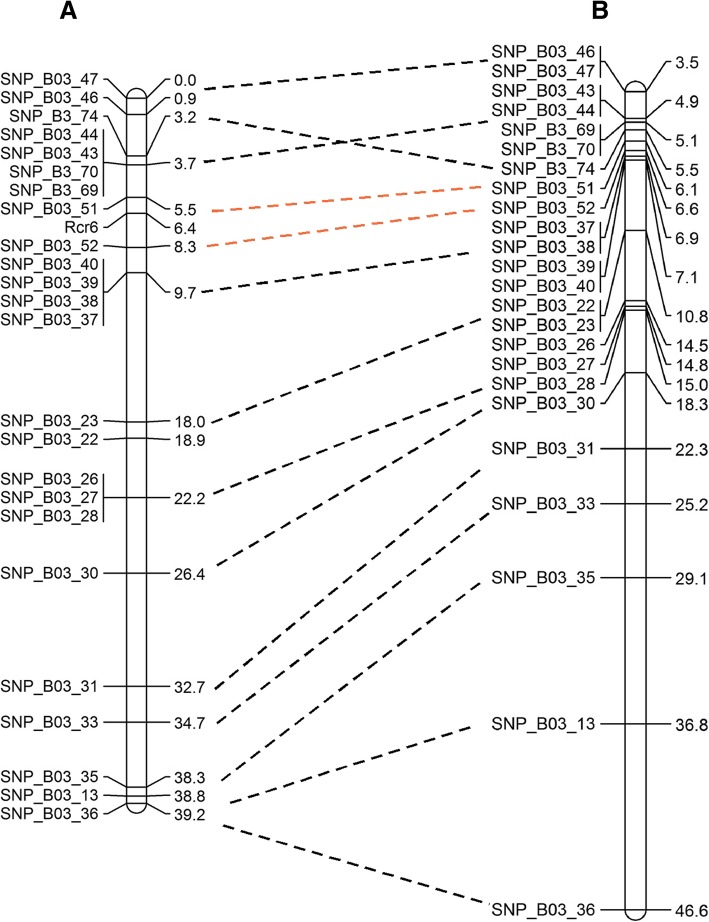
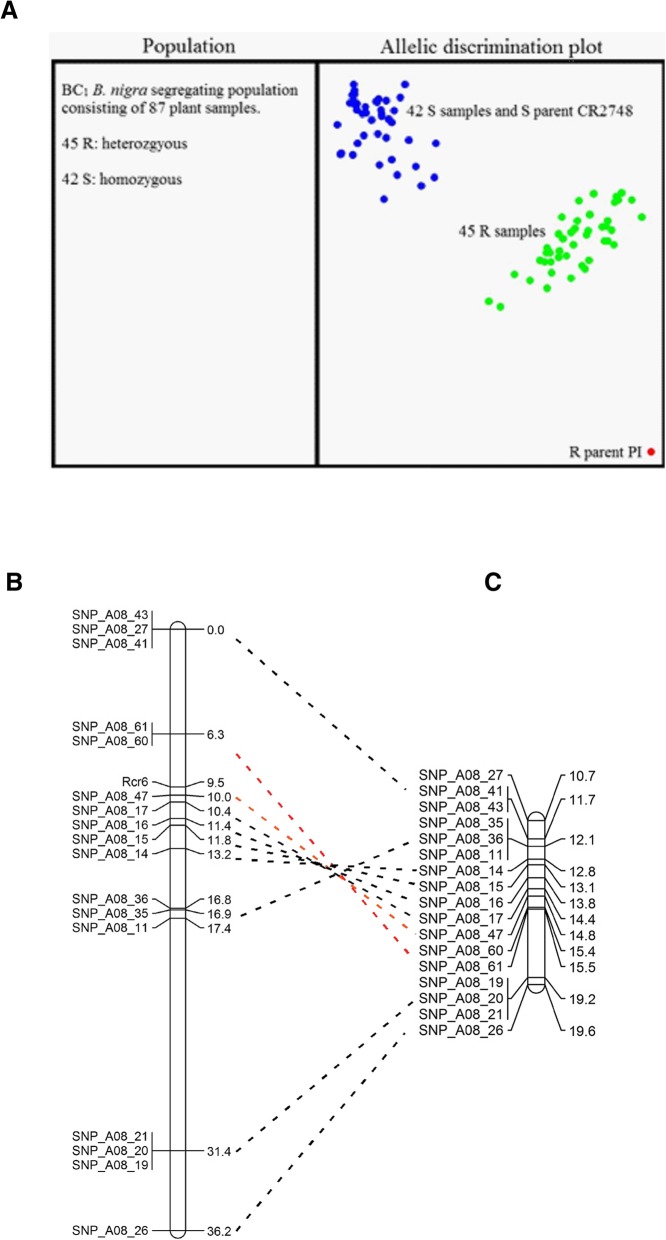
Reads of R and S bulks from BSR-Seq were initially aligned onto B. rapa (A-genome; B. nigra has the B-genome) where Rcr6 was associated with chromosome A08. KASP analysis showed that Rcr6 was flanked by SNP markers homologous to the region of 14.8-15.4 Mb of chromosome A08. There were 190 genes annotated in this region, with five genes (Bra010552, Bra010588, Bra010589, Bra010590 and Bra010663) identified as encoding the toll-interleukin-1 receptor / nucleotide-binding site / leucine-rich-repeat (TIR-NBS-LRR; TNL) class of proteins. The reads from BSR-Seq were then aligned into a draft B-genome of B. nigra, where Rcr6 was mapped on chromosome B3. KASP analysis indicated that Rcr6 was located on chromosome B3 in a 0.5 Mb region from 6.1-6.6 Mb. Only one TNL gene homologous to the B. rapa gene Bra010663 was identified in the target region. This gene is a likely candidate for Rcr6. Subsequent analysis of the Rcr6 equivalent region based on a published B. nigra genome was performed. This gene is located into chromosome B7 of the published B-genome, homologous to BniB015819.
Rcr6 was the first gene identified and mapped in the B-genome of Brassica species. It resides in a genomic region homologous to chromosome A08 of A-genome. Based on this finding, it could possibly integrate into A08 of B. napus using marker assisted selection with SNP markers tightly linked to Rcr6 developed in this study.
由 Plasmodiophora brassicae Woronin 引起的根肿病是芸薹属物种的一种非常重要的病害。根肿病的防治主要依赖于遗传抗性。在黑芥品系 PI 219576(高抗,R)× CR2748(高感,S)的杂交中,所有 F1 代植株均对根肿病具有抗性。BC 代中 R:S 的比例为 1:1,而 F1 代中为 3R:1S,这表明一个显性基因控制了 PI 219576 中的根肿病抗性。该基因被命名为 Rcr6。通过对黑芥 A 基因组和甘蓝型油菜 B 基因组的基因组测序信息进行 bulked segregant RNA 测序(BSR-Seq)和 Kompetitive Allele Specific PCR(KASP)分析,对 Rcr6 进行了定位。
BSR-Seq 中 R 和 S 两个品系的reads 最初被映射到芸薹属 A 基因组(黑芥具有 B 基因组)上,Rcr6 与 A08 染色体相关联。KASP 分析表明,Rcr6 被 14.8-15.4 Mb 的 A08 染色体区域上的 SNP 标记所包围。在这个区域有 190 个注释基因,其中 5 个基因(Bra010552、Bra010588、Bra010589、Bra010590 和 Bra010663)被鉴定为编码 Toll-白细胞介素-1 受体/核苷酸结合位点/亮氨酸丰富重复(TIR-NBS-LRR;TNL)类蛋白。然后,将 BSR-Seq 的 reads 映射到黑芥的一个草案 B 基因组中,Rcr6 被定位到 B3 染色体上。KASP 分析表明,Rcr6 位于 B3 染色体上,位于 6.1-6.6 Mb 的 0.5 Mb 区域内。在目标区域内只鉴定到一个与芸薹属 Bra010663 基因同源的 TNL 基因。该基因可能是 Rcr6 的候选基因。随后对基于已发表的黑芥基因组的 Rcr6 等效区域进行了分析。该基因位于已发表的 B 基因组的 B7 染色体上,与 BniB015819 同源。
Rcr6 是第一个在芸薹属物种的 B 基因组中被鉴定和定位的基因。它位于与 A 基因组 A08 染色体同源的基因组区域。基于这一发现,有可能利用本研究中开发的与 Rcr6 紧密连锁的 SNP 标记,通过标记辅助选择将其整合到油菜的 A08 染色体上。