Department of Epidemiology and Biostatistics, School of Public Health, Peking University Health Science Center, 38 Xueyuan Road, Beijing, 100191, China.
Department of Epidemiology, Harvard T.H. Chan School of Public Health, Boston, MA, 02115, USA.
Eur J Epidemiol. 2019 Aug;34(8):753-763. doi: 10.1007/s10654-019-00530-5. Epub 2019 May 31.
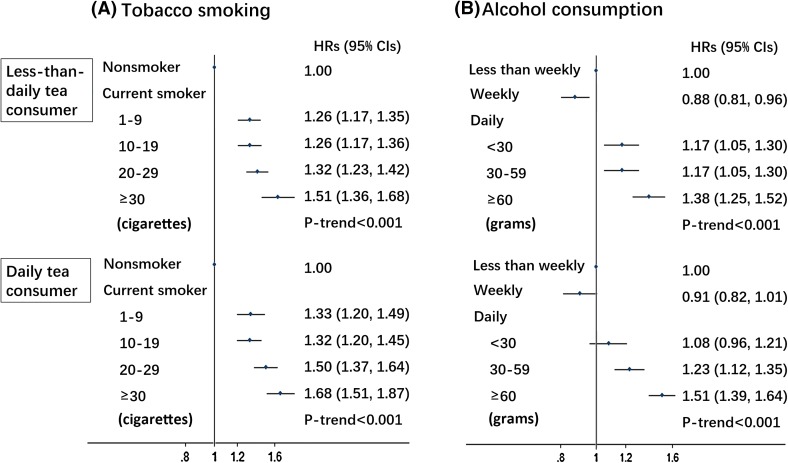
Current experimental and epidemiological studies provide inconsistent evidence toward the association between tea consumption and cancer incidence. We investigated whether tea consumption was associated with the incidence of all cancers and six leading types of cancer (lung cancer, stomach cancer, colorectal cancer, liver cancer, female breast cancer and cervix uteri cancer) among 455,981 participants aged 30-79 years in the prospective cohort China Kadoorie Biobank. Tea consumption was assessed at baseline (2004-2008) with an interviewer-administered questionnaire. Cancer cases were identified by linkage to the national health insurance system. Cox proportional hazard regression models were used to estimate hazard ratios (HRs) and 95% confidence intervals (CIs). In the present population, daily tea consumers were more likely to be current smokers and daily alcohol consumers. 22,652 incident cancers occurred during 10.1 years follow-up (5.04 cases/1000 person-years). When we restricted analyses to non-smokers and non-excessive alcohol consumers to minimize confounding, tea consumption was not associated with all cancers (daily consumers who added tea leaves > 4.0 g/day vs. less-than-weekly consumers: HR, 1.03; 95%CI, 0.93-1.13), lung cancer (HR, 1.08; CI, 0.84-1.40), colorectal cancer (HR, 1.08; CI, 0.81-1.45) and liver cancer (HR, 1.08; CI, 0.75-1.55), yet might be associated with increased risk of stomach cancer (HR, 1.46; CI, 1.07-1.99). In both less-than-daily and daily tea consumers, all cancer risk increased with the amount of tobacco smoked or alcohol consumed. Our findings suggest tea consumption may not provide preventive effect against cancer incidence.
目前的实验和流行病学研究提供的证据并不一致,无法明确茶的摄入与癌症发病率之间的关系。我们在中国慢性病前瞻性研究中,对 455981 名年龄在 30-79 岁的参与者进行了一项前瞻性队列研究,调查了茶的摄入与所有癌症以及六种主要癌症(肺癌、胃癌、结直肠癌、肝癌、乳腺癌和宫颈癌)的发病率之间的关系。在基线(2004-2008 年)通过问卷调查评估了茶的摄入情况。通过与国家健康保险系统的链接来确定癌症病例。使用 Cox 比例风险回归模型来估计风险比(HRs)和 95%置信区间(CIs)。在本研究人群中,每天喝茶的人更有可能是当前吸烟者和每日饮酒者。在 10.1 年的随访期间,共发生了 22652 例癌症事件(5.04 例/1000 人年)。当我们将分析限制在非吸烟者和非过量饮酒者中,以最大限度地减少混杂因素时,茶的摄入与所有癌症(每天饮用茶叶超过 4.0 克的消费者与每周饮用不到一次的消费者相比:HR,1.03;95%CI,0.93-1.13)、肺癌(HR,1.08;CI,0.84-1.40)、结直肠癌(HR,1.08;CI,0.81-1.45)和肝癌(HR,1.08;CI,0.75-1.55)均无关联,但可能与胃癌风险增加相关(HR,1.46;CI,1.07-1.99)。在非每日和每日饮茶者中,随着吸烟量或饮酒量的增加,所有癌症的风险均增加。我们的研究结果表明,茶的摄入可能无法提供预防癌症发病率的效果。