Otero Patricia, Torres Ángela J, Vázquez Fernando L, Blanco Vanessa, Ferraces María J, Díaz Olga
Department of Psychology, University of A Coruña, A Coruña, Spain.
Department of Psychiatry, Radiology, Public Health, Nursing and Medicine, University of Santiago de Compostela, Santiago de Compostela, Spain.
Front Psychol. 2019 May 15;10:1144. doi: 10.3389/fpsyg.2019.01144. eCollection 2019.
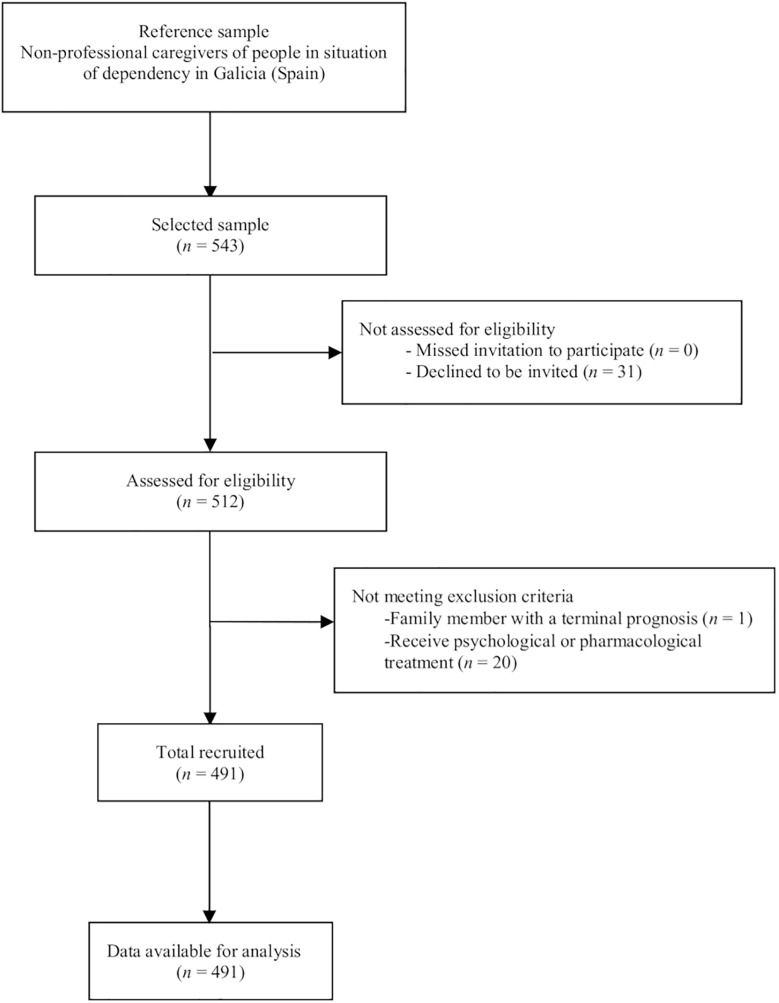
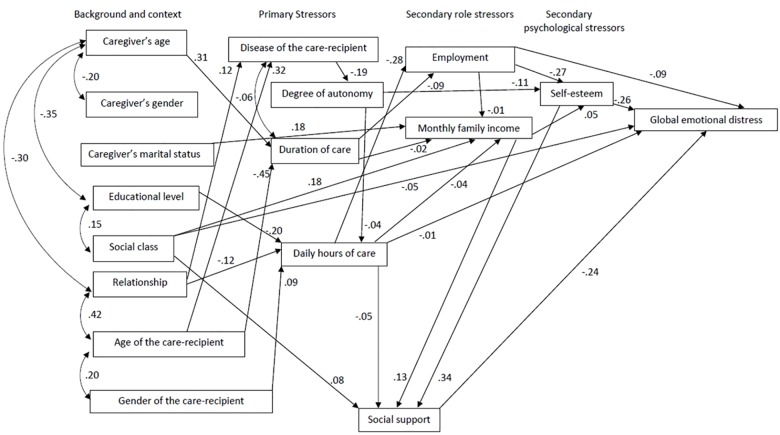
Research on mental health of non-professional caregivers has focused on caregivers of people with specific diseases, especially dementia. Less is known about caregivers of people with other diseases. The aims of this study were (a) to determine the caregivers' emotional state in a random sample of caregivers of people in situations of dependency, (b) to analyze the association between each disease of the care-recipient (a variety of 23 diseases included in the International Classification of Diseases) and the emotional state of the caregiver, and (c) based on the theoretical model, to analyze the relationship of the different study variables in the appearance of the emotional distress of the caregiver. A sample of 491 non-professional caregivers was selected randomly (89.0% women, average age 55.3 years). Trained psychologists collected sociodemographic and care-related characteristics and evaluated the global emotional distress, somatic symptoms, anxiety-insomnia, social dysfunction, depression, probable mental disorder case, self-esteem, and social support. It was found that (a) the caregivers showed moderate emotional distress, and 33.8% presented a probable mental disorder. (b) Caring for a care-recipient with cat's cry syndrome or epilepsy was related to suffering from social dysfunction, and caring for a care-recipient with autism was related to having a probable mental health case. (c) Social support mediated the relationship between social class, daily hours of care, monthly family income, self-esteem and global emotional distress. There is an important impact on the emotional state of the caregivers. This impact was similar in caregivers of care-recipients with different diseases, except in caregivers caring for a care-recipient with cat's cry syndrome or epilepsy (related to social dysfunction), and in caregivers caring for a care-recipient with autism (related to having a probable mental health case).
对非专业照料者心理健康的研究主要集中在患有特定疾病人群的照料者身上,尤其是痴呆症患者的照料者。对于患有其他疾病人群的照料者,我们了解得较少。本研究的目的是:(a)在随机抽取的处于依赖状态人群的照料者样本中,确定照料者的情绪状态;(b)分析受照料者的每种疾病(《国际疾病分类》中包含的23种疾病)与照料者情绪状态之间的关联;(c)基于理论模型,分析不同研究变量在照料者出现情绪困扰方面的关系。随机选取了491名非专业照料者作为样本(女性占89.0%,平均年龄55.3岁)。经过培训的心理学家收集了社会人口学和与照料相关的特征,并评估了总体情绪困扰、躯体症状、焦虑失眠、社会功能障碍、抑郁、可能的精神障碍病例、自尊和社会支持。研究发现:(a)照料者表现出中度情绪困扰,33.8%的人可能患有精神障碍。(b)照料患有猫叫综合征或癫痫的受照料者与社会功能障碍有关,照料患有自闭症的受照料者与可能患有心理健康问题有关。(c)社会支持在社会阶层、每日照料时长、家庭月收入、自尊和总体情绪困扰之间的关系中起中介作用。这对照料者的情绪状态有重要影响。这种影响在照料不同疾病受照料者的照料者中相似,但照料患有猫叫综合征或癫痫的受照料者(与社会功能障碍有关)以及照料患有自闭症的受照料者(与可能患有心理健康问题有关)的照料者除外。