London School of Hygiene and Tropical Medicine, London, United Kingdom.
Wellcome Trust Centre for Anti-Infectives Research, School of Life Sciences, University of Dundee, Dundee, United Kingdom.
Antimicrob Agents Chemother. 2019 Jul 25;63(8). doi: 10.1128/AAC.00795-19. Print 2019 Aug.
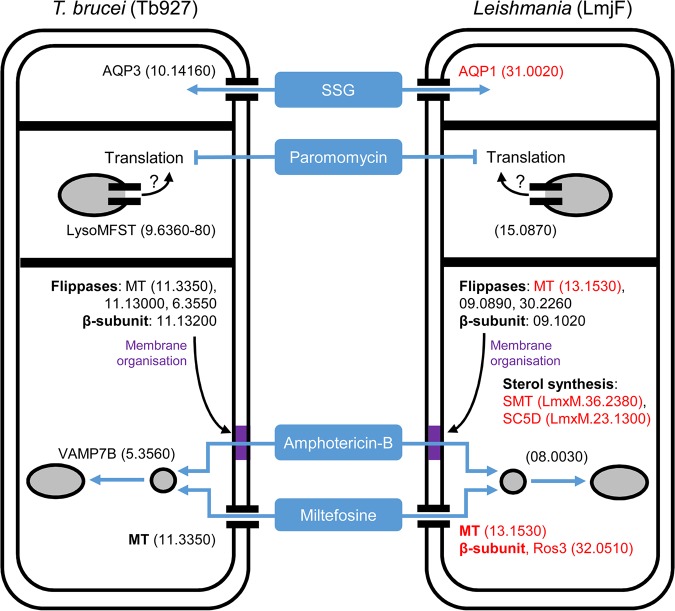
The arsenal of drugs used to treat leishmaniasis, caused by spp., is limited and beset by toxicity and emergent resistance. Furthermore, our understanding of drug mode of action and potential routes to resistance is limited. Forward genetic approaches have revolutionized our understanding of drug mode of action in the related kinetoplastid parasite Therefore, we screened our genome-scale RNA interference (RNAi) library against the current antileishmanial drugs sodium stibogluconate (antimonial), paromomycin, miltefosine, and amphotericin B. Identification of orthologues of the known antimonial and miltefosine plasma membrane transporters effectively validated our approach, while a cohort of 42 novel drug efficacy determinants provides new insights and serves as a resource. Follow-up analyses revealed the antimonial selectivity of the aquaglyceroporin TbAQP3. A lysosomal major facilitator superfamily transporter contributes to paromomycin-aminoglycoside efficacy. The vesicle-associated membrane protein TbVAMP7B and a flippase contribute to amphotericin B and miltefosine action and are potential cross-resistance determinants. Finally, multiple phospholipid-transporting flippases, including the orthologue of the miltefosine transporter, a putative β-subunit/CDC50 cofactor, and additional membrane-associated hits, affect amphotericin B efficacy, providing new insights into mechanisms of drug uptake and action. The findings from this orthology-based chemogenomic profiling approach substantially advance our understanding of antileishmanial drug action and potential resistance mechanisms and should facilitate the development of improved therapies as well as surveillance for drug-resistant parasites.
用于治疗由 spp.引起的利什曼病的药物种类有限,且存在毒性和耐药性问题。此外,我们对药物作用模式和耐药潜在途径的理解也很有限。正向遗传学方法极大地改变了我们对相关动基体寄生虫中药物作用模式的理解。因此,我们针对当前的抗利什曼病药物(葡萄糖酸锑钠、巴龙霉素、米替福新和两性霉素 B)筛选了我们的全基因组 RNA 干扰(RNAi)文库。鉴定出已知的锑和米替福新质膜转运蛋白的同源物,有效地验证了我们的方法,而一组 42 种新型药物功效决定因素提供了新的见解,并可作为资源。后续分析揭示了 Aquaglyceroporin TbAQP3 对锑的选择性。溶酶体主要易化超家族转运蛋白有助于巴龙霉素-氨基糖苷类药物的功效。囊泡相关膜蛋白 TbVAMP7B 和翻转酶有助于两性霉素 B 和米替福新的作用,是潜在的交叉耐药决定因素。最后,多种磷脂转运翻转酶,包括 miltefosine 转运蛋白的同源物、假定的β亚基/CDC50 辅助因子和其他膜相关命中,影响两性霉素 B 的功效,为药物摄取和作用的机制提供了新的见解。基于这种同源化学基因组学分析方法的研究结果极大地提高了我们对抗利什曼病药物作用和潜在耐药机制的理解,应该有助于开发改进的治疗方法以及监测耐药寄生虫。