1Plant Genomics and Breeding Center, Crop Science Department, Eliseu Maciel College of Agronomy, Federal University of Pelotas, Capão do Leão Campus, Capão do Leão, Rio Grande do Sul 96010-610 Brazil.
2Plant Sciences Division, 1-32 Agriculture, University of Missouri, Columbia, MO 65211 USA.
Hereditas. 2019 May 29;156:16. doi: 10.1186/s41065-019-0093-9. eCollection 2019.
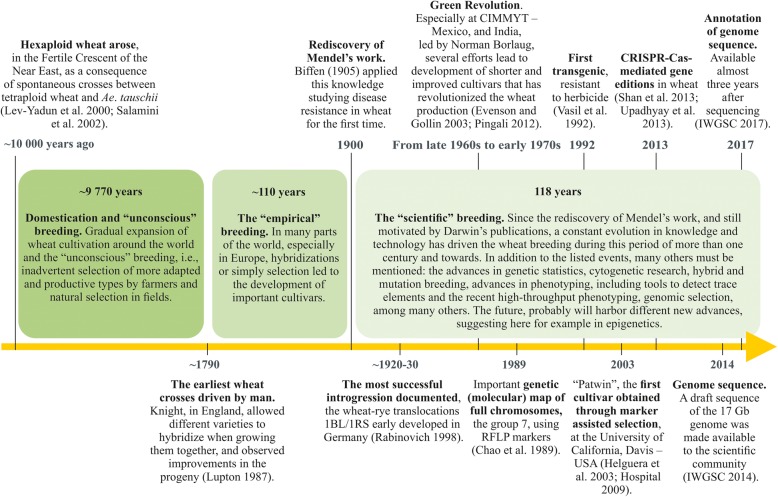
Bread wheat is one of the most important crops in the world. Its domestication coincides with the beginning of agriculture and since then, it has been constantly under selection by humans. Its breeding has followed millennia of cultivation, sometimes with unintended selection on adaptive traits, and later by applying intentional but empirical selective pressures. For more than one century, wheat breeding has been based on science, and has been constantly evolving due to on farm agronomy and breeding program improvements. The aim of this work is to briefly review wheat breeding, with emphasis on the current advances.
Improving yield potential, resistance/tolerance to biotic and abiotic stresses, and baking quality, have been priorities for breeding this cereal, however, new objectives are arising, such as biofortification enhancement. The narrow genetic diversity and complexity of its genome have hampered the breeding progress and the application of biotechnology. Old approaches, such as the introgression from relative species, mutagenesis, and hybrid breeding are strongly reappearing, motivated by an accumulation of knowledge and new technologies. A revolution has taken place regarding the use of molecular markers whereby thousands of plants can be routinely genotyped for thousands of loci. After 13 years, the wheat reference genome sequence and annotation has finally been completed, and is currently available to the scientific community. Transgenics, an unusual approach for wheat improvement, still represents a potential tool, however it is being replaced by gene editing, whose technology along with genomic selection, speed breeding, and high-throughput phenotyping make up the most recent frontiers for future wheat improvement.
Agriculture and plant breeding are constantly evolving, wheat has played a major role in these processes and will continue through decades to come.
小麦是世界上最重要的作物之一。它的驯化与农业的起源相吻合,从那时起,它就不断受到人类的选择。它的培育经历了几千年的种植,有时对适应性特征进行了无意的选择,后来又通过施加有目的但经验性的选择压力。一个多世纪以来,小麦的培育一直基于科学,并由于田间农学和培育计划的改进而不断发展。本文的目的是简要回顾小麦的培育,重点介绍当前的进展。
提高产量潜力、对生物和非生物胁迫的抗性/耐受性,以及烘焙质量,一直是培育这种谷物的重点,但新的目标正在出现,例如生物强化。其狭窄的遗传多样性和复杂的基因组阻碍了培育进展和生物技术的应用。旧的方法,如从相对物种的导入、诱变和杂交育种,由于知识的积累和新技术的出现,正重新受到强烈关注。分子标记的使用发生了一场革命,通过这种方法,可以对数千个植物进行常规的数千个基因座的基因型分析。经过 13 年,小麦参考基因组序列和注释终于完成,并已向科学界提供。转基因技术,一种对小麦改良的不寻常方法,仍然是一种潜在的工具,但它正被基因编辑所取代,其技术与基因组选择、快速培育和高通量表型分析一起构成了未来小麦改良的最新前沿。
农业和植物培育在不断发展,小麦在这些过程中发挥了重要作用,并将在未来几十年继续发挥重要作用。