Li Zhihua, Xue Yanxia, Zhou Hailian, Li Yang, Usman Babar, Jiao Xiaozhen, Wang Xinyi, Liu Fang, Qin Baoxiang, Li Rongbai, Qiu Yongfu
State Key Laboratory for Conservation and Utilization of Subtropical Agro-bioresources, Agricultural College, Guangxi University, Nanning, 530005, China.
School of Electrical and Control Engineering, North University of China, Taiyuan, 030051, China.
Rice (N Y). 2019 Jun 4;12(1):41. doi: 10.1186/s12284-019-0289-7.
The brown planthopper (Nilaparvata lugens Stål; BPH), one of the most destructive pests of rice, has proven to be a substantial threat, conferring enormous production losses in Asia and becoming a difficult challenge to manipulate and control under field conditions. The continuous use of insecticides promotes the resurgence of BPH, which results in resistant varieties adapting through the upgrading of new BPH biotypes. To overcome resistance acquired by BPH against resistance varieties, different forms of novel resistant gene fusions act as functional domains for breeding to enhance insect resistance.
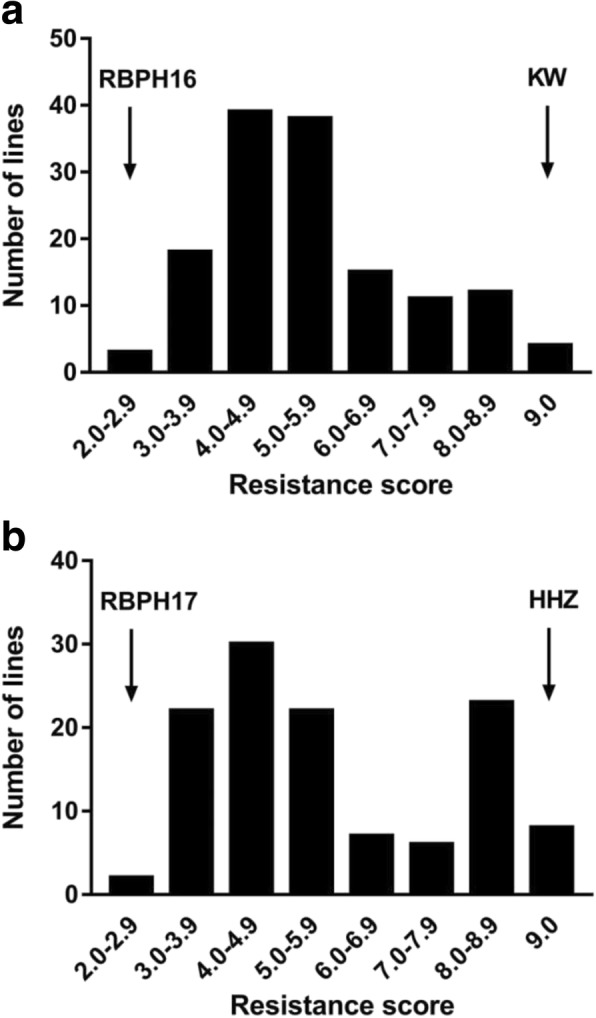
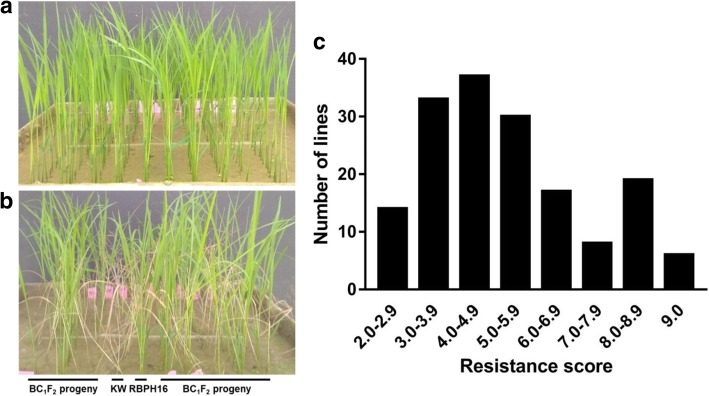
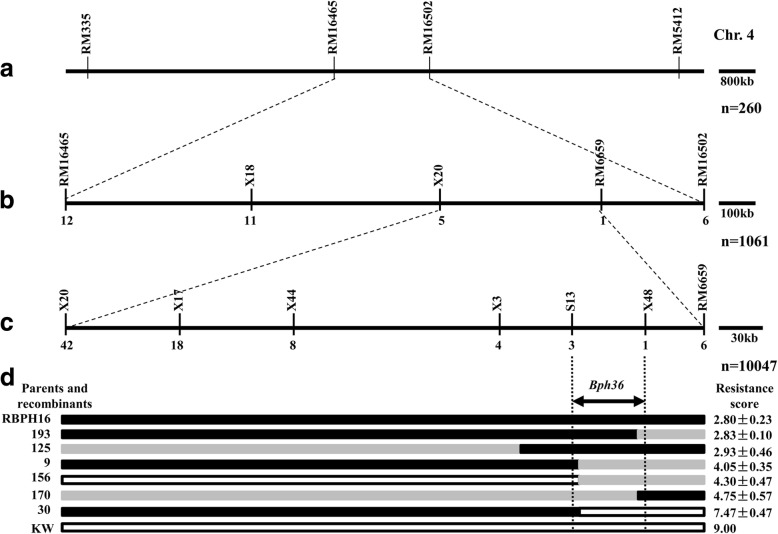
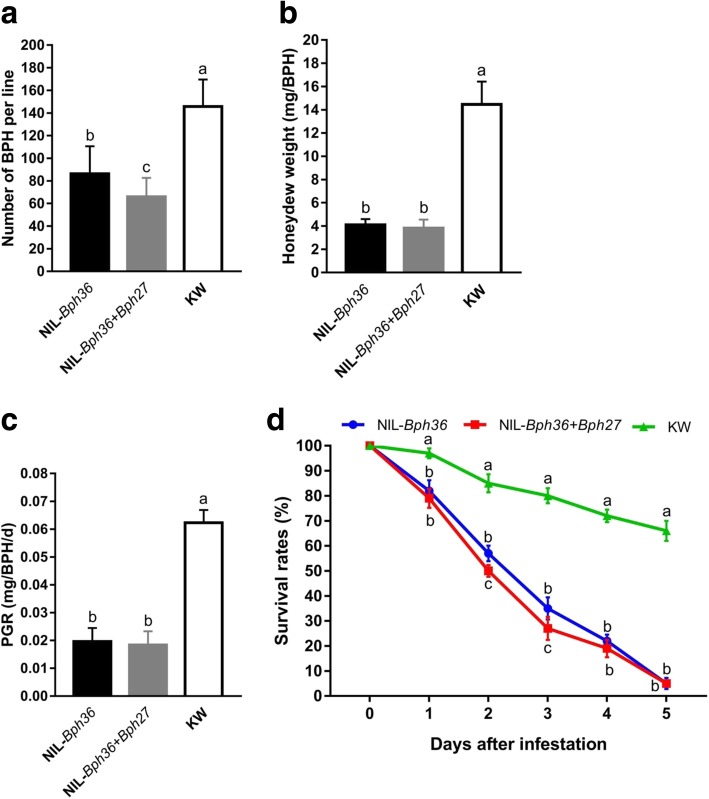
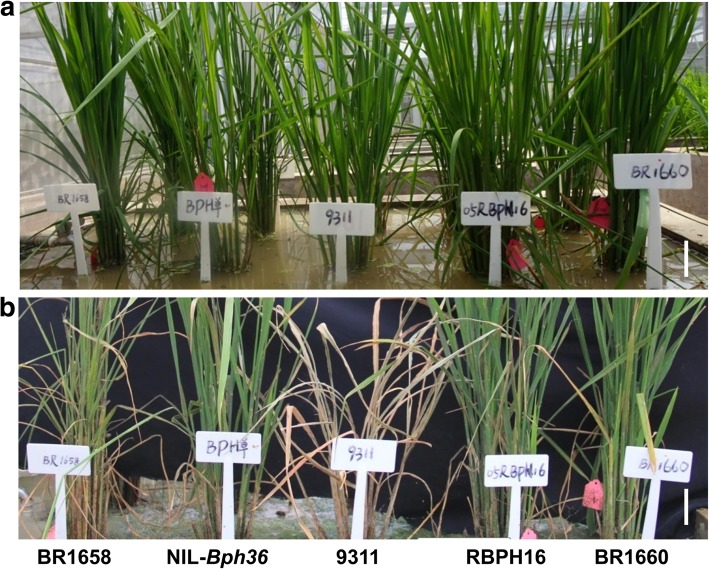
The current study reports on the novel BPH resistance gene Bph36 derived from two introgression lines (RBPH16 and RBPH17) developed from wild rice GX2183 which was previously reported to be resistant to BPH. Using two F crossing populations (Kangwenqizhan × RBPH16 and Huanghuazhan × RBPH17) in a bulked segregant analysis (BSA) for identification of resistant genes and QTL analysis, two QTLs for BPH resistance were generated on the long and short arms of chromosome 4, which was further confirmed by developing BCF populations by backcrossing via marker assisted selection (MAS) approach. One BPH resistance locus on the short arm of chromosome 4 was mapped to a 38-kb interval flanked by InDel markers S13 and X48, and then was named Bph36, whereas another locus on the long arm of chromosome 4 was also detected in an interval flanked by RM16766 and RM17033, which was the same as that of Bph27. An evaluation analysis based on four parameters (BPH host selection, honeydew weight, BPH survival rate and BPH population growth rate) shows that Bph36 conferred high levels antibiosis and antixenosis to BPH. Moreover, Bph36 pyramided with Bph3, Bph27, and Bph29 through MAS into elite cultivars 9311 and MH511 (harbored Xa23), creating different background breeding lines that also exhibited strong resistance to BPH in the seedling or tillering stage.
Bph36 can be utilized in BPH resistance breeding programs to develop high resistant rice lines and the high-resolution fine mapping will facilitate further map-based cloning and marker-assisted gene pyramiding of resistant gene. MAS exploited to pyramid with Bph3, Bph27, Bph29, and Xa23 was confirmed the effectiveness for BPH resistance breeding in rice and provided insights into the molecular mechanism of defense to control this devastating insect.
褐飞虱(Nilaparvata lugens Stål;BPH)是水稻最具破坏性的害虫之一,已被证明是一个重大威胁,在亚洲造成了巨大的产量损失,并且在田间条件下难以控制。持续使用杀虫剂促使褐飞虱再度猖獗,这导致抗性品种通过新的褐飞虱生物型升级而适应。为了克服褐飞虱对抗性品种产生的抗性,不同形式的新型抗性基因融合作为育种的功能域以增强抗虫性。
本研究报道了从野生稻GX2183培育的两个渗入系(RBPH16和RBPH17)中获得的新型褐飞虱抗性基因Bph36,此前报道野生稻GX2183对褐飞虱具有抗性。利用两个F杂交群体(抗文旗占×RBPH16和黄花占×RBPH17)进行混合分组分析法(BSA)以鉴定抗性基因和QTL分析,在第4染色体的长臂和短臂上产生了两个褐飞虱抗性QTL,通过标记辅助选择(MAS)回交法构建BCF群体进一步证实了这一点。第4染色体短臂上的一个褐飞虱抗性位点被定位到由InDel标记S13和X48侧翼的38 kb区间,随后被命名为Bph36,而第4染色体长臂上的另一个位点也在由RM16766和RM17033侧翼的区间中检测到,这与Bph27的区间相同。基于四个参数(褐飞虱寄主选择、蜜露重量、褐飞虱存活率和褐飞虱种群增长率)的评价分析表明,Bph36对褐飞虱具有高水平的抗生性和抗生性。此外,通过MAS将Bph36与Bph3、Bph27和Bph29聚合到优良品种9311和MH511(含有Xa23)中,创建了不同背景的育种系这些育种系在苗期或分蘖期也表现出对褐飞虱的强抗性。
Bph36可用于褐飞虱抗性育种计划,以培育高抗水稻品系,高分辨率精细定位将有助于进一步基于图谱的克隆和抗性基因的标记辅助基因聚合。利用MAS将Bph3、Bph27、Bph29和Xa23聚合被证实对水稻褐飞虱抗性育种有效,并为控制这种毁灭性害虫的防御分子机制提供了见解。