Department of Rheumatology, Levanger Hospital, Nord-Trøndelag Hospital Trust, Levanger, Norway.
Department of Clinical and Molecular Medicine, NTNU - Norwegian University of Science and Technology, Trondheim, Norway.
RMD Open. 2019 Apr 20;5(1):e000912. doi: 10.1136/rmdopen-2019-000912. eCollection 2019.
Patients with rheumatoid arthritis (RA) suffer from more cardiovascular disease (CVD), and develop cardiovascular risk factors at an earlier age than the general population. Cardiorespiratory fitness (CRF) is an important predictor of cardiovascular health. There are few data regarding CRF of RA patients, measured as peak oxygen uptake (VO) by the gold standard method; cardiopulmonary exercise testing. We compared CRF in RA patients to those from a healthy population, and investigated if risk factors for CVD and RA-specific variables including subjective and objective disease activity measures were associated with CRF in RA patients.
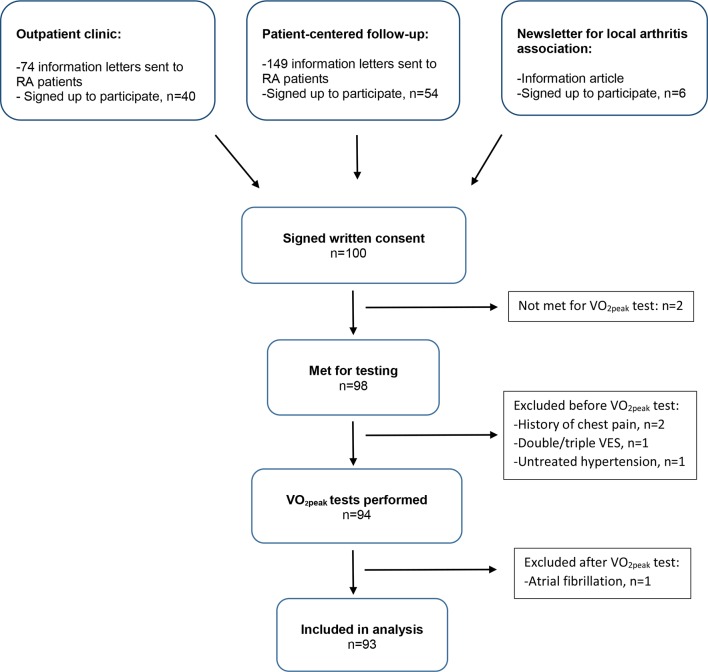
VO tests of RA patients (n=93) were compared to those of an age-matched and gender-matched healthy population (n=4631) from the Nord-Trøndelag Health Study. Predictors of VO were found using Lasso (least absolute shrinkage and selection operator) regression, followed by standardised multiple linear regression.
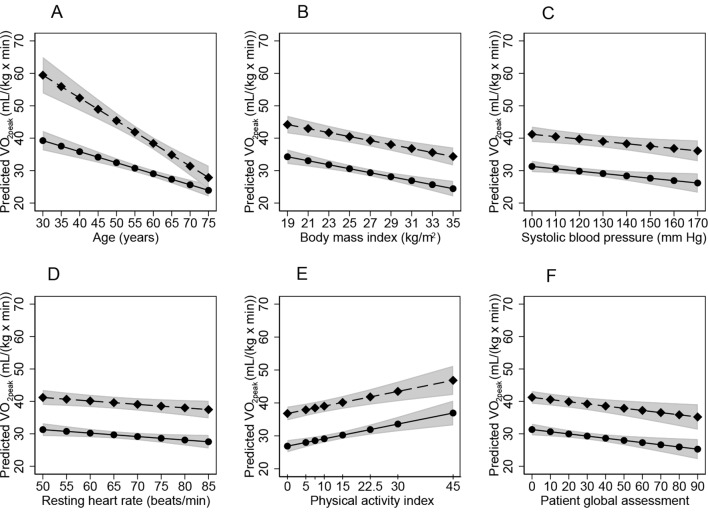
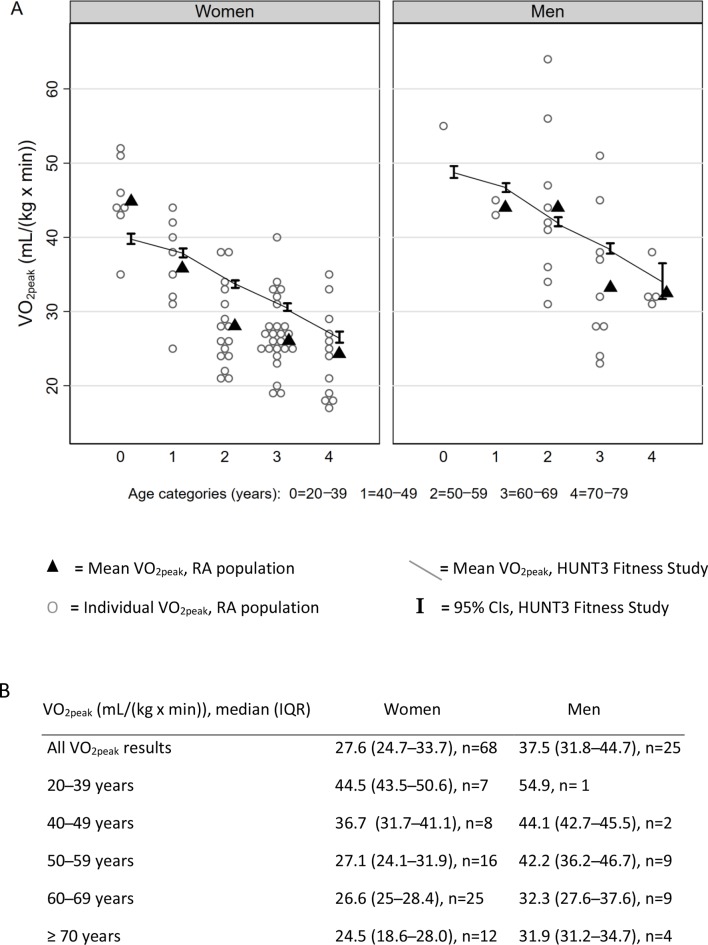
Women with RA ≥40 years and men with RA aged 40-49 years or 60-69 years had up to 20% lower CRF than the healthy population in the same age groups. By relative importance, body mass index (standardised coefficient=-0.25, p<0.001), physical activity level (coefficient=0.21, p<0.001), patient global assessment (PGA; coefficient=-0.14, p=0.006), systolic blood pressure (coefficient=-0.12, p=0.016), resting heart rate (coefficient=-0.11, p=0.032) and smoking (coefficient=-0.10, p=0.046) were significant predictors of CRF (R=0.82, gender-adjusted and age-adjusted).
CRF in RA patients was lower than in a healthy population. CRF was associated with common risk factors for CVD and the PGA score. Focusing on fitness in RA patients may improve cardiovascular health.
类风湿关节炎(RA)患者患心血管疾病(CVD)的风险更高,并且比普通人群更早出现心血管风险因素。心肺功能(CRF)是心血管健康的重要预测指标。关于 RA 患者的 CRF,通过心肺运动测试测量的峰值摄氧量(VO),数据很少。我们将 RA 患者的 CRF 与健康人群进行了比较,并研究了 CVD 的危险因素以及 RA 特异性变量,包括主观和客观疾病活动指标,是否与 RA 患者的 CRF 相关。
将 RA 患者(n=93)的 VO 测试结果与年龄和性别匹配的健康人群(n=4631)的 VO 测试结果进行比较,来自诺尔兰健康研究。使用 Lasso(最小绝对收缩和选择算子)回归找到 VO 的预测因子,然后进行标准化多元线性回归。
≥40 岁的女性和 40-49 岁或 60-69 岁的男性 RA 患者的 CRF 比同年龄组的健康人群低 20%。通过相对重要性,体重指数(标准化系数=-0.25,p<0.001)、身体活动水平(系数=0.21,p<0.001)、患者总体评估(PGA;系数=-0.14,p=0.006)、收缩压(系数=-0.12,p=0.016)、静息心率(系数=-0.11,p=0.032)和吸烟(系数=-0.10,p=0.046)是 CRF 的显著预测因子(R=0.82,性别调整和年龄调整)。
RA 患者的 CRF 低于健康人群。CRF 与 CVD 的常见危险因素和 PGA 评分相关。关注 RA 患者的健康状况可能会改善心血管健康。