Department of Medical Imaging, Qianfoshan Hospital Affiliated to Shandong University, Jinan, Shandong 250014, P.R. China.
Mol Med Rep. 2019 Aug;20(2):1121-1130. doi: 10.3892/mmr.2019.10307. Epub 2019 May 28.
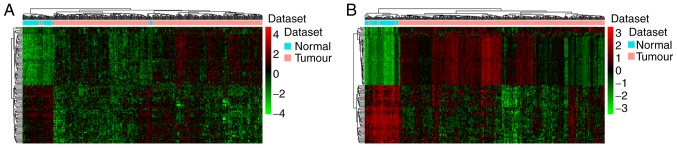
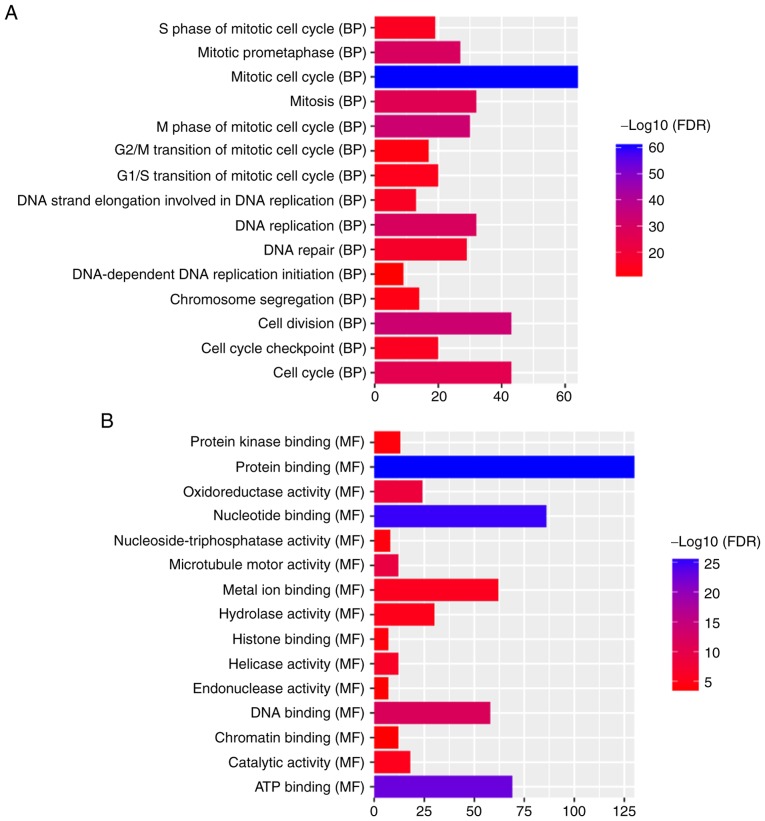
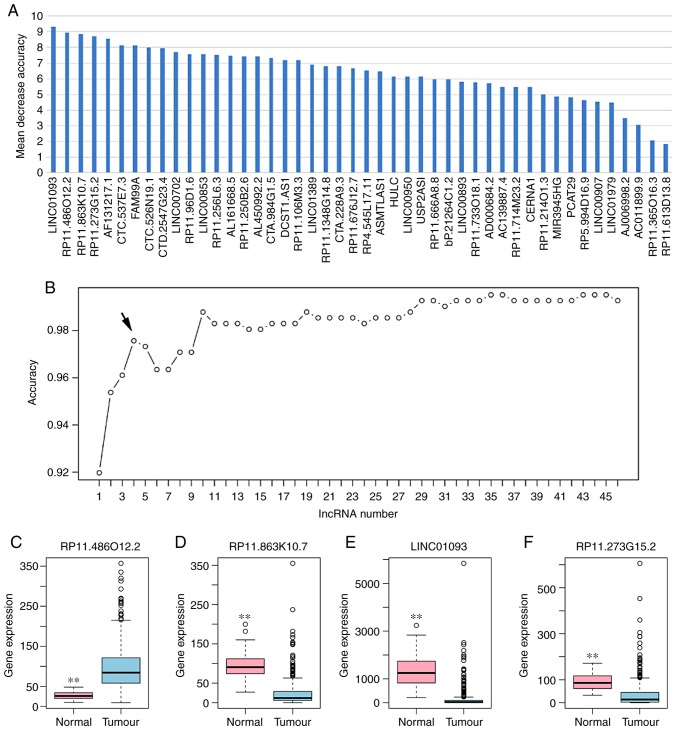
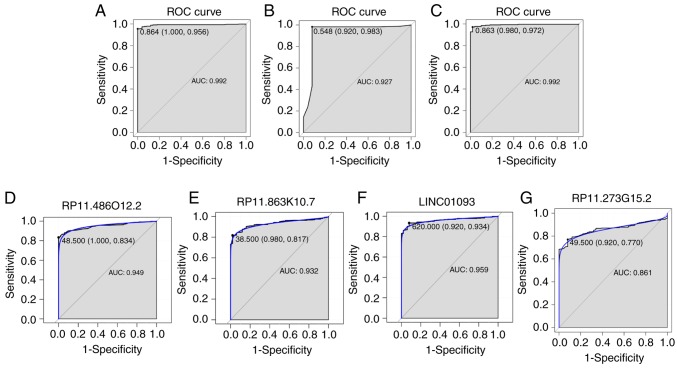
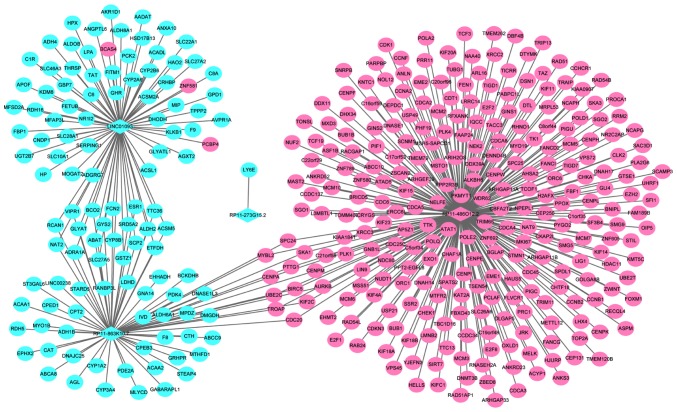
Liver cancer is a leading cause of cancer‑associated mortality worldwide. Hepatocellular carcinoma (HCC) is the most common subtype of liver cancer. The aim of the present study was to identify long non‑coding RNA (lncRNAs) as diagnostic biomarkers for HCC. The lncRNA and mRNA expression profiles of a large group of patients with HCC were obtained from The Cancer Genome Atlas. The differentially expressed lncRNAs (DElncRNAs) and the differentially expressed mRNAs (DEmRNAs) were identified by bioinformatics analysis. Using feature selection procedure and a classification model, the optimal diagnostic lncRNA biomarkers for HCC were identified. Classification models, including random forests, decision tree and support vector machine (SVM), were established to distinguish between HCC and normal tissues. DEmRNAs co‑expressed with the lncRNAs were considered as targets of DElncRNAs. Functional annotation of DEmRNAs co‑expressed with these lncRNAs biomarkers was performed. Receiver operating characteristic curve analysis of lncRNAs biomarkers was conducted. A total of 3,177 lncRNAs and 15,183 mRNAs between HCC and normal tissues were obtained. RP11‑486O12.2, RP11‑863K10.7, LINC01093 and RP11‑273G15.2 were identified as optimal diagnostic lncRNA biomarkers for HCC that were co‑expressed with 273, 69, 76 and 1 DEmRNAs, respectively. The area under the curve values of the random forest model, decision tree model and SVM model were 0.992, 0.927 and 0.992, and the specificity and sensitivity of the three models were 100.0 and 95.6, 92.0 and 98.3 and 98.0 and 97.2%, respectively. 'PPAR signaling pathway' and 'retinol metabolism' were two significantly enriched target pathways of DElncRNAs. The present study identified four DElncRNAs, including RP11‑486O12.2, RP11‑863K10.7, LINC01093 and RP11‑273G15.2, as potential diagnostic biomarkers of HCC. Functional annotation of target DEmRNAs provided novel evidence for examining the precise roles of lncRNA in HCC.
肝癌是全球癌症相关死亡的主要原因之一。肝细胞癌(HCC)是最常见的肝癌亚型。本研究旨在鉴定长非编码 RNA(lncRNA)作为 HCC 的诊断生物标志物。从癌症基因组图谱中获得了一组大量 HCC 患者的 lncRNA 和 mRNA 表达谱。通过生物信息学分析鉴定差异表达的 lncRNA(DElncRNA)和差异表达的 mRNA(DEmRNA)。使用特征选择过程和分类模型,鉴定出 HCC 的最佳诊断 lncRNA 生物标志物。建立了分类模型,包括随机森林、决策树和支持向量机(SVM),以区分 HCC 和正常组织。与 lncRNA 共表达的 DEmRNA 被认为是 DElncRNA 的靶标。对与这些 lncRNA 生物标志物共表达的 DEmRNA 进行功能注释。进行 lncRNA 生物标志物的受试者工作特征曲线分析。在 HCC 和正常组织之间获得了 3177 个 lncRNA 和 15183 个 mRNA。RP11-486O12.2、RP11-863K10.7、LINC01093 和 RP11-273G15.2 被鉴定为 HCC 的最佳诊断 lncRNA 生物标志物,它们分别与 273、69、76 和 1 个 DEmRNA 共表达。随机森林模型、决策树模型和 SVM 模型的曲线下面积值分别为 0.992、0.927 和 0.992,三个模型的特异性和灵敏度分别为 100.0 和 95.6、92.0 和 98.3 和 98.0 和 97.2%。“过氧化物酶体增殖物激活受体信号通路”和“视黄醇代谢”是 DElncRNA 显著富集的两个靶通路。本研究鉴定了 4 个 DElncRNA,包括 RP11-486O12.2、RP11-863K10.7、LINC01093 和 RP11-273G15.2,作为 HCC 的潜在诊断生物标志物。对靶 DEmRNA 的功能注释为研究 lncRNA 在 HCC 中的精确作用提供了新的证据。