Department of Clinical Sciences Lund, Section of Oncology and Pathology, Lund University, Barngatan 4, SE-221 85, Lund, Sweden.
Center for Translational Cancer Research, Technical University of Munich, Munich, Germany.
J Exp Clin Cancer Res. 2019 Jun 7;38(1):241. doi: 10.1186/s13046-019-1228-6.
Primary brain tumors, in particular glioblastoma (GBM), remain among the most challenging cancers. Like most malignant tumors, GBM is characterized by hypoxic stress that triggers paracrine, adaptive responses, such as angiogenesis and macrophage recruitment, rescuing cancer cells from metabolic catastrophe and conventional oncological treatments. The unmet need of strategies to efficiently target tumor "stressness" represents a strong clinical motivation to better understand the underlying mechanisms of stress adaptation. Here, we have investigated how lipid loading may be involved in the paracrine crosstalk between cancer cells and the stromal compartment of the hypoxic tumor microenvironment.
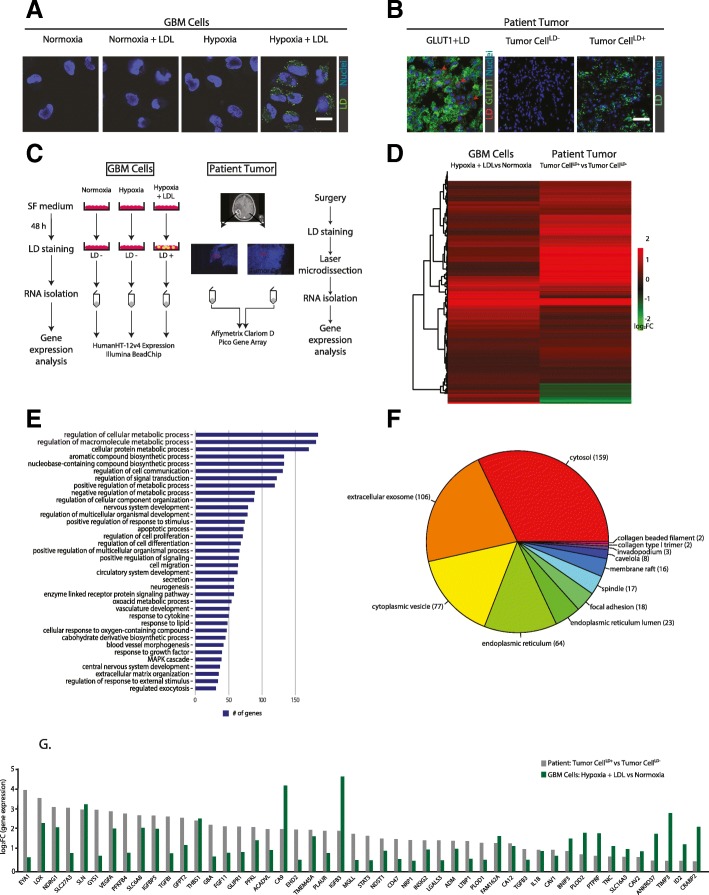
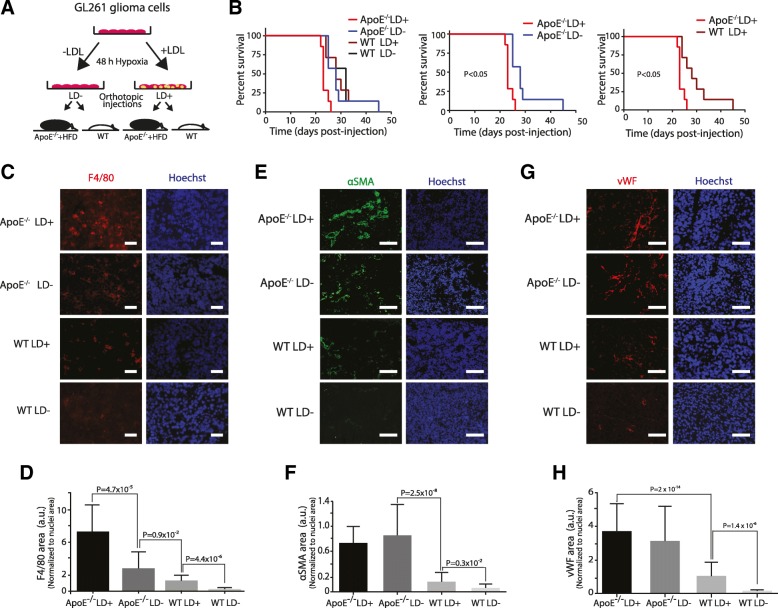
Regions from patient GBM tumors with or without the lipid loaded phenotype were isolated by laser capture microdissection and subjected to comparative gene expression analysis in parallel with cultured GBM cells with or without lipid loading. The potential involvement of extracellular lipids in the paracrine crosstalk with stromal cells was studied by immunoprofiling of the secretome and functional studies in vitro as well as in various orthotopic GBM mouse models, including hyperlipidemic ApoE-/- mice. Statistical analyses of quantitative experimental methodologies were performed using unpaired Student's T test. For survival analyses of mouse experiments, log-rank test was used, whereas Kaplan-Meier was performed to analyze patient survival.
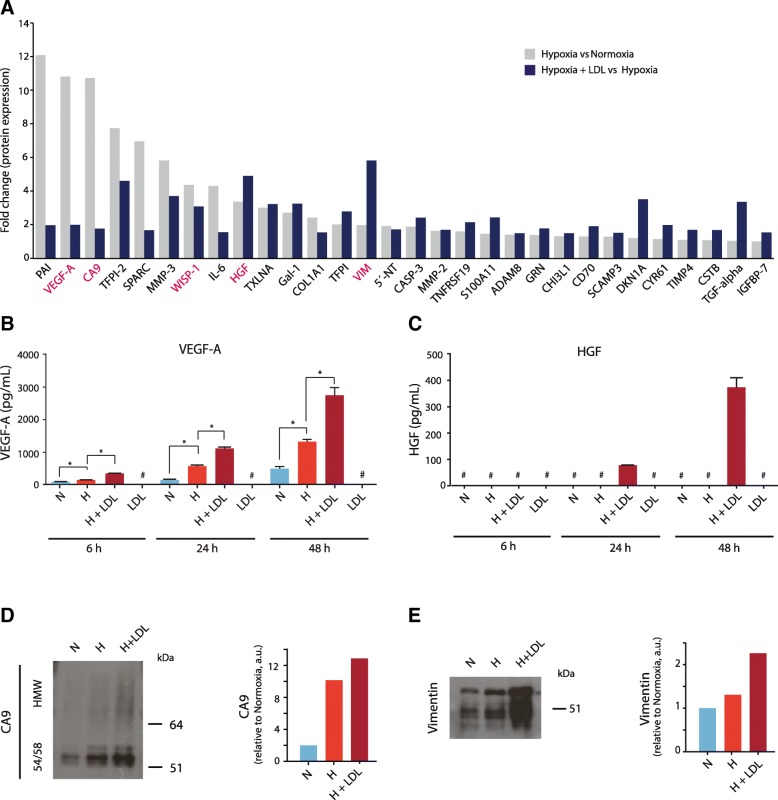
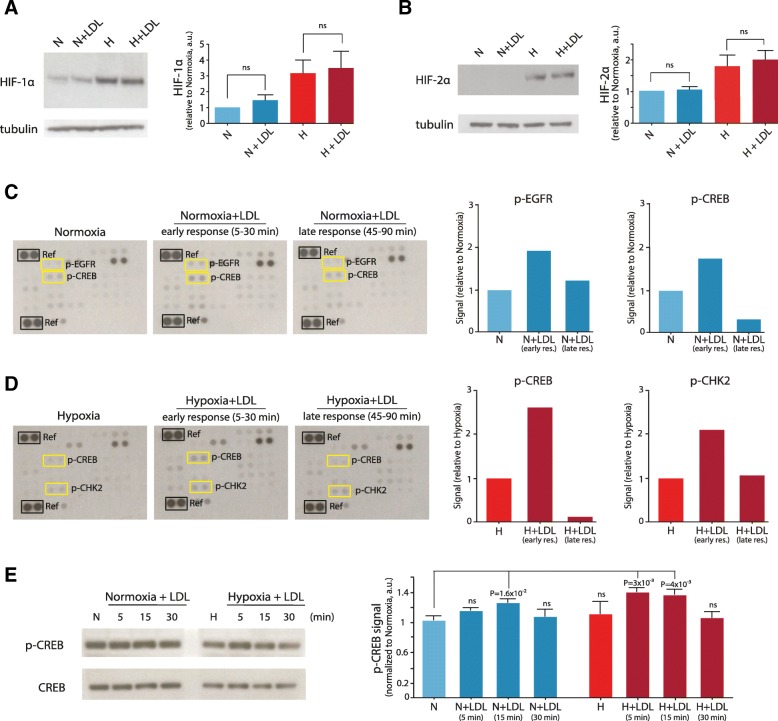
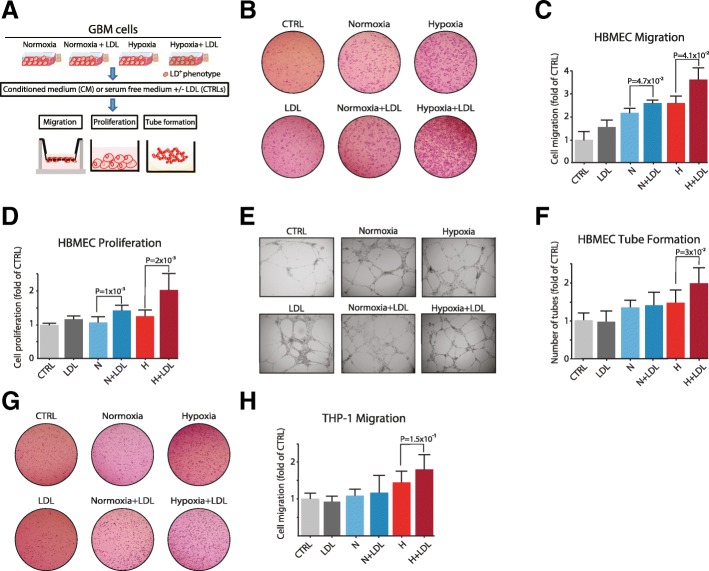
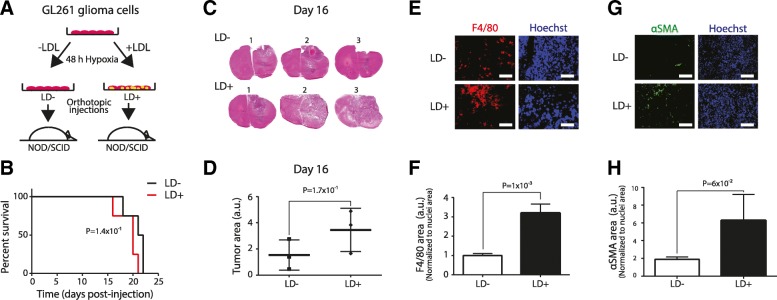
We show that the lipid loaded niche of GBM patient tumors exhibits an amplified hypoxic response and that the acquisition of extracellular lipids by GBM cells can reinforce paracrine activation of stromal cells and immune cells. At the functional level, we show that lipid loading augments the secretion of e.g. VEGF and HGF, and may potentiate the cross-activation of endothelial cells and macrophages. In line with these data, in vivo studies suggest that combined local tumor lipid loading and systemic hyperlipidemia of ApoE-/- mice receiving a high fat diet induces tumor vascularization and macrophage recruitment, and was shown to significantly decrease animal survival.
Together, these data identify extracellular lipid loading as a potentially targetable modulator of the paracrine adaptive response in the hypoxic tumor niche and suggest the contribution of the distinct lipid loaded phenotype in shaping the glioma microenvironment.
原发性脑肿瘤,特别是胶质母细胞瘤(GBM),仍然是最具挑战性的癌症之一。与大多数恶性肿瘤一样,GBM 的特征是缺氧应激,这种应激会触发旁分泌、适应性反应,如血管生成和巨噬细胞募集,从而使癌细胞免于代谢灾难和传统的肿瘤治疗。缺乏有效靶向肿瘤“应激性”的策略,这代表了更好地理解应激适应潜在机制的强烈临床动机。在这里,我们研究了脂质加载如何参与缺氧肿瘤微环境中癌细胞与基质区室之间的旁分泌串扰。
通过激光捕获显微解剖分离有或无脂质加载表型的患者 GBM 肿瘤的区域,并与有或无脂质加载的培养 GBM 细胞进行平行的基因表达分析。通过免疫组化分析分泌组和体外以及各种原位 GBM 小鼠模型(包括高脂血症 ApoE-/- 小鼠)中的功能研究,研究了细胞外脂质在与基质细胞的旁分泌串扰中的潜在作用。使用未配对的学生 T 检验对定量实验方法学的统计分析。对于小鼠实验的生存分析,使用对数秩检验,而 Kaplan-Meier 用于分析患者的生存。
我们表明,GBM 患者肿瘤的脂质加载生态位表现出放大的缺氧反应,并且 GBM 细胞获得细胞外脂质可以增强对基质细胞和免疫细胞的旁分泌激活。在功能水平上,我们表明脂质加载增强了例如 VEGF 和 HGF 的分泌,并可能增强内皮细胞和巨噬细胞的交叉激活。与这些数据一致,体内研究表明,局部肿瘤脂质加载和接受高脂肪饮食的 ApoE-/- 小鼠的全身高脂血症会诱导肿瘤血管生成和巨噬细胞募集,并显著降低动物的存活率。
总之,这些数据将细胞外脂质加载确定为缺氧肿瘤生态位中旁分泌适应性反应的潜在靶向调节剂,并表明不同的脂质加载表型在塑造神经胶质瘤微环境方面的贡献。