Marine Biological Laboratory, Woods Hole, Massachusetts 02543, USA; email:
The Forsyth Institute, Cambridge, Massachusetts 02142, USA; email:
Annu Rev Microbiol. 2019 Sep 8;73:335-358. doi: 10.1146/annurev-micro-090817-062503. Epub 2019 Jun 10.
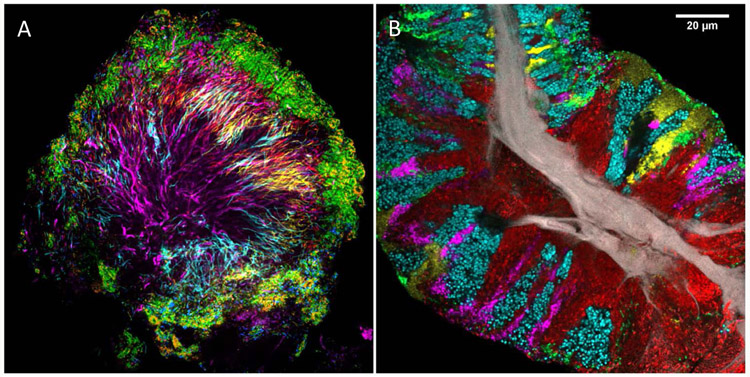
Microbial communities are complex and dynamic, composed of hundreds of taxa interacting across multiple spatial scales. Advances in sequencing and imaging technology have led to great strides in understanding both the composition and the spatial organization of these complex communities. In the human mouth, sequencing results indicate that distinct sites host microbial communities that not only are distinguishable but to a meaningful degree are composed of entirely different microbes. Imaging suggests that the spatial organization of these communities is also distinct. Together, the literature supports the idea that most oral microbes are site specialists. A clear understanding of microbiota structure at different sites in the mouth enables mechanistic studies, informs the generation of hypotheses, and strengthens the position of oral microbiology as a model system for microbial ecology in general.
微生物群落复杂而动态,由数百个在多个空间尺度上相互作用的分类群组成。测序和成像技术的进步使得我们对这些复杂群落的组成和空间组织有了很大的了解。在人类口腔中,测序结果表明,不同的部位宿主微生物群落不仅可以区分,而且在很大程度上由完全不同的微生物组成。成像表明,这些群落的空间组织也是不同的。文献综述支持大多数口腔微生物是特定部位微生物的观点。清楚地了解口腔不同部位的微生物群落结构,可以进行机制研究,为假说的提出提供信息,并加强口腔微生物学作为一般微生物生态学模型系统的地位。