Othman Fatimah, Ambak Rashidah, Siew Man Cheong, Mohd Zaki Nor Azian, Ahmad Mohd Hasnan, Abdul Aziz Nur Shahida, Baharuddin Azli, Salleh Ruhaya, Aris Tahir
Centre for Nutrition Epidemiology Research, Institute for Public Health, Ministry of Health Malaysia, Kuala Lumpur, Malaysia.
J Nutr Metab. 2019 May 2;2019:6781597. doi: 10.1155/2019/6781597. eCollection 2019.
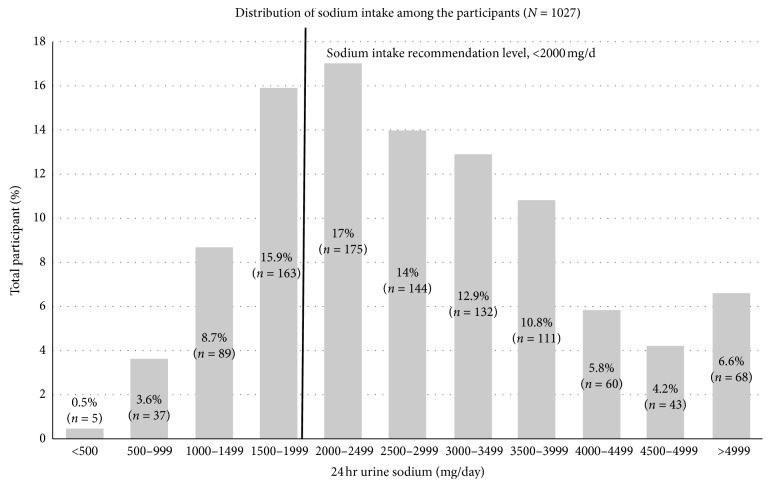
Dietary consumption and other environmental factors are known factors associated with sodium intake. However, little is known about the influence of energy intake on this relationship. The aim of this study was to determine the risk factors associated with high sodium intake assessed from urine sodium excretion and the influence of energy intake. A nationwide, cross-sectional study was conducted from 2015 to 2016 among Malaysian health staff (MySalt 2015). A total of 1027 participants from 1568 targeted participants aged 18 years and older that were randomly selected were included in this study. Sodium intake was determined by measuring sodium excretion in the 24 hr urine test. Dietary, sociodemography, and anthropometry variables as associated risk factors were assessed. Multiple logistic regression models were used to determine the association between high sodium intake (≥2000 mg/day urinary sodium) and potential risk factors. The prevalence of high sodium intake in this study was 70.1% (=733). High sodium intake was associated with male (OR 1.93, 95% confidence interval (CI) 1.41, 2.64), Bumiputera Sarawak ethnicity (OR 0.24, 95% CI 0.09, 0.62), and energy-adjusted sodium intake (mg/d) (OR 1.19, 95% CI 1.03-1.39). Our results suggested that sex, ethnicity, and energy-adjusted sodium consumption were strong risk factors associated with high sodium intake independent from energy and other potential confounding factors.
饮食摄入及其他环境因素是与钠摄入相关的已知因素。然而,关于能量摄入对这种关系的影响却知之甚少。本研究的目的是确定与通过尿钠排泄评估的高钠摄入相关的风险因素以及能量摄入的影响。2015年至2016年在马来西亚卫生工作人员中开展了一项全国性横断面研究(MySalt 2015)。本研究纳入了从1568名年龄在18岁及以上的目标参与者中随机选取的1027名参与者。通过测量24小时尿液检测中的钠排泄量来确定钠摄入量。评估了作为相关风险因素的饮食、社会人口统计学和人体测量学变量。使用多元逻辑回归模型来确定高钠摄入(尿钠≥2000毫克/天)与潜在风险因素之间的关联。本研究中高钠摄入的患病率为70.1%(=733)。高钠摄入与男性(比值比1.93,95%置信区间(CI)1.41,2.64)、砂拉越马来原住民种族(比值比0.24,95%CI 0.09,0.62)以及能量调整后的钠摄入量(毫克/天)(比值比1.19,95%CI 1.03 - 1.39)相关。我们的结果表明,性别、种族以及能量调整后的钠消耗是与高钠摄入相关的强大风险因素,独立于能量及其他潜在混杂因素。